Your college admission essay is one of the only parts of your application where an admissions officer hears your actual voice. Grades and test scores show what you’ve done. The essay shows who you are, how you think, and why you’d add something specific to a campus. This guide covers what’s changed and what still matters for the 2026-2027 application cycle.
What Is a College Admission Essay?
A college admission essay is a short piece of writing submitted as part of your college application. Most students applying through the Common Application write one personal statement that gets sent to every school on their list.
There are three different types of essays you may need to write, and they’re not interchangeable:
- The personal statement (the Common App essay): one essay, sent to all your Common App schools, focused on who you are as a person.
- Supplemental essays: shorter, school-specific essays that many selective colleges require in addition to the personal statement, usually answering “why this school” or “why this major.”
- Scholarship essays: separate essays tied to specific scholarship applications, often with their own prompts and word limits.
Our guide focuses mainly on the personal statement, since it’s the essay nearly every applicant has to write. The structure and voice advice below applies to supplemental essays too.
2026-2027 Application Essentials You Need to Know
A few concrete facts before you start writing:
- The Common App opens for the 2026-2027 cycle on August 1, 2026, for students applying to enter college in Fall 2027.
- The personal statement word limit is 650 words maximum, 250 words minimum. There’s no reward for using every word – a tight 550-word essay beats a padded 650-word one.
- The Common App has kept the same seven essay prompts in place since the 2023-2024 cycle, including the open “topic of your choice” option.
- Beyond the personal statement, there are two optional sections worth knowing about: the Additional Information section (300 words, for context like an illness, a schedule disruption, or an academic explanation) and the Challenges & Circumstances prompt (250 words, for things like housing instability or a family emergency). Both are optional – use them only if something genuinely needs explaining that doesn’t fit elsewhere in your application.
How Long Should a College Essay Be?
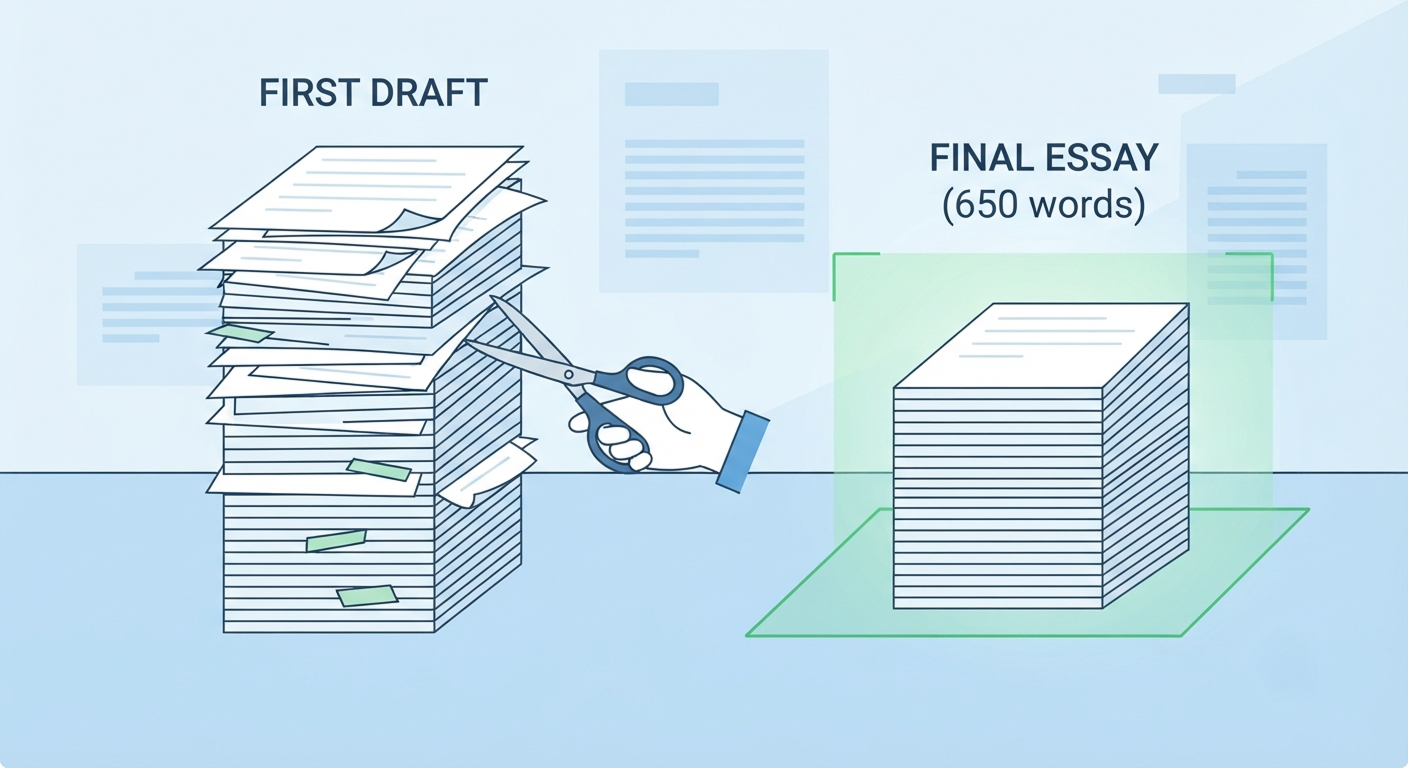
For the Common App personal statement, aim for 600 to 650 words. Essays under 500 words don’t leave enough room to tell a specific story and reflect on what it meant.
Ignore any advice that says “three to five pages”. That figure doesn’t match how the application portal works and will leave you either wildly over the limit or padding your essay with filler to reach it. Length should follow the story, not the other way around: write a full draft first, then cut anything that doesn’t earn its place.
How to Choose the Right Essay Topic

The biggest mistake students make is picking a prompt first and then trying to force a story into it. Work backward instead: figure out the moment, realization, or detail about yourself you actually want an admissions officer to know, then find the prompt that gives it the most room.
For example, a student who changed their mind about something – say, deciding that a “hobby” (coding, music production, cooking) was actually worth pursuing seriously – could write that story as a response to the prompt about questioning a belief, or just as easily as an open “topic of your choice” essay. The prompt is a frame.
A useful test: could this essay have been written by 500 other applicants with the words swapped out? If yes, the topic is probably too broad or too generic. The best essays are built on a specific, small moment rather than a big, general theme.
Topics and Clichés to Avoid
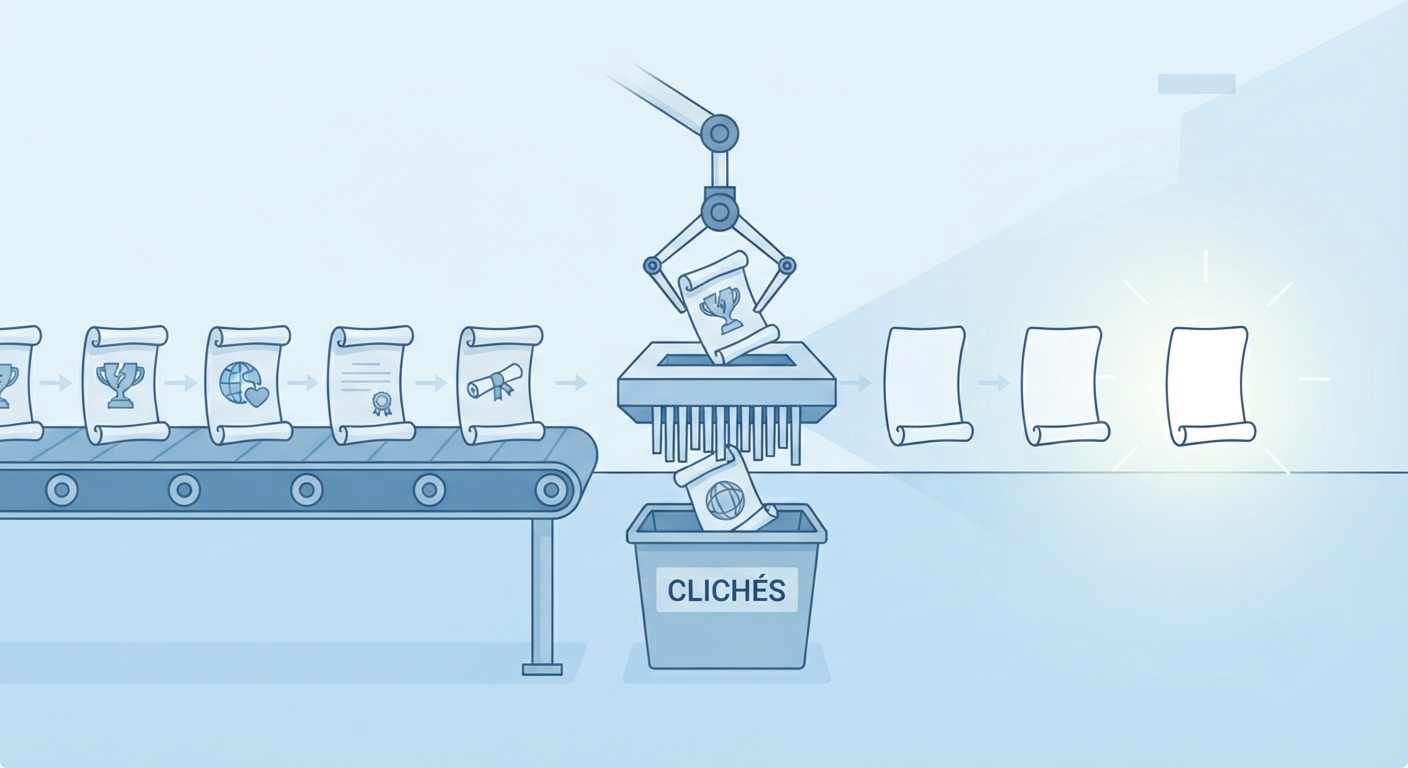
Admissions officers read thousands of essays a season. Certain topics show up so often they’ve become instant skip-signals, even when the underlying story is genuine. Be especially careful with:
- The sports injury comeback (unless the essay is really about something other than perseverance in general terms).
- The mission trip or volunteer “eye-opening” essay – especially ones that center the writer’s own growth over the people they were supposedly helping.
- The “hard work is important” moral – a lesson so generic it could close any story.
- A restated résumé – listing achievements in paragraph form instead of narrating one specific experience.
How to Write a Winning Essay: Structure and Voice
Start with a hook that drops the reader into a specific moment rather than a broad statement. Compare:
Generic: “Ever since I was young, I have always loved helping people, which is why I want to study medicine.”
Specific: “The blood pressure cuff was too big for her arm, and I didn’t know what to do about it, so I just kept talking.”
The second version creates a question the reader wants answered, which is the whole job of an opening line.
The strongest essays tend to follow a simple arc: a specific scene, what it revealed or changed about how the writer sees something, and a closing reflection that shows growth without spelling out a moral in one obvious sentence. “Show, don’t tell” means trusting a well-chosen detail to do the work a broad claim can’t – mentioning what you noticed, said, or did in the moment.
Read the draft out loud before finishing. If it sounds like it could have been written about someone else, it needs another pass.
Can You Use AI (ChatGPT) to Write Your College Essay?
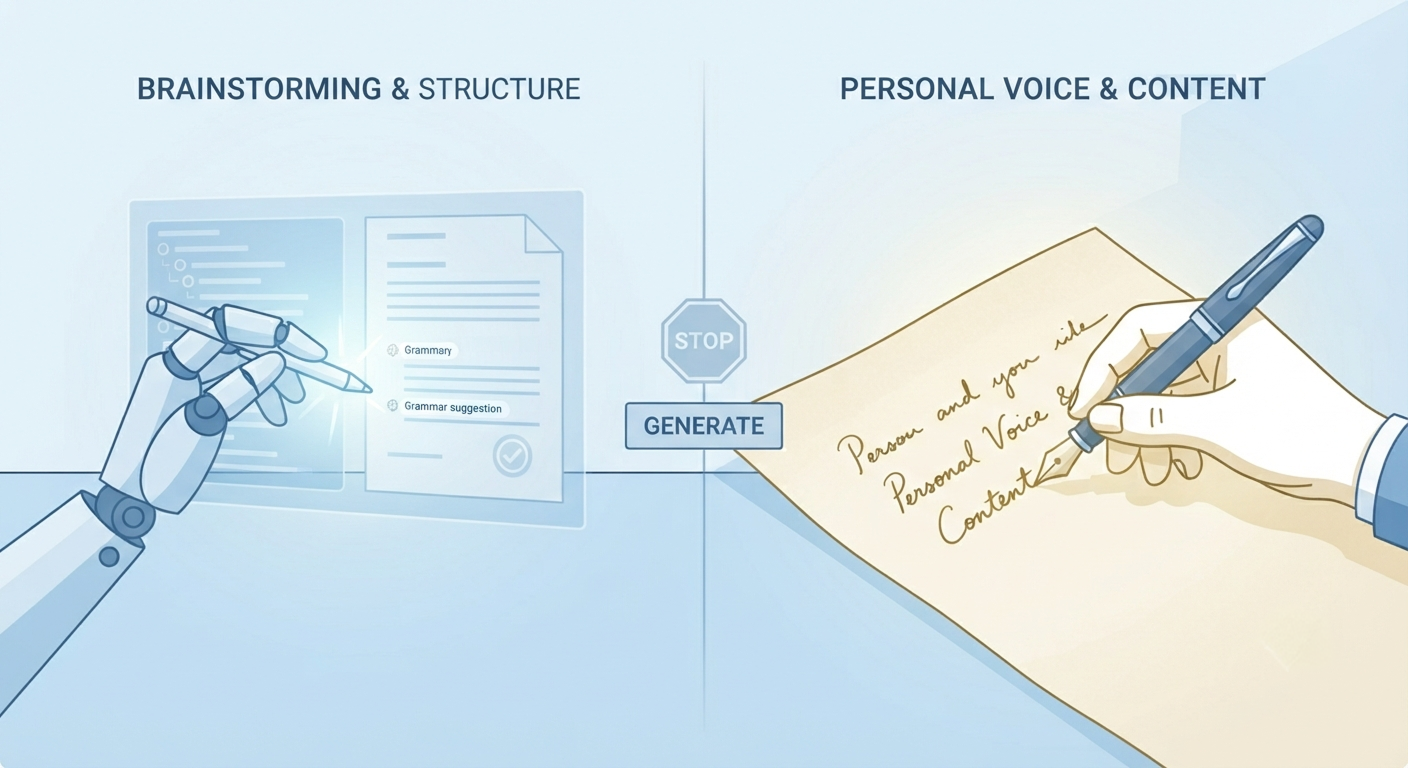
Worth being direct about, since it’s the question every applicant this cycle is quietly asking. When students submit a Common App application, they certify that the personal statement is their own original work. That doesn’t mean AI tools are off-limits entirely (plenty of students use them to brainstorm topics, check grammar, or get unstuck on structure). Having a tool to draft or substantially rewrite the essay’s actual content crosses into work that isn’t yours, and admissions readers are increasingly good at spotting the flattened, generic voice AI-generated essays tend to have.
The safest way to think about it: AI can be a sounding board, not a ghostwriter. The specific memories, phrasing, and self-reflection in a strong essay are exactly the parts a tool can’t generate for you, because it wasn’t there.
How to Format Your Essay for the Application Portal
Formatting mistakes are avoidable, but they trip up more applicants than you’d expect:
- Font and spacing: stick to a standard 12-point font (Times New Roman, Georgia, or Arial). Single or 1.5 spacing is fine – double-spacing isn’t required and sometimes displays awkwardly in the portal’s text box.
- Avoid bold, italics, and special characters where possible. Formatting doesn’t always transfer cleanly when pasted into the application’s text field, and a broken paragraph break can make an otherwise strong essay look sloppy.
- If you’re uploading a PDF, double-check it renders correctly and isn’t cutting off your final paragraph.
- Paste as plain text first, then proofread inside the actual portal, since spacing and line breaks can shift during the transfer.
What Do Admissions Officers Actually Look For?
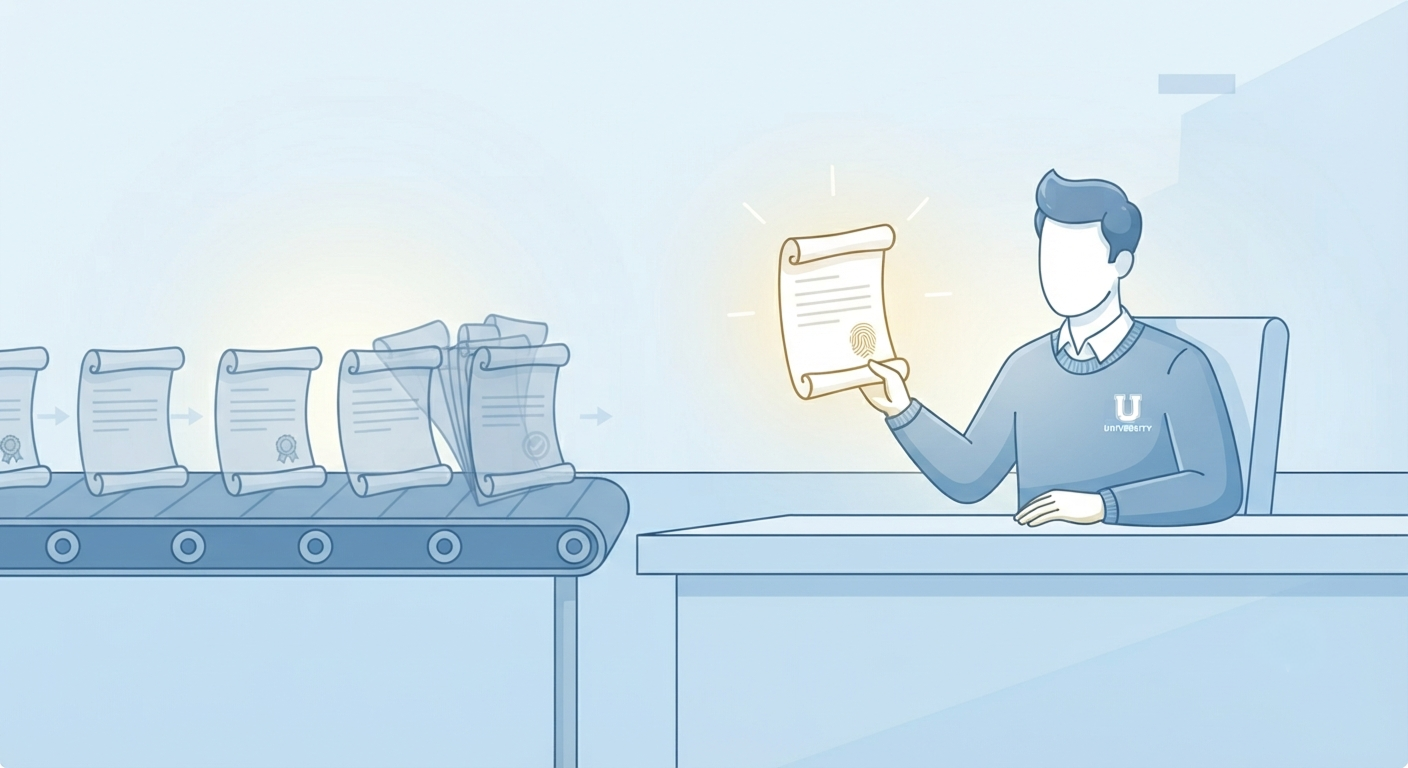
Most essays get read in roughly 90 to 120 seconds, so first impressions matter more than students expect. In that short window, readers are generally looking for:
- A clear, specific voice rather than a generic “impressive” tone.
- The signs of self-awareness are what the author came to understand as a result of this.
- Something that isn’t visible anywhere else in the application, since grades, scores, and activity lists are covered elsewhere.
Do You Need Supplemental Essays Too?
For most students applying to selective schools, the personal statement is only part of the essay workload. Many colleges require additional, school-specific supplemental essays – often shorter, and often asking “why this school” or “why this major” directly.
The University of California system works differently from the Common App entirely: instead of one personal statement, applicants respond to four Personal Insight Questions of their choosing, each capped at 350 words, submitted through the UC application rather than the Common App. If a UC school is on your list, budget separate time for this – it’s a different format with its own word limits and its own set of expectations.
Sample Essay Excerpt (Before / After)
Before (generic): “Volunteering at the animal shelter taught me the importance of compassion and responsibility. I learned that every living being deserves care, and this experience shaped who I am today.”
After (specific): “The kennel numbers didn’t match the intake sheet, and by the time I figured out why, the dog I’d been walking for three weeks had already been adopted without me getting to say goodbye. I spent the rest of that shift re-checking every clipboard twice, not because anyone asked me to, but because I couldn’t stand the idea of it happening again.”
The rewritten version shows a specific failure, a specific reaction, and lets the reader infer the growth.
FAQ
Do I need to write a different essay for every college I apply to?
No. The Common App personal statement is submitted once and sent to every Common App school on your list. Supplemental essays, however, are usually school-specific and need to be written separately for each college that requires them.
Can I write about mental health or a difficult personal experience?
Yes, but with care. These topics can make for genuine, powerful essays when the focus stays on your response and growth rather than on the difficulty itself as the main subject. If you’re unsure whether something belongs in the essay or in the optional Challenges & Circumstances section, a counselor or writing coach can help you decide.
What’s the difference between the Common App essay and a supplemental essay?
The Common App essay is one longer personal statement (up to 650 words) sent to every school on your list. Supplemental essays are shorter, school-specific responses — often 100 to 350 words — required by individual colleges in addition to the personal statement.
Should I have someone else edit my essay?
Getting feedback on clarity, structure, and grammar from a teacher, counselor, or editor is normal and expected. The line to watch is between editing and rewriting — feedback should sharpen your voice, not replace it.
What happens if my essay goes over 650 words?
The Common App portal won’t let you submit an essay over the 650-word limit, so you’ll need to cut it down before you can move forward with your application.
Sources
- College Transitions – How to Approach the Common App Essay Prompts in 2026-27
- Harvard – My Very Unofficial Tips on Writing Your College Essay
- Johns Hopkins University Admissions – Essays That Worked
- University of Notre Dame – Tips from A Notre Dame Admissions Counselor (Part 2)
- National Association for College Admission Counseling – Top Ten Tips for Writing a College Essay