Most students who struggle with analytical essays aren’t struggling because they lack intelligence. They’re struggling because nobody showed them what a good one actually looks like. Reading about thesis statements is fine. Seeing a thesis statement do real work inside a real essay – that’s something else entirely.
This page exists for that reason. Five examples, each one chosen to demonstrate a specific aspect of analytical writing that tends to trip people up. Some are polished. One is deliberately rough around the edges. The commentary after each isn’t there to explain the obvious; it’s there to show the moves being made beneath the surface.
What Makes an Essay Analytical in the First Place
Before diving in, it’s worth being direct about something. Students often conflate three different essay types: descriptive, argumentative, and analytical. A descriptive essay tells you what something is. An argumentative essay tries to convince you of a position. An analytical essay does something more precise – it takes a subject apart, examines how the pieces function, and builds an interpretation based on that examination.
The distinction matters because the goal of an analytical essay isn’t to win an argument. It’s to generate insight. That’s actually harder. Persuasion has rhetorical shortcuts. Analysis doesn’t.
Example 1: Literary Analysis (High School Level)

Topic: How does George Orwell use the character of Boxer in Animal Farm to critique blind loyalty?
Excerpt:
Boxer’s most revealing characteristic is not his strength but his refusal to think independently. When doubt enters the farm’s political life, Boxer responds with two maxims: “I will work harder” and “Napoleon is always right.” These phrases are not expressions of genuine belief. They are cognitive closures – a way of shutting down the discomfort that comes from contradictory evidence. Orwell positions Boxer not as a villain but as a tragedy. He is the revolution’s most valuable asset and its most exploitable one, and the novel suggests these two facts are not coincidental.
What works here:
The thesis is embedded in the analysis rather than stated flatly at the top. Notice that the student isn’t just identifying Boxer’s qualities – they’re interpreting what those qualities mean within the text’s larger argument. The phrase “cognitive closures” is doing serious work; it moves the essay from description into interpretation.
The body paragraph follows a clean structure: claim, textual evidence, explanation of evidence, connection to the essay’s broader argument. That four-part structure is the engine of almost every effective analytical paragraph.
What could be stronger: The paragraph would benefit from at least one more piece of evidence. Two textual examples generally hold more weight than one, especially in literary analysis where pattern-recognition is part of the point.
Example 2: Historical Analysis (First-Year College Level)

Topic: What does the Homestead Act of 1862 reveal about the federal government’s understanding of land ownership?
Excerpt:
The Homestead Act’s definition of “improvement” – requiring settlers to cultivate land and build a dwelling within five years – encoded a specific and culturally particular vision of productive land use. This vision was not neutral. It presumed that agricultural cultivation constituted legitimate ownership in a way that Indigenous land management practices, which prioritized sustainable use over transformation, did not. The Act didn’t simply distribute land; it distributed a philosophy. And that philosophy had consequences that extended far beyond the 270 million acres eventually transferred under its provisions.
What works here:
This excerpt demonstrates something important: analysis of framing and language, not just events. The student isn’t summarizing the Homestead Act – they’re interrogating the assumptions baked into its language. That’s a higher-order analytical move.
The transition from the specific (“cultivate land and build a dwelling”) to the systemic (“a philosophy”) is handled well. The essay earns its broader claim rather than asserting it without grounding.
What to notice about structure: The writer moves from evidence to interpretation to implication. That sequence – evidence → interpretation → significance – appears in virtually every strong analytical body paragraph, regardless of the subject matter. Understanding how to write an analytical essay is, in large part, understanding how to execute that sequence with precision.
Example 3: Close Reading of a Visual Text (College Level)

Topic: How does the composition of Dorothea Lange’s Migrant Mother (1936) construct the subject’s identity?
Excerpt:
Lange’s framing eliminates context almost entirely. The woman’s face occupies the upper third of the image; her two children turn away, pressing their faces into her shoulders. This arrangement produces a figure without location – she could be anywhere suffering occurs. The children’s averted faces matter structurally: their anonymity transfers all identifying weight onto the mother. She becomes, by design, both a specific woman and a universal symbol. The photograph has often been praised for its “dignity,” but a more precise word might be legibility. Lange made a suffering person readable to an audience that might otherwise have looked away.
What works here:
The student resists the easy interpretation – instead of simply affirming the photograph’s emotional power, they complicate it. The shift from “dignity” to “legibility” is a genuine analytical move, not a semantic quibble. It changes what the photograph is doing and who it’s doing it for.
This kind of critical nuance is what separates a B essay from an A essay at most universities. It’s not contrarianism for its own sake. It’s intellectual precision.
Example 4: A Rougher Draft (With Annotations)

Sometimes it helps to see an imperfect example. This excerpt was submitted by a first-year student and includes the kind of mistakes instructors see constantly.
Original:
In the novel The Great Gatsby, F. Scott Fitzgerald shows that the American Dream is corrupt. Gatsby worked hard to get rich, but he was still rejected by old money. This shows that no matter what you do, if you weren’t born rich, society won’t accept you. The green light at the end of Daisy’s dock is a symbol of Gatsby’s dreams.
The problems:
The thesis (“the American Dream is corrupt”) is asserted rather than argued. It’s a conclusion dressed up as a starting point. The analysis that follows describes rather than interprets – “Gatsby worked hard to get rich” is plot summary, not analysis.
The final sentence about the green light is accurate but undeveloped. Identifying a symbol isn’t analysis; explaining how the symbol functions within the text’s argument is.
Revised version:
Fitzgerald’s critique of the American Dream operates through a structural irony: Gatsby achieves precisely what the Dream promises – wealth, spectacle, proximity to power – and it means nothing. The rejection Gatsby faces from Tom and Daisy isn’t incidental; it’s the mechanism through which the novel exposes the Dream’s built-in exclusions. The green light functions not as hope but as permanent deferral. Gatsby doesn’t reach it. That’s the point.
The revised version doesn’t just correct the original – it shows what analytical thinking actually looks like when applied to the same material.
Example 5: Policy and Social Analysis (Advanced College Level)

Topic: How does the framing of “food deserts” in public health discourse shape policy responses?
Excerpt:
The term “food desert” implies scarcity as the primary problem – that low-income communities lack access to healthy food simply because grocery stores haven’t been built there. This framing supports a predictable set of solutions: attract supermarkets, build infrastructure, increase retail options. What it obscures is equally significant. Studies have found that introducing supermarkets into food deserts does not reliably change residents’ purchasing or eating habits. The problem, it turns out, is not only geographic but economic. Framing matters because it determines what counts as a solution, and in this case, the dominant frame has directed substantial resources toward interventions with limited evidence of effectiveness.
What works here:
The analytical move here is meta-level: the student is analyzing how a concept is constructed rather than simply engaging with its content. This is sophisticated analytical writing. It requires understanding that language choices in policy and scholarship are not neutral – they shape what gets studied, funded, and implemented.
This kind of analysis draws on evidence beyond the text itself (the reference to studies), which is appropriate at an advanced college level. The paragraph doesn’t just describe; it traces a chain of causation from linguistic framing to policy outcome.
A Note on Structure Before You Write
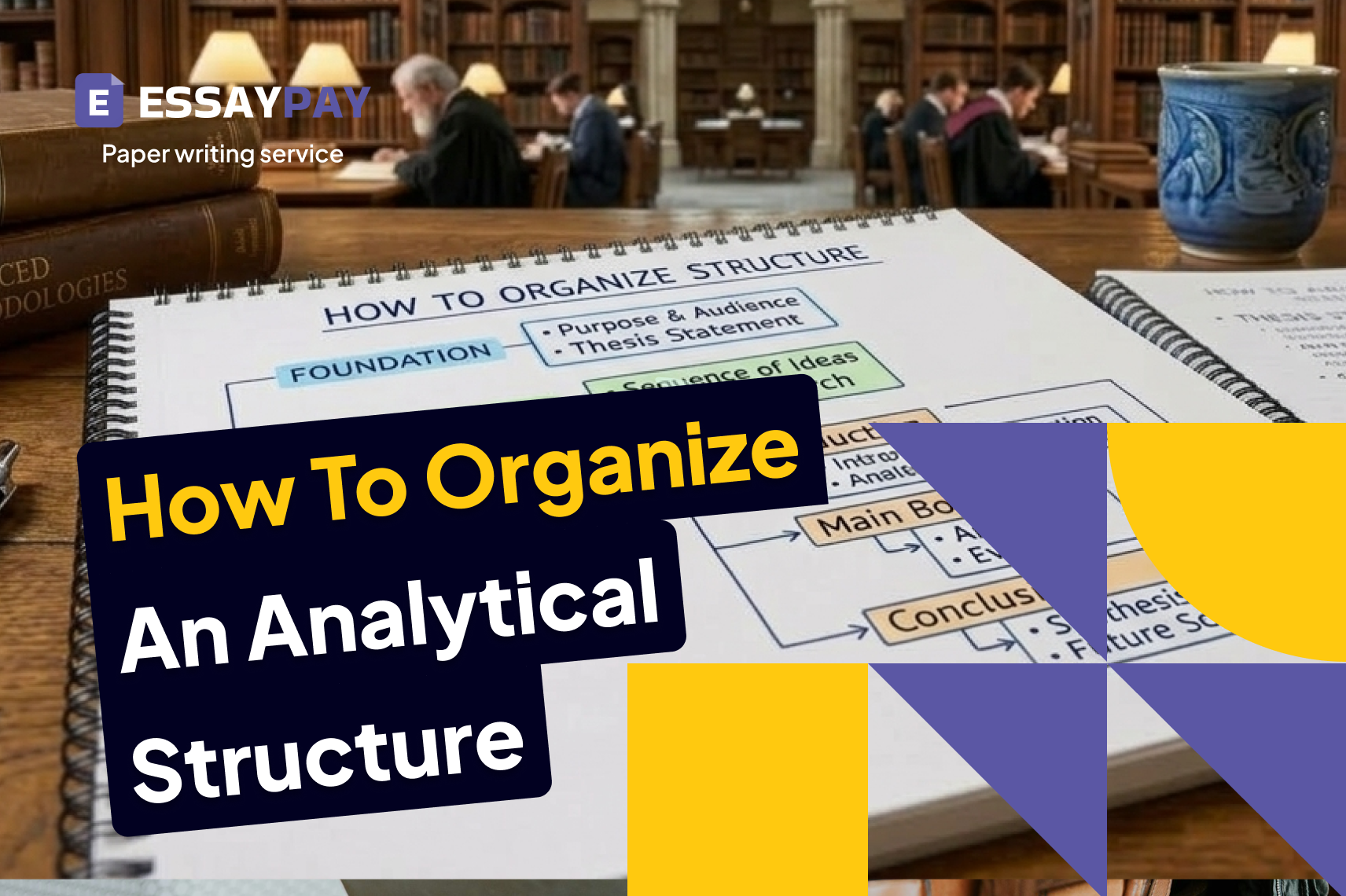
Across all five examples, certain structural patterns recur. A claim is made. Evidence is introduced. The evidence is interpreted. The interpretation is connected to a larger argument. That’s not a rigid formula – it’s a description of what analytical thinking looks like when it’s working.
If you’re building your own approach from scratch, sketching out an analytical essay outline before writing helps prevent the most common structural problems: paragraphs that summarize instead of analyze, thesis statements that describe instead of argue, conclusions that simply restate the introduction.
The examples above cover five different subject areas and three different academic levels. But the underlying logic is consistent. An analytical essay earns its claims through close, careful engagement with evidence. It doesn’t assert; it demonstrates.
Choosing What to Analyze
One thing students underestimate is how much the topic itself shapes the quality of the analysis. Some subjects are easier to analyze than others – not because they’re simpler, but because they contain more visible tensions, contradictions, or mechanisms to examine.
Strong analytical essay topics tend to have something working beneath the surface: a tension between stated purpose and actual effect, a word or image that carries more weight than it appears to, a historical event whose causes are still disputed. The five topics above were chosen partly for that reason – each one rewards careful examination rather than surface-level summary.
A Final Observation
There’s a difference between writing an essay that demonstrates analytical thinking and writing an essay that performs analytical thinking. The performed version uses sophisticated vocabulary and complex sentence structures, but the underlying logic is thin. The demonstrated version might be rougher in places, but its claims are genuinely earned by its evidence.
Most instructors can tell the difference. That’s worth keeping in mind when revising.
For students who want structured feedback on their own drafts, working with a writing center tutor or using an analytical essay writing service that focuses on developmental feedback – rather than just polishing – can accelerate the learning curve considerably. But the examples above are a starting point. Study the moves being made. Then make them yourself.