Most students approach analytical writing backwards. They gather sources, summarize what happened, and call it analysis. It isn’t. Analysis is the part that comes after the summary ends – the interpretation, the “so what,” the argument that couldn’t exist without deliberate thinking. Getting that distinction right is the difference between a paper that earns a B-minus and one that actually says something.
This guide walks through the full process: choosing a subject, building a thesis, structuring body paragraphs, and revising with intention. The goal is not just completion. It’s coherence.
What Analytical Writing Actually Requires
An analytical essay doesn’t describe. It argues. The writer takes a position on how or why something works – a text, an event, a cultural pattern, a scientific claim – and defends that position using evidence drawn from the subject itself.
The common mistake is conflating analysis with opinion. “I think the author uses symbolism effectively” is an opinion. “The author’s use of recurring water imagery reinforces the protagonist’s psychological deterioration across three key scenes” is an analysis. One is a feeling. The other is a claim with a structure behind it.
Research from the National Council of Teachers of English has consistently noted that students struggle most with the interpretive leap – moving from observation to argument. The observation is easy. The argument takes practice.
Choosing a Subject
Some assignments come with a topic already assigned. Others don’t. When there’s freedom involved, it helps to think about what makes a good analytical subject: complexity, multiple possible interpretations, enough evidence to work with.
Strong topics for analytical essay assignments span a wide range – the rhetoric of political speeches, the narrative structure of a novel, the visual composition of propaganda posters, the ethical assumptions embedded in social policy. What they share is this: they reward close examination. They don’t yield their meaning at a glance.
Weaker topics are usually too broad (analyzing “the theme of identity in American literature”) or too narrow (analyzing one sentence from one poem). The goal is a subject that is focused enough to argue about but expansive enough to support several connected claims.
Building a Thesis
The thesis is the most important sentence in the essay. Not because instructors say so, but because everything else – every piece of evidence, every paragraph transition, every concluding observation – derives its relevance from the thesis. If the thesis is vague, the whole essay wobbles.
A strong thesis statement for an analytical essay does three things: it names the subject, it makes a specific claim about that subject, and it signals why that claim matters or what the essay will demonstrate.
Compare these two:
- Weak: “Shakespeare uses many literary devices in Hamlet.”
- Strong: “Shakespeare’s repeated use of theatrical metaphors in Hamlet positions the play’s central moral crisis as fundamentally performative, suggesting that ethics, not just identity, can be a kind of costume.”
The second is arguable. Someone could disagree with it. That’s the point. A thesis no one could dispute isn’t a thesis – it’s a fact statement.
Structuring the Essay

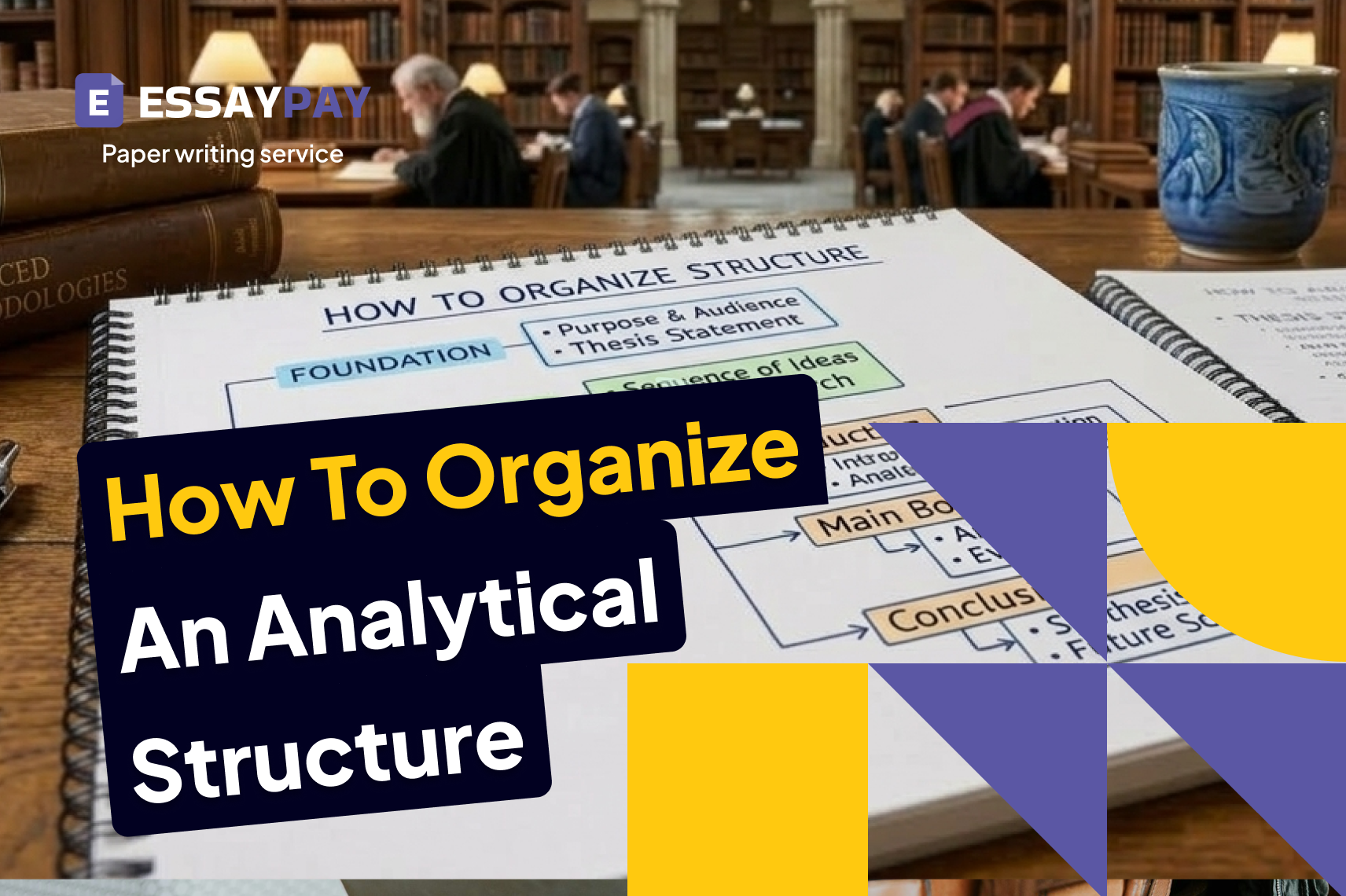
Analytical essays follow a recognizable structure, though the execution varies by discipline and assignment length. At minimum, the structure includes:
| Section | Purpose |
| Introduction | Contextualizes the subject, ends with the thesis |
| Body Paragraphs | Each develops one claim with evidence and analysis |
| Conclusion | Synthesizes the argument, not a mere summary |
Each body paragraph should open with a topic sentence that connects to the thesis, include at least one piece of evidence (a quotation, a statistic, a specific example), and then spend more time analyzing that evidence than introducing it. This ratio matters more than most students realize. If the paragraph has three sentences of evidence and one of analysis, it’s still a summary.
The analytical move – the “this suggests,” the “this reveals,” the “what this demonstrates” – has to take up more real estate than the evidence itself.
Using Evidence Effectively
Evidence in an analytical essay isn’t decoration. It’s the raw material that the argument processes. Dropping a quote and moving on is a missed opportunity. The writer’s job is to explain what the evidence means in the context of their specific claim.
Consider a student analyzing an analytical essay example on Orwell’s 1984. They might quote the passage about doublethink and then immediately explain how the syntax of the passage – not just the concept it describes – enacts the very disorientation it names. That’s analysis. The evidence and the interpretation are doing work together, not separately.
Revision Isn’t Optional
First drafts of analytical essays tend to be exploratory. That’s fine – they’re supposed to be. The thinking gets clearer in revision. A useful revision strategy: read the thesis, then read only the topic sentences of each body paragraph. Do they connect? Do they form a coherent sequence? If not, that’s the structural problem to solve before touching the prose.
Sentences matter too. Analytical writing doesn’t need to be ornate, but it does need precision. Vague language (“this shows that society has issues”) undermines specific argumentation. Replace every vague term with a specific one.
A Note on Academic Integrity
Some students, overwhelmed or running out of time, consider shortcuts. There are services that offer to buy an analytical essay outright – finished, formatted, delivered fast. Beyond the ethical problems, which are serious, there’s a practical one: analytical writing is a transferable skill. Every field that requires reasoned decision-making, structured argument, or interpretation of complex data uses it. Avoiding the practice doesn’t eliminate the need.
Final Checklist Before Submission
Before handing in any analytical essay, it helps to verify:
- The thesis makes a specific, arguable claim
- Each body paragraph has a clear topic sentence tied to the thesis
- Evidence is followed by analysis, not just citation
- The conclusion synthesizes rather than merely restates
- The language is precise throughout
Analytical writing is hard because thinking is hard. The essay is evidence of the thinking – not a substitute for it.