Most writers approach the outline as a formality. A skeleton they slap together before the real work starts, then abandon halfway through. That instinct makes sense. Outlines feel bureaucratic. But that’s usually because the outline was built wrong. A good analytical essay outline isn’t a list of sections; it’s a thinking tool. And there’s a meaningful difference.
The outline is where the argument gets stress-tested before a single body paragraph gets written. Skip it, and the essay tends to sprawl. Claims appear without support. The reasoning circles. What should be a confident argument ends up reading as a long summary with thesis-shaped punctuation marks scattered throughout.
According to a study published in the Journal of Writing Research, students who used structured pre-writing strategies, including outlining, produced essays scored significantly higher on coherence and argument development than those who didn’t. That’s not surprising to anyone who has watched a writer revise their way out of a structural hole they could have avoided entirely.
What the Outline Actually Does
Before getting into the mechanics, it helps to understand what analytical writing is actually trying to accomplish. An analytical essay isn’t a summary and it isn’t an opinion piece. It takes a text, a phenomenon, a data set, something concrete, and makes a specific, defensible claim about it. Then it proves that claim through close reading, evidence, and reasoning.
The analytical essay structure exists to support that purpose. Introduction, thesis, body paragraphs built around evidence, conclusion. Simple in theory. In practice, the structure only works if each element earns its place. An outline forces that reckoning early, when the cost of changing direction is low.
Start With the Thesis, Not the Hook
Writers often begin their outlines with an introduction section and then try to work their way toward the thesis. That’s backwards. The thesis is the engine. Everything else is built around it.
A strong analytical thesis makes a specific interpretive claim. “Shakespeare’s Hamlet explores the theme of revenge” is not a thesis; it’s a topic sentence at best. “Hamlet’s inability to act on his vengeance reflects an internal conflict between moral consciousness and filial duty” is a thesis because it’s arguable, specific, and implies a line of reasoning that needs to be demonstrated.
Once the thesis is locked in, the outline builds out from it. What three or four pieces of evidence most directly support the claim? What does each piece of evidence actually prove? What counterarguments exist, and how does the essay handle them?
The Body Paragraph Blueprint
Each body paragraph in an analytical essay follows a logic that mirrors the essay’s overall structure. Knowing how to write an effective analytical essay comes down to understanding this recursion: each paragraph is its own small argument, complete with claim, evidence, and analysis.
A useful format for the outline looks something like this:
| Outline Element | Purpose |
| Topic sentence | States the paragraph’s specific claim |
| Evidence (quote or data) | Introduces the textual or empirical support |
| Analysis | Explains what the evidence proves and why it matters |
| Transition | Connects this paragraph’s claim to the next |
Students often over-invest in finding the perfect quote and under-invest in the analysis. The quote doesn’t argue anything by itself. The analysis is the essay. That reversal in priority is one of the most common structural errors, and a well-built outline catches it before it becomes a draft problem.
A Workable Outline Template
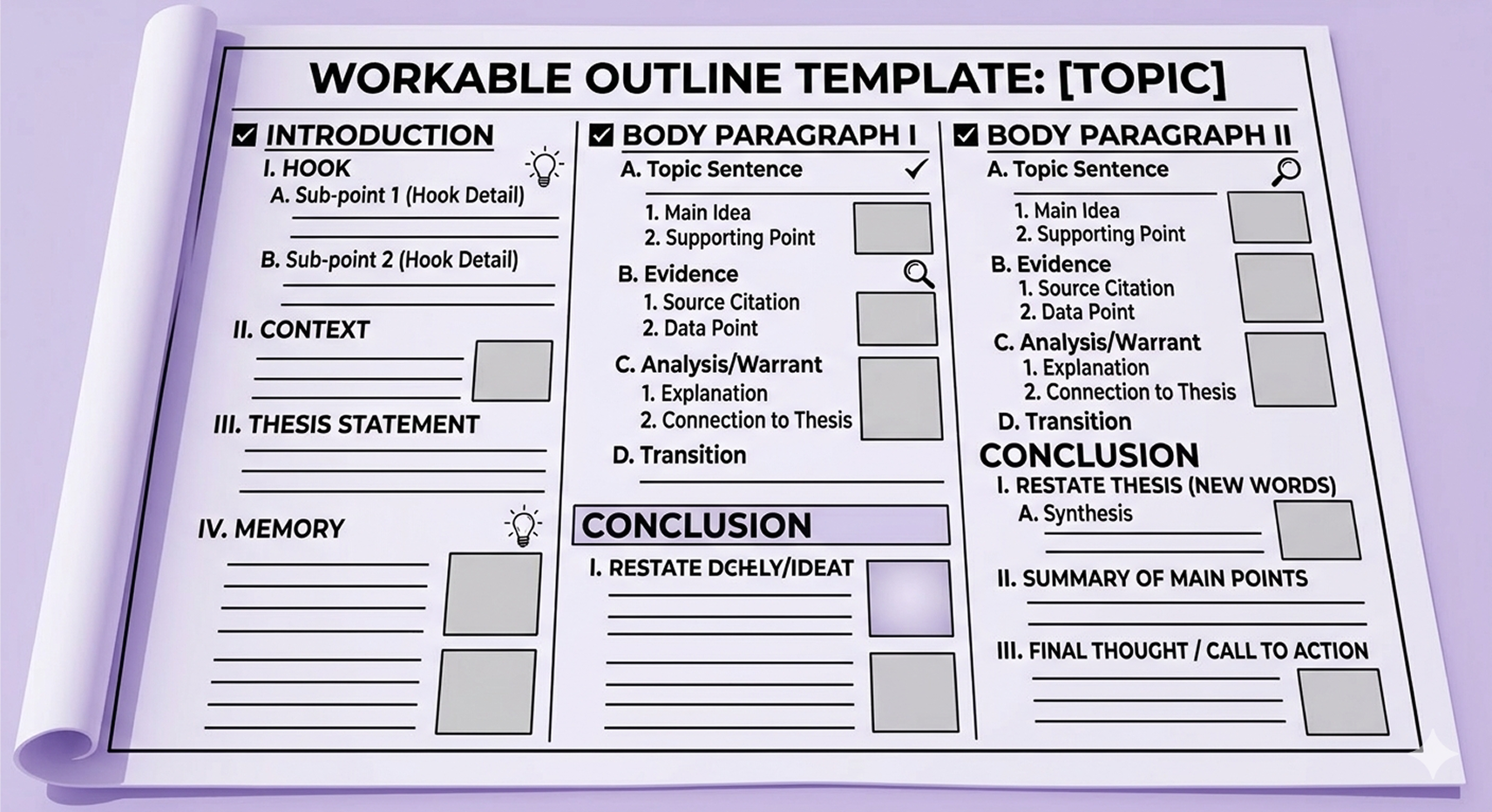
Here’s what a full outline actually looks like in practice:
- Introduction
- Hook: context or question that opens the problem
- Background: minimal, only what the reader needs
- Thesis: the specific arguable claim
- Body Paragraph 1
- Topic sentence (supports Thesis)
- Evidence: [specific quote/data]
- Analysis: why this evidence proves the topic sentence
- Bridge to next paragraph
III. Body Paragraph 2
- Topic sentence (extends or complicates the argument)
- Evidence
- Analysis
- Bridge
- Body Paragraph 3 (optional: counterargument + rebuttal)
- Acknowledge an opposing view
- Refute it using evidence already established
- Reinforce the thesis
- Conclusion
- Restate thesis in new language
- Synthesize, don’t summarize
- Broader implication or closing thought
That’s the analytical essay format in its most functional form. Nothing revolutionary. But the value isn’t in the template; it’s in how honest the writer is when filling it out. If the analysis section for a body paragraph is blank or vague during outlining, that’s the argument telling the writer something important.
Where Writers Tend to Go Wrong
The outline reveals problems. That’s its job. But a few failure patterns come up again and again.
Treating evidence as argument. A paragraph can be full of excellent quotes and still make no argument. The outline helps because it forces the writer to articulate the analysis separately from the evidence.
Thesis drift. Body paragraphs start proving something slightly different than what the thesis claims. The outline, when referenced regularly, catches this early.
Missing transitions. The logical relationship between paragraphs is invisible in the draft but should be traceable in the outline. If body paragraph two doesn’t clearly follow from body paragraph one, the outline reveals that gap.
Over-relying on summary. This is especially common when working with literary texts. The outline should prompt the question: am I interpreting this, or just describing it?
When to Seek Outside Help
Sometimes the argument doesn’t come together no matter how many times the outline gets revised. That’s not a personal failure. It’s often a sign that the thesis needs rethinking, or that the evidence doesn’t actually support the claim being made.
For writers who are genuinely stuck or working on high-stakes assignments, a professional analytical essay writing service can help identify structural problems that are difficult to see from inside the work. The value isn’t in having someone else do the thinking; it’s in getting a reader who can say, plainly, where the argument loses its thread.
The Outline Is the Essay, Roughly
A completed outline should tell the full story of the essay in compressed form. If someone reads the thesis and all the topic sentences in order, they should be able to follow the argument without reading the body paragraphs. That’s the test.
If the argument doesn’t hold together at the outline stage, it won’t hold together in the draft either. More words don’t fix structural problems. They bury them.
The writers who resist outlining often do so because they find it constraining. But the constraint is the point. An outline doesn’t prevent a good essay from happening. It prevents a bad one from taking up three drafts to fix.