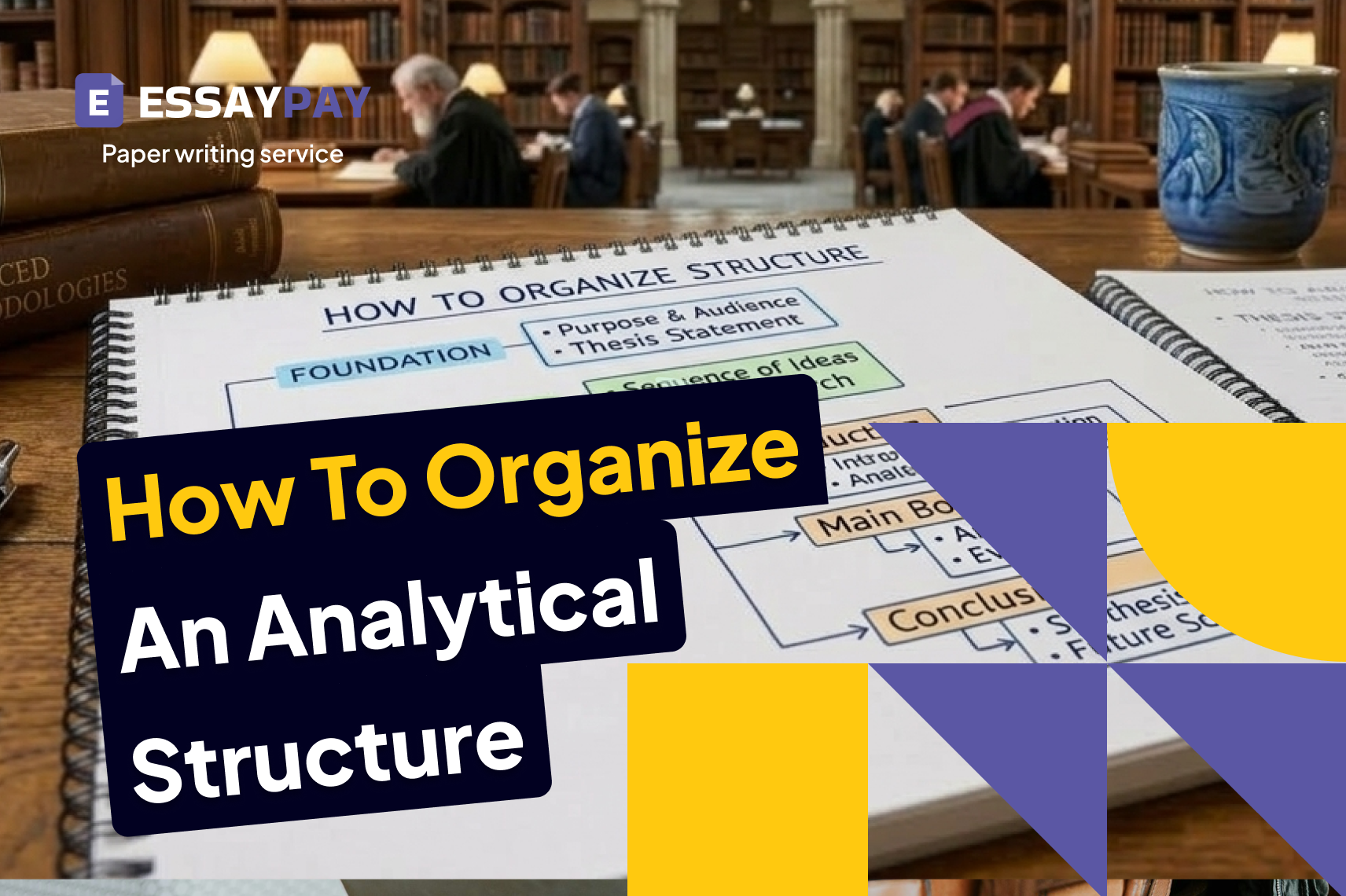
Most students sit down to write an analytical essay and immediately open a blank document. That’s the first mistake. Structure isn’t something that happens after the ideas arrive. It’s what makes the ideas legible in the first place.
An analytical essay isn’t a summary. It isn’t a review. It isn’t an opinion piece dressed up in formal language. It’s an argument built from evidence, and the difference between a mediocre one and a genuinely strong one almost always comes down to how that argument is organized. Not how smart the writer is. Not how interesting the topic is. Organization.
So here’s what that actually looks like, from the ground up.
The Introduction Isn’t Where You Warm Up
One of the most common habits instructors see in student writing is the warm-up introduction. Two or three sentences of vague context, a definition from Merriam-Webster, a gesture toward relevance. It reads as stalling. Professors notice immediately.
The introduction has one structural job: establish the context, narrow toward the specific text or problem being analyzed, and deliver a thesis that makes an actual claim. That claim should be arguable, not self-evident. “Shakespeare uses imagery in Macbeth” is not a thesis. “Shakespeare’s use of blood imagery in Macbeth reflects a growing inability to separate guilt from identity” is.
A good analytical essay thesis example might look something like this: “In ‘The Yellow Wallpaper,’ Gilman uses the narrator’s progressive fixation on the wallpaper’s pattern as a structural metaphor for the constraints imposed on women’s intellectual autonomy in the 19th century.” That thesis names a technique, a text, and an interpretive claim. It gives the rest of the essay a direction.
Without that, the essay sprawls. Every paragraph feels disconnected. The reader keeps waiting for a point that never quite crystallizes.
Body Paragraphs: The Architecture of Analysis

Each body paragraph functions as a mini-argument. Not a collection of observations. An argument.
The structure that actually works, and that emerges consistently across AP rubrics, IB criteria, and university composition courses, follows a recognizable logic:
| Element | Function |
| Topic sentence | States the paragraph’s specific claim |
| Evidence | Quotation, data, or textual reference |
| Analysis | Explains what the evidence shows and why it matters |
| Transition | Connects to the next paragraph’s claim |
The analysis step is where most essays fail. Writers drop in a quote and move on, as if the evidence speaks for itself. It rarely does. The analytical move is the interpretive layer. What does this specific word choice reveal? What does this structural decision imply about the author’s argument? Why does this data point undercut the dominant narrative?
Research on writing instruction suggests that a significant majority of student essays lose points specifically for insufficient analysis. Not insufficient evidence. Insufficient analysis of evidence already present. The evidence is there. The interpretation isn’t.
Body paragraphs should also maintain a clear through-line to the thesis. Each one should answer, implicitly or explicitly: how does this support the central claim? If a paragraph can’t answer that question, it probably doesn’t belong.
Counterargument and Complexity

An analytical essay that only advances its own argument, never acknowledging what complicates it, tends to feel thin. Even in undergraduate writing, the strongest essays engage with the tension in their own claims.
This doesn’t have to be elaborate. One paragraph that acknowledges an alternative reading, or that concedes a limitation in the evidence, adds intellectual credibility. It signals that the writer understands the material well enough to see its edges.
The counterargument paragraph typically appears after the main body of evidence, just before the conclusion. It should introduce the opposing view clearly, then explain why the essay’s central argument still holds despite that complication. The goal isn’t to dismantle the counterargument, necessarily. It’s to show the writer is thinking carefully, not just advocating.
The Conclusion Does More Work Than You Think
Conclusions are frequently the weakest section of an analytical essay, mostly because writers treat them as a formality. Restate the thesis. Summarize the paragraphs. Gesture toward “broader implications.” Done.
That approach produces a conclusion that feels mechanical. The reader closes the essay without any sense of significance.
A more effective conclusion returns to the thesis, but deepens it. It synthesizes rather than summarizes. It answers the implicit question: so what? Why does this analysis matter beyond the text itself? That can mean connecting the argument to a broader cultural or historical pattern. It can mean articulating what this particular reading reveals about how meaning gets made in literature, or data, or policy. It doesn’t have to be grand. It just has to feel earned.
Outlines Are Not Optional
Before drafting, a writer who understands how analytical essays work will produce a roadmap. Knowing how each section connects to the others before any prose gets written changes the quality of the prose significantly.
An analytical essay outline example typically includes the thesis in full, a brief description of each body paragraph’s claim (not its content), a note about where the counterargument appears, and a phrase or two summarizing the conclusion’s synthesizing move. That’s it. It doesn’t need to be detailed. It needs to be clear about direction.
Writers who skip the outline often find themselves revising entire sections because the essay’s logic shifted mid-draft. The outline makes the structure visible before the writing begins, which is when structural problems are cheapest to fix.
A Note on Speed and Efficiency
Students who need to produce an analytical essay under time pressure, whether for an exam or a tight deadline, sometimes search for how to write an analytical essay fast. The honest answer is that speed comes from having internalized the structure. If the thesis formula, the body paragraph logic, and the outline process are habitual, drafting becomes much faster. There’s no figuring out what comes next.
That’s also why some writers turn to analytical essay writing services when they’re overwhelmed or uncertain about the standards expected in a new academic context. Understanding what a well-organized analytical essay looks like, from thesis to conclusion, is itself a skill, and watching a model built to professional standards can clarify expectations in ways that abstract instruction sometimes can’t.
What Good Structure Actually Feels Like
A well-organized analytical essay has a quality that’s hard to name but easy to recognize. The reader always knows where they are in the argument. Each paragraph feels necessary. The conclusion doesn’t just end the essay; it closes it.
That quality doesn’t come from talent. It comes from deliberate attention to structure, revision, and a willingness to see organization not as a constraint but as the thing that makes the argument possible in the first place.
The structure is the essay. Everything else is decoration.