An argument paper can reason brilliantly and still bleed points in the parentheses. The claim is sharp, the evidence is real, and the grade drops anyway: a period on the wrong side of a citation, a quotation dropped into a paragraph with no introduction, a source cited in the text and missing from the list at the back. Formatting failures in this genre are almost never about margins. They are about the machinery that connects the essay to its sources, because an argumentative essay is the one assignment where format and credibility are the same thing.
That changes what deserves attention. Page setup takes five minutes and rarely varies; citation mechanics carry real points and real plagiarism risk, so this page spends its space accordingly.
The two-minute version
- Argument papers in English and humanities courses default to MLA (9th edition, 2021); psychology, education, and social sciences default to APA (7th edition). The prompt overrides both.
- Every source cited in the text must appear in the end list, and every listed source must be cited in the text; graders check the match both ways.
- In MLA, the period goes after the parenthetical citation, never before it: …end of quote” (Author 24).
- Quotations running longer than four typed lines (MLA) become indented block quotes with no quotation marks, and the citation moves after the final period.
- Page basics are shared across styles: 12-point serif font, double spacing, 1-inch margins, half-inch paragraph indents.
The First Thirty Seconds on the Grader’s Screen
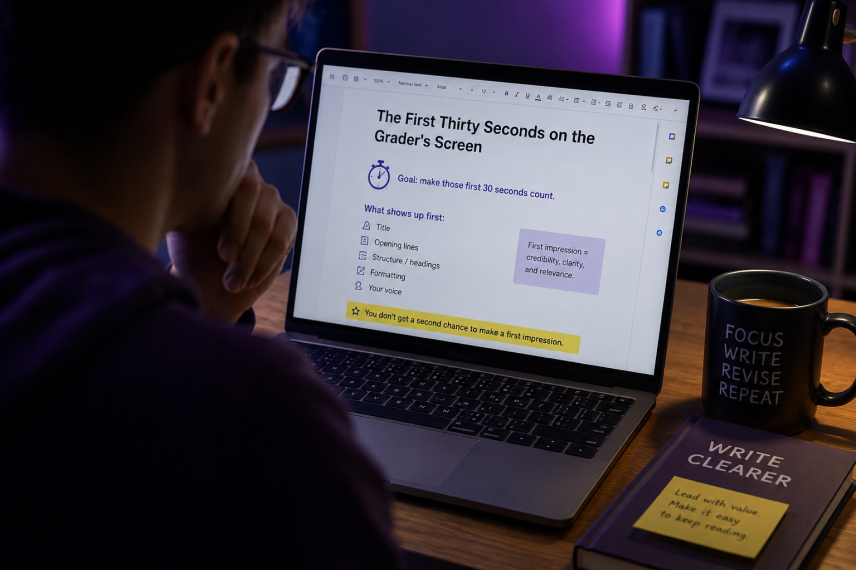
Formatting rules make more sense once the reading order behind them is visible. An instructor opening a submission runs an almost involuntary sequence, and each stop on it is a formatting rule wearing its reason:
- The file name loads first, before any content. A syllabus-pattern name signals a student who reads instructions; final_FINAL_v3.docx signals the opposite before word one.
- The first page answers “did this student use the required style” in one glance: MLA’s heading block or APA’s title page, each unmistakable.
- The thesis gets read next, at the end of the first paragraph where both styles expect it; a grader hunting for it is already annotating. What that sentence must contain is its own craft, and any solid thesis statement example for argumentative essay work shows the pattern the grader is scanning for.
- A skim for parentheses. Before reading a single argument, experienced graders flip through checking that citations exist at all, and that quoted material is visibly quoted.
- The last page. Works Cited or References gets a ten-second scan: alphabetical, hanging indents, plausible entries. Only then does the actual reading begin.
Five stops, thirty seconds, and the paper has already earned or lost its formatting points. The genre-specific weight sits at stops four and five, because the format of an argumentative essay is mostly the machinery connecting claims to sources, the one layer descriptive and narrative assignments get to skip.
Choosing the Style Without Guessing
When the prompt names no style, the course’s discipline decides it:
- English, composition, literature, most humanities → MLA, 9th edition (2021): author-page citations, Works Cited, no title page;
- psychology, education, nursing, sociology, business → APA, 7th edition: author-date citations, References, a title page for student papers;
- history → often Chicago notes-bibliography, the one system built on numbered footnotes;
- still ambiguous → ask, in one sentence, before drafting; instructors answer this question gladly because grading mixed styles is worse for them than for anyone.
The shared baseline across all three barely varies: a readable 12-point serif, double spacing, 1-inch margins, half-inch paragraph indents, continuous prose without internal headings at essay length.
A Cited Paragraph and Its Paper Trail, Rendered
The fastest way to absorb citation mechanics is seeing a body paragraph and its end-list entries as the pair they are. The MLA-style sample below argues one point from two sources; the annotations name each rule as it fires.
The rules firing above: the quotation is introduced, never dropped in bare; the period sits after the parenthetical, not inside the quotation marks; the paraphrase of Reyes still carries a citation with page numbers; author names in the text remove the need to repeat them in parentheses; and the Works Cited entries use hanging indents, alphabetical order, and italics for the standalone work. The bracketed publisher and journal details are placeholders because these sources are illustrative; a real paper fills them from real sources.
Two-way matching is the check graders run first: both in-text names appear in the list, and both listed entries are used in the text. An orphan on either side reads as carelessness at best and padding at worst.
The Same Evidence in MLA 9 and APA 7
Courses split between the two systems, and the differences cluster in predictable places. One sentence of evidence, formatted both ways:
| Element | MLA 9 | APA 7 |
| In-text citation | (Nguyen 214) – author and page, no comma | (Nguyen, 2024, p. 214) – author, year, page with p. |
| Author named in the sentence | Nguyen argues… (214) | Nguyen (2024) argues… (p. 214) |
| End list title | Works Cited | References |
| Block quote threshold | More than four typed lines of prose | 40 words or more |
| First page | Heading block, no title page | Separate title page required |
| Emphasis in entries | Title case for titles | Sentence case for article and book titles |
The safe default when the prompt is silent: MLA in an English or composition course, APA anywhere the syllabus mentions psychology, education, nursing, or social science. Asking beats guessing, and instructors answer this question happily because grading mixed citation styles is worse for them than for anyone.
Block Quotes and Why Argument Papers Should Ration Them
When a quotation crosses the threshold (four lines in MLA, 40 words in APA), the formatting inverts: the passage is set off in an indented block, the quotation marks disappear, and the citation moves after the closing period. A correctly built block looks like this in MLA:
…consumed more faculty hours than in-person invigilation ever had, without producing a measurable decline in misconduct findings across three review cycles. (Reyes 91)
The formatting rule is mechanical; the judgment behind it is the part worth internalizing. A long quotation hands the microphone to someone else, and an argumentative essay format example overloaded with blocks reads as a writer hiding behind sources rather than arguing through them. The working ratio in strong papers: paraphrase carries most of the evidence, short integrated quotes carry the sharpest phrasings, and block quotes appear once or twice per paper, if at all.
The Repair Log: Five Fixes, Shown as Diffs
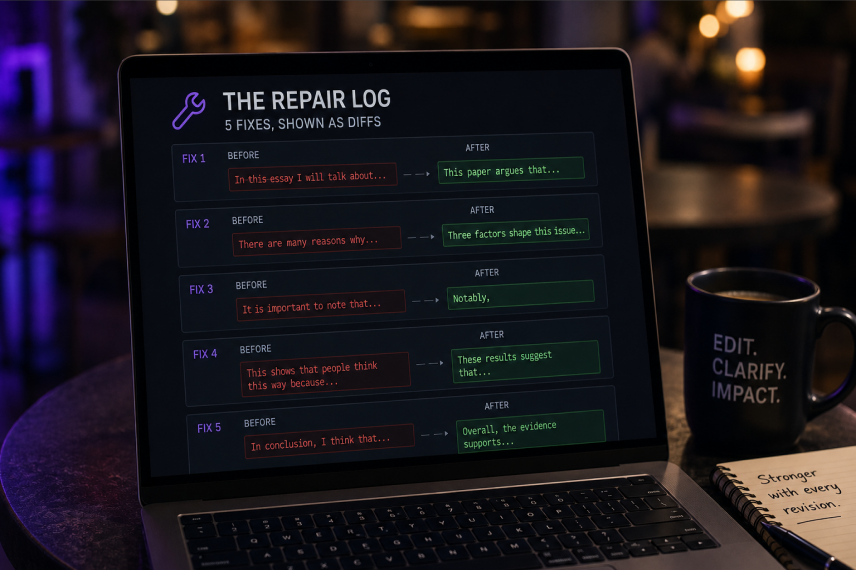
The recurring citation errors are easiest to kill when shown as before/after pairs, the way an editor’s tracked changes would render them:
Fix 1 – the floating period
✗ …no counterpart in gains to honesty.” (Nguyen 214)
✓ …no counterpart in gains to honesty” (Nguyen 214).
One period, and it comes after the parentheses. Two sentence-enders around one citation is the single most-marked mechanical error in this genre.
Fix 2 – the dropped quote
✗ Proctoring adds stress. “The costs land on honest students” (Reyes 88). This is a problem.
✓ Proctoring adds stress precisely where it should not: as Reyes documents, “the costs land on honest students” (88).
A quotation standing alone as its own sentence reads as pasted research; a signal phrase welds it into the argument and moves the author’s name out of the parentheses.
Fix 3 – the uncited paraphrase
✗ Appeals against automated flags ended up consuming more faculty time than live proctoring ever did.
✓ Appeals against automated flags ended up consuming more faculty time than live proctoring ever did (Reyes 88-90).
Rewording changes nothing about the debt. The idea is still borrowed, and this omission is the most common accidental-plagiarism pattern in argument papers.
Fix 4 – the one-way list
✗ References list: 9 entries. Citations in the text: 5 sources.
✓ Every listed entry cited, every citation listed – the two-way match.
Extra uncited entries read as padding; cited-but-unlisted sources read as something worse. Graders check the match in both directions, and so should the final pass.
Fix 5 – the generator artifact
✗ nguyen, L. Testing under watch: SURVEILLANCE and the student experience, [publisher] 2024
✓ Nguyen, Lan. Testing Under Watch: Surveillance and the Student Experience. [Publisher], 2024.
Citation generators mangle capitalization, punctuation, and author order in recognizable ways. They draft; the writer verifies each entry against the current handbook’s pattern before it ships.
The Submission Layer in the Checker Era
Argument papers pass through more software than any other essay type, and knowing how to format an argumentative essay now includes knowing what the software sees:
- similarity checkers match quoted material by design, so a paper with legitimate quotations shows a nonzero score; what matters is that matched text sits inside quotation marks or blocks, with citations attached;
- both MLA and APA have published official guidance on citing generative AI tools, so a paper that used one for brainstorming or summaries has a correct disclosure format available, and the course policy decides whether such use is permitted at all;
- the file itself follows the syllabus: named per the requested pattern, submitted as .docx unless PDF is specified, opened once after upload to confirm nothing garbled.
Formatting is also the easiest place to reverse-engineer. Reading one finished example of argumentative essay work with this page open, matching each citation and entry against the rules, teaches the mechanics faster than memorizing them in the abstract.
The Ten-Minute Close-Out, Timed
Run once, in order, after the writing is done; the minutes are honest estimates for a five-page paper:
- Minute 1: style confirmed against the prompt; one detail spot-checked in each zone (first page, header, spacing).
- Minutes 2–4: the quote pass – every quotation introduced, the period after every parenthetical, blocks formatted where the threshold demands.
- Minutes 5–6: the paraphrase pass – every borrowed idea carries a citation, page numbers included where the style wants them.
- Minutes 7–8: the two-way match between in-text citations and the end list, run in both directions.
- Minute 9: end-list entries alphabetized, hanging-indented, and eyeballed against a handbook pattern rather than trusted to a generator.
- Minute 10: file named per the syllabus, submitted, reopened once to confirm nothing garbled in upload.
A paper that clears this list has spent its formatting budget where this genre actually grades it. Getting the argument itself to deserve the clean mechanics is the longer road, mapped from prompt to revision in the guide on how to write an argumentative essay; and when the deadline has outrun both, professionally prepared papers from argumentative essay writing services arrive with this entire checklist already executed, which is worth seeing once if only as a model of source mechanics done cleanly.
FAQ
How many sources does a format for argumentative essay assignments assume?
Course essays typically expect 3–5 credible sources; research papers 6–10 or more. The honest minimum is one solid source per body claim plus one representing the opposition; a ten-entry list attached to a three-page paper reads as decoration.
Does the Works Cited or References page count toward the word count?
Almost never; word counts conventionally mean body text. The same applies to an APA title page. When a rubric counts pages instead of words, ask, because “five pages” sometimes includes the list and sometimes does not.
Is there a limit on how much of the paper can be quotation?
No formal rule, but the working ceiling experienced graders apply is roughly 10–15 percent of the text; beyond that, the paper reads as assembled rather than argued. Paraphrase with citation carries evidence at no such cost.
Can generative AI tools be cited, and how?
Both MLA and APA have published official formats for citing generative AI output, so a correct citation exists when course policy permits the use. The citation never launders the policy question: permitted use gets disclosed and cited, and prohibited use is prohibited regardless of formatting.
Footnotes or parenthetical citations?
MLA and APA both use parenthetical in-text citations as the default; numbered footnotes belong to Chicago style, which appears mainly in history courses. Using footnotes in an MLA paper is the format equivalent of answering a different assignment.