Most students do not get stuck on critical thinking essays because they have no opinion. They get stuck because opinion is not enough. The assignment sounds simple at first. Read the issue. Take a position. Support it. Then the draft starts drifting. One paragraph summarizes. Another overstates. A third sounds confident but proves almost nothing. That pattern is common, and it usually has one cause: the writer started with a reaction instead of a method.
A critical thinking essay works better when the writer slows down and builds the argument in stages. That does not mean making the paper stiff. It means giving the thinking somewhere solid to stand. The simplest version of the process can be reduced to four moves: question the claim, test the evidence, add pressure from the other side, and conclude with discipline. Once those moves are visible, the essay becomes much easier to control.
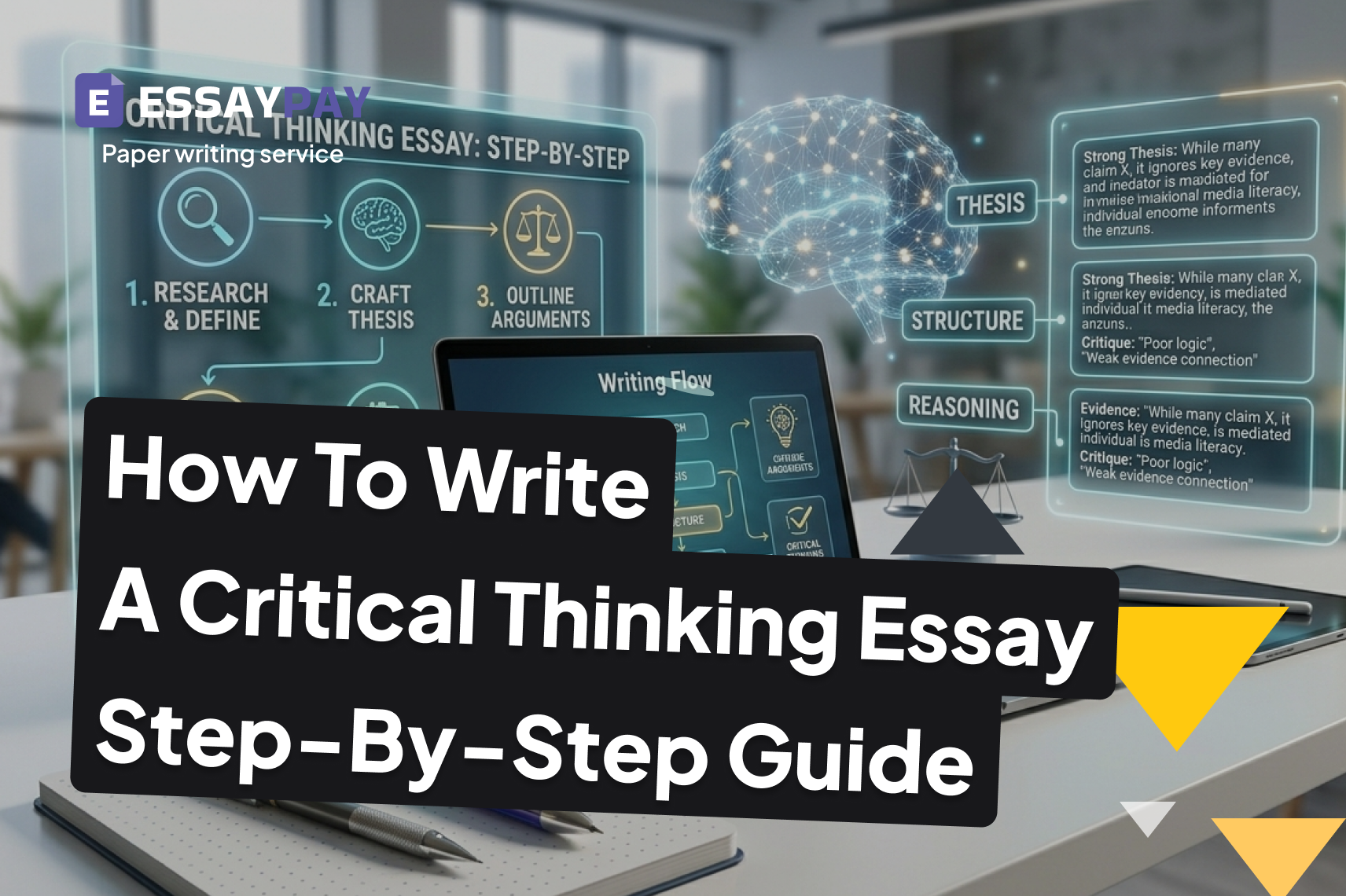
A Simple Four-Step Method That Actually Helps
The strongest method is not always the fanciest one. In practice, a useful critical thinking process is direct.
- Turn the topic into a real question.
- Collect evidence, then challenge it.
- Add the strongest opposing view.
- Write a conclusion that matches the proof.
That is the whole frame. Everything else is refinement.
Step 1: Turn the Topic Into a Real Question
A weak essay often begins with a slogan. A stronger one begins with a problem.
“Social media is harmful” is a slogan.
“Under what conditions does social media weaken attention and trust?” is a real question.
The first version pushes the writer toward certainty too early. The second leaves room for thought, evidence, and disagreement.
This is where Thesis Refinement matters. The first draft of a topic is often too broad, too emotional, or too obvious. The writer has to narrow it until the issue becomes genuinely arguable.
Good topics for critical thinking essay assignments usually contain one of these elements:
- competing values;
- mixed evidence;
- unintended consequences;
- a gap between intention and result;
- different outcomes for different groups.
Examples:
- Should AI tools be allowed in first-year writing courses?
- Do college rankings distort student choices?
- Should cities regulate short-term rentals?
A smaller, sharper question usually produces stronger reasoning because it forces specificity.
Step 2: Gather Evidence, Then Doubt It
Many students stop thinking once they find sources that agree with them. That is where weak analysis often begins.
Evidence is not valuable simply because it exists. It has to be tested.
Ask:
- Who produced the source?
- What exactly was measured?
- What was left out?
- Does it support the whole claim or only part of it?
- Is the data current enough to matter?
This is where Burden of Proof becomes practical. If the writer makes a broad claim, the evidence must be broad enough to support it. If the evidence is narrow or uncertain, the conclusion has to shrink.
Two common reasoning paths appear here:
- Deductive Reasoning: starts with a general rule and moves toward a conclusion.
- Inductive Reasoning: starts with observations and builds a probable conclusion.
Most student essays rely more on induction, which is normal. Still, probability should be presented honestly.
A helpful side tool is Argument Mapping. Sketch the logic in plain words:
claim → support → objection → response
That tiny step prevents many messy paragraphs and exposes weak assumptions early.
Step 3: Add Pressure From the Other Side
This is the step many students avoid, and it is often the step that lifts a paper from average to strong.
A critical thinking essay should not treat the other side as foolish. It should present the strongest version of the opposing case, then test it fairly. That method is called Steelmanning.
It makes the essay more credible because the writer is not hiding from difficulty.
Socratic Questioning is useful here. Ask:
- What would a sharp critic say?
- Which part of my argument is weakest?
- What assumption is doing too much work?
- What evidence would challenge me?
- What alternative explanation have I ignored?
The writer also has to watch for common logic errors.
False Dichotomy appears often:
- Either ban the technology or surrender to chaos.
- Either support the policy or reject fairness.
- Either trust the data or ignore science.
Serious issues are rarely built that way. Strong essays resist fake binaries and look for the real range of options.
Counterfactual Analysis can also help. Ask what might have happened without the policy, trend, or event being discussed. That question often exposes weak cause-and-effect claims.
Step 4: Write a Conclusion With Restraint
Weak: Remote work is better than office work.
Stronger thesis statement for critical thinking essay: Remote work can improve satisfaction and reduce commuting costs, but its long-term success depends on management quality, role design, and collaboration needs.
It tells the reader:
- what the evidence supports;
- what remains uncertain;
- why those limits matter;
- what conclusion is reasonable now.
This is where Epistemic Humility becomes more than a theory term. It becomes tone.
“The evidence suggests mixed outcomes across age groups” often sounds stronger than “This policy clearly fails society.”
A careful writer knows when the evidence allows a narrow conclusion instead of a sweeping one. That restraint often reads as more intelligent than exaggerated certainty.
A Full Mini Example
Below is a compact example that shows how the method works when turned into a real essay shape.
Prompt: Should universities use AI detectors to identify dishonest student writing?
Working thesis: AI detectors may help flag suspicious submissions, but universities should not treat detector scores as proof of misconduct because accuracy varies across writing styles, language backgrounds, and revision patterns.
Mini outline:
- Explain why schools want detectors.
- Show reliability concerns.
- Add a counterargument about academic integrity.
- Propose a more balanced policy.
Sample introduction:
Universities are under pressure to respond to AI-assisted writing, and detection tools appear to offer a quick solution. Their appeal is obvious: they promise speed, consistency, and a way to discourage dishonesty. Yet convenience is not the same as fairness. If detector scores are treated as evidence rather than warnings, institutions risk punishing legitimate work on the basis of uncertain software judgments. A more defensible approach would use detectors as one signal among several, not as the final authority.
Sample body paragraph:
The main weakness of AI detection lies in its unstable reliability. A detector may assign a high probability score to text that is fully human-written but highly structured, heavily revised, or produced by a multilingual student using unusually formal syntax. This problem matters because a score is not self-explanatory. It does not reveal intent, drafting history, or authorship process. Under a Claim-Evidence-Reasoning (CER) model, the claim would be that detector scores are limited indicators, the evidence would include documented false positives and institutional caution statements, and the reasoning would show why uncertainty makes those scores insufficient as stand-alone proof.
Counterargument paragraph:
Supporters of detector use argue that universities need efficient tools to protect academic standards, and that concern is legitimate. In large courses, manual investigation of every suspicious paper may be unrealistic. Still, the need for efficiency does not erase the need for due process. A fairer system would combine detector flags with draft records, writing samples, instructor judgment, and an appeal process. That approach accepts the practical value of the tool without pretending the tool is infallible.
Sample conclusion:
AI detectors may remain part of university policy, but their proper role is limited. They are better suited to initiating review than determining guilt. When institutions confuse suspicion with proof, they risk undermining the very academic integrity they claim to defend.
This example works because the logic stays visible from start to finish. The thesis is qualified, the evidence is interpreted rather than dropped into the page, and the opposing view is treated as real. The conclusion does not try to solve the whole future of AI in education. It solves the narrower question the essay actually addressed.
How to Build Strong Paragraphs Without Overcomplicating Them
Students often ask for critical thinking essay structure as if the entire challenge were architectural. Structure matters, but the real problem is usually paragraph logic. One practical tool here is PEEL: point, evidence, explanation, link. It is simple, maybe even plain, but it keeps paragraphs from collapsing into quotation piles or vague opinion.
Another useful concept is the Warrant. That is the hidden bridge between evidence and claim. If a study shows lower attendance in one setting, the writer still has to explain why that evidence supports the broader conclusion being made. Many drafts fail at the warrant level. The evidence is present, but the connection remains unspoken. Readers then feel the paragraph is incomplete even if they cannot immediately say why.
Cognitive Dissonance also matters more than students realize. A writer may find evidence that complicates a preferred conclusion and feel the urge to minimize it. That tension is normal. Good revision means noticing the discomfort and following it instead of hiding it.
Common Problems That Weaken Otherwise Good Drafts
| Problem | What it does to the essay | Better correction |
| Topic too broad | Creates summary instead of analysis | Narrow the question before drafting |
| Overconfident thesis | Breaks under basic objections | Add conditions, limits, or context |
| Weak source use | Makes claims sound borrowed or shallow | Explain why each source matters |
| No counterargument | Makes the essay feel one-sided | Address the strongest opposing view |
| Bloated conclusion | Overstates what the essay proved | Match the scope of the conclusion to the evidence |
What to Do When the Deadline Gets Close
When time runs short, some students search for ways to buy critical thinking essay help. That instinct usually comes from panic, not laziness. Still, the most useful support is the kind that improves reasoning, structure, and revision rather than just handing over text with no learning attached. A paper can solve one deadline. A method solves more than one.
A Revision Pass That Actually Improves the Paper
Before submitting, the writer can ask a few blunt questions:
- Did each paragraph make one clear point?
- Did every major claim carry enough proof?
- Did the essay present the strongest opposing view fairly?
- Did any sentence claim more than the evidence supports?
- Would a skeptical reader understand why the conclusion follows?
If the answer to two or three of those is no, the draft is not finished. That is not failure. It is just normal writing.
Why This Skill Lasts
A critical thinking essay is not really a performance of intelligence. It is practice in disciplined judgment. The student learns to question first impressions, test persuasive claims, and stay alert when an argument becomes too neat too quickly. That habit lasts longer than the assignment. The paper is temporary. The thinking method is the real result.