Yes, EssayPay uses both plagiarism checkers and AI detection tools. Every completed order goes through the company’s internal quality-control process before delivery. EssayPay uses recognized external checking systems to cross-check the results. The two checks serve different purposes. Plagiarism screening looks for text that matches existing material. AI detection examines writing patterns that indicate machine-generated sentences. EssayPay runs both because passing only one type of check would not provide a complete quality review.
Students have an option to ask for additional verification. EssayPay advertises a free AI report with every order and offers a detailed plagiarism report (paid extra). It states that GPTZero, Copyleaks, and Originality.ai are among the tools used for extra checks.
Technical Overview
| Question | Answer |
| Does EssayPay check papers for plagiarism? | Yes. Every completed paper is screened before delivery. |
| Does EssayPay use AI detectors? | Yes. Papers are run through multiple AI detection tools and reviewed by editors when necessary. |
| Are the checks part of every order? | Internal originality and AI screening are part of the quality-control workflow. |
| Is an AI report available? | Yes. EssayPay can provide a free AI report with every order. |
| Can students order an additional plagiarism report? | Yes. A detailed report from a premium plagiarism detection system is available as an optional add-on. |
| Which external tools are mentioned? | GPTZero, Copyleaks, Originality.ai |
How EssayPay Checks Papers Before Delivery
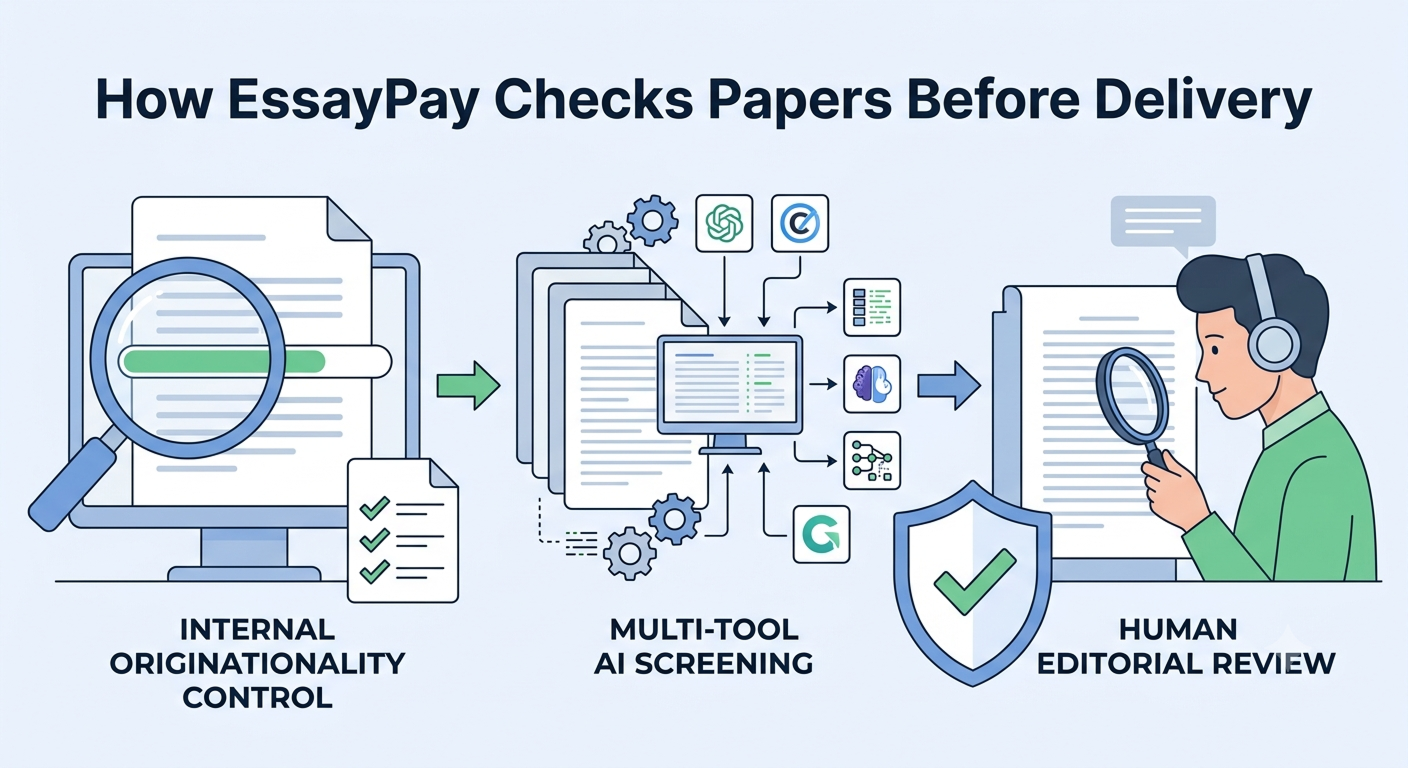
EssayPay does not rely on a single scan. Its process combines automated screening, external detection tools, and editorial review. You can conduct your own analysis using EssayPay’s free essay-checking tool now.
This layered approach matters because no individual checker evaluates every aspect of a paper. A plagiarism scanner finds matching language but cannot always determine whether the match is a correctly cited quotation. An AI detector identifies unusual writing patterns. However, its result is still a statistical estimate rather than direct proof of how the text was created.
EssayPay’s workflow addresses these limitations through several stages.
1. Internal Plagiarism Screening
Every completed order is checked with plagiarism detection software before it is released to the student. The purpose is to identify copied wording, insufficiently paraphrased passages. This screening is a standard part of its originality control, so users shouldn’t request it.
2. Multiple AI Detection Scans
According to EssayPay’s AI policy completed projects are processed through several AI detection tools. The results are cross-checked because different detectors respond differently to the same passage. A section that is not identified by one system still requires attention after another scan.
3. Human Editorial Review
Software does not make the final quality decision. When a scan identifies possible AI influence or another concern, the paper is sent to its editorial team.
Editors examine sentence rhythm, lexical variation, transitions, argument development, and the overall flow of the paper. This human review helps distinguish an actual writing problem from a questionable automated result.
4. Additional External Verification
EssayPay also presents external tools as another verification layer. If you need your paper to pass a specific checker (for example, GPTZero, Copyleaks, Originality.ai, or Turnitin), simply mention it when placing your order.
Students who want more detailed confirmation can add a premium plagiarism report to an order. Current pricing at $9.99 and is a downloadable analysis prepared through a premium plagiarism detection system. This extra report gives the student a separate document they can review for additional peace of mind.
Does EssayPay Use Plagiarism Checkers?
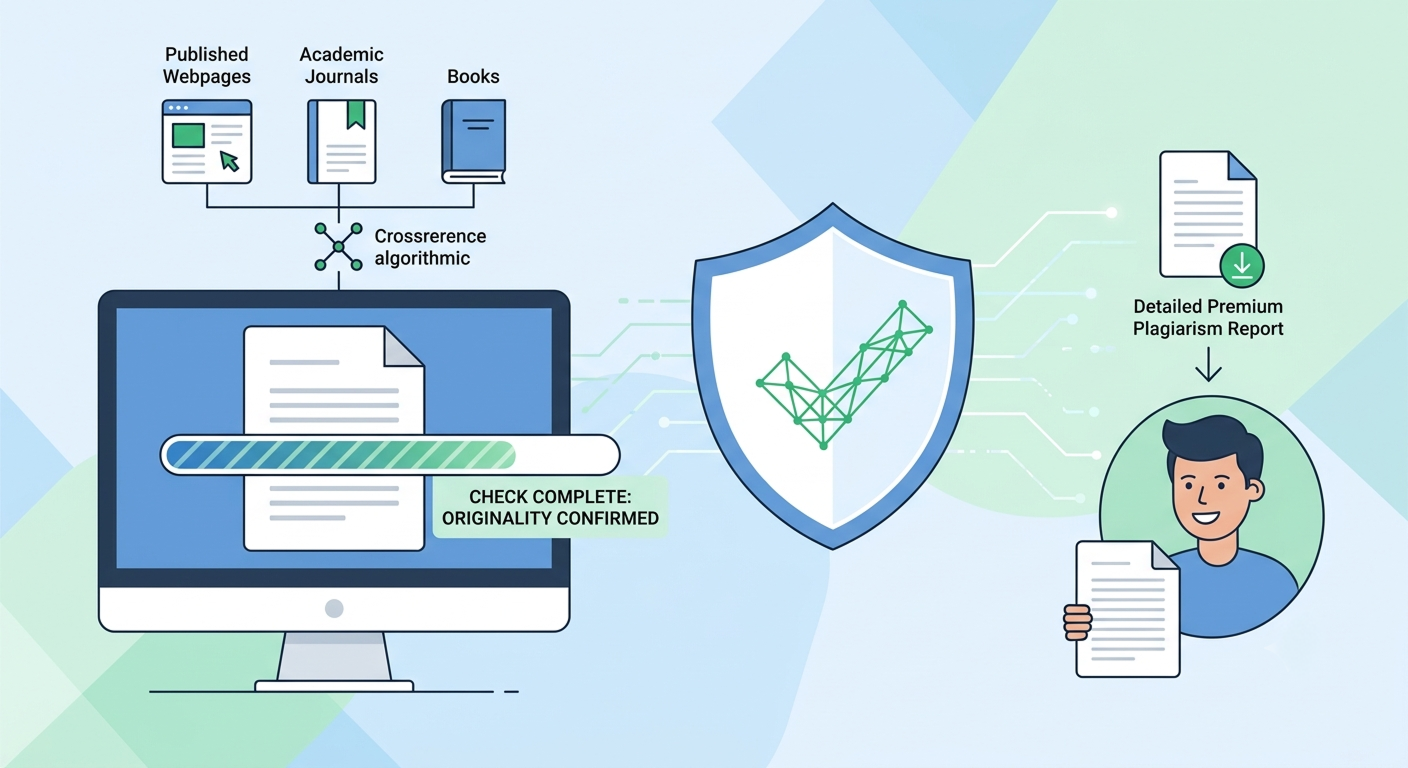
Yes. EssayPay states that every paper is checked for plagiarism before delivery. Its writers are expected to create each order from scratch. The completed doc is then screened for unoriginal material.
A plagiarism checker generally compares the text with several types of existing content:
- Published webpages
- Academic journals and periodicals
- Books and other publications
- Institutional databases
- Previously submitted papers
- Other documents stored in the checker’s index
When similar wording is found, the software highlights the passage and identifies a possible source. It calculates the proportion of matching text.
Matching text is not automatically plagiarism. Turnitin explains that its Similarity Report identifies wording that resembles content in its databases. It does not independently determine whether plagiarism occurred. Quotations, references, assignment templates, and common technical language all produce matches.
That is why EssayPay combines automated scans with human review rather than treating one percentage as the final answer.
Internal Screening vs a Paid Plagiarism Report
The distinction between these two services should be clear.
Internal screening is part of the EssayPay workflow. It is completed before the paper is delivered and is intended to identify originality problems during quality control.
The additional plagiarism report is an optional document that the student can purchase. It provides a more detailed external analysis that can be downloaded and reviewed separately. EssayPay’s FAQ states that students request an official plagiarism report with a completed paper.
A student does not need to purchase the report for the paper to receive the standard internal originality check. The add-on exists for students who want another level of documentation and reassurance.
Does EssayPay Use AI Detection Tools?
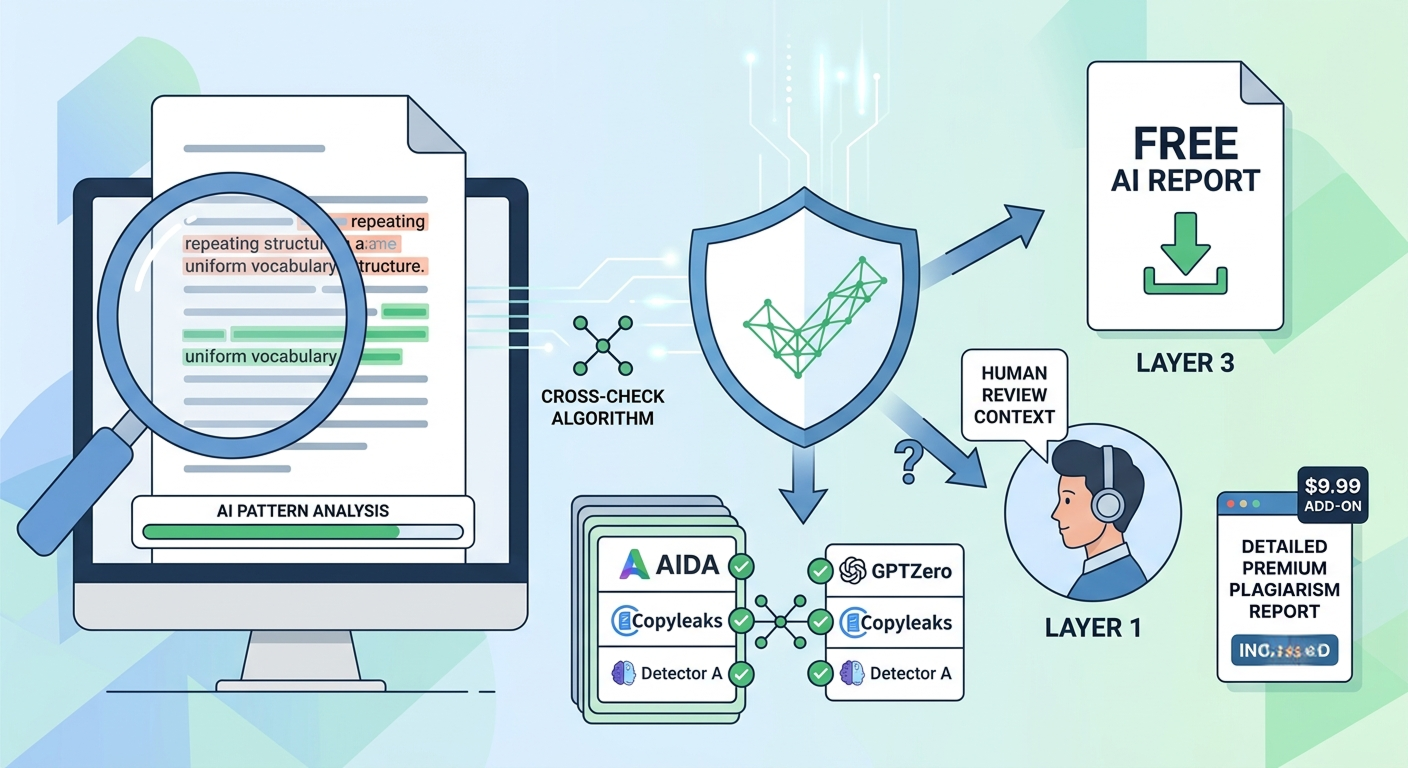
Yes. EssayPay has a dedicated AI detection policy and uses multiple tools to review every completed project.
This check supports the company’s stated no-AI policy. EssayPay’s writers are not permitted to use AI-generated drafts, including drafts that would later be edited by a human writer. The papers prepared by the EssayPay are 100% human-written work based on independent research and the student’s instructions.
What AI Detectors Examine
AI detection is different from plagiarism checking. The detector does not primarily search for copied passages. Instead, it analyzes statistical and linguistic patterns, such as:
- Predictability of word choices
- Repetition of sentence structures
- Similar sentence lengths
- Uniform vocabulary
- Limited variation in phrasing
- Formulaic transitions
- Patterns associated with AI paraphrasing
The tool then estimates whether qualifying text has been produced or modified using generative AI.
That estimate is not the same as a plagiarism percentage. Turnitin confirms that its AI Writing Report is separate from its Similarity Report. One assesses potential AI-generated writing patterns, while the other finds text that matches existing sources.
Why EssayPay Uses Several AI Detectors
Different detection systems use different algorithms and thresholds. The same paper therefore receives different results from separate tools.
EssayPay’s policy cross-checks multiple scans instead of accepting the result of one detector. If a potential issue appears, editors review the relevant sections before the paper is approved.
This process provides three layers of control:
- The first detector identifies possible AI-related patterns.
- Additional detectors confirm or challenge that result.
- A human editor examines the writing in context.
EssayPay’s detection software is updated as AI models and detection technologies change.
Is a Free AI Report Included?
The AI report and the optional paid plagiarism report should not be confused:
| Verification | Availability |
| Internal plagiarism check | Included before delivery |
| Internal multi-tool AI screening | Included before delivery |
| AI report | Advertised as free with every order |
| Detailed premium plagiarism report | Optional paid add-on |
This setup lets every order receive standard quality screening while giving students the option to obtain more detailed external verification.
EssayPay and Turnitin
Students should still understand what a Turnitin result means.
A Similarity Report measures how much submitted text matches sources within Turnitin’s databases. It does not automatically label the paper as plagiarized. A high percentage can include properly quoted and cited material, while a low percentage still contain one serious uncited match.
Turnitin does not establish one universal “safe” similarity percentage. Acceptable levels depend on the assignment, subject, institution, and instructor. Students should review each highlighted match rather than focusing only on the total score.
Can AI Detectors Still Flag Human Writing?
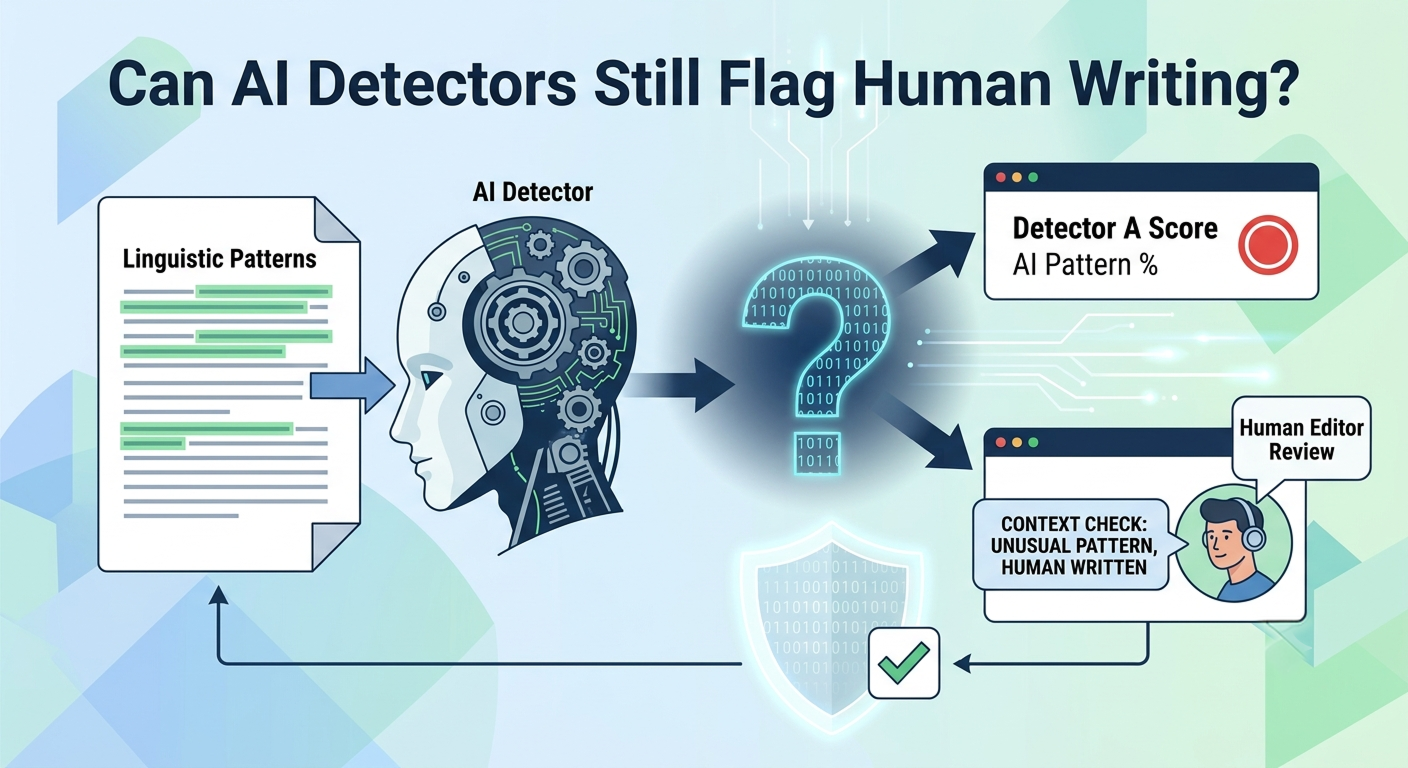
It is possible. AI detection systems are not infallible.
Turnitin states that its AI model misidentifies human-written, AI-generated, or AI-paraphrased passages. It also advises institutions not to use an AI score as the sole basis for taking action against a student. The result requires further review and human judgment.
This limitation explains why EssayPay uses more than one scan and sends questionable results to human editors. The goal is not to chase one detector score. It is to review the paper from several technical and editorial perspectives.
Does Passing Both Checks Guarantee Academic Approval?
No detection report guarantees how a professor or university will evaluate a submission.
A paper receive low plagiarism and AI scores but still contain:
- Incorrect facts
- Weak arguments
- Irrelevant evidence
- Missing citations
- Inaccurate references
- Formatting mistakes
- Content that does not answer the assignment
- Assistance that conflicts with a course policy
EssayPay provides completed papers as model materials that help students study structure, research methods, citation practices, and academic writing. Students remain responsible for understanding the content and complying with their institution’s rules.
How to Review a Paper After Delivery
Even after a paper has passed EssayPay’s checks, the student should review it personally.
Start by reading the entire argument. Confirm that the thesis answers the assignment and that every section supports it.
Next, open the cited sources. Check author names, publication dates, quotations, page numbers, and reference entries.
Review the similarity or AI report when one is provided. Look at the highlighted sections rather than treating the final percentage as a pass-or-fail grade.
Finally, use the paper according to the university’s academic-integrity rules. A technically clean report does not replace responsible use or personal understanding.
Frequently Asked Questions
Will my university produce the same similarity score as EssayPay’s check?
Not necessarily. Scores can differ because universities use different databases, exclusion settings, software versions, and institutional configurations.
Can a reference list increase the similarity percentage?
Yes. Titles, publication details, standard citation formats, and commonly used source information are recognized as matching text even when they are formatted correctly.
What should I do when a correctly cited quotation is highlighted?
Check that quotation marks, page numbers, and source details are accurate. A highlighted quotation is not automatically a problem when the material is clearly attributed and permitted by the assignment.
Does an originality report verify facts and sources?
No. A plagiarism report identifies textual similarities, but it does not confirm that statistics are accurate, sources are reliable, or references support the claims made in the paper.
Can I submit my own draft for originality-related review?
Students can provide an existing draft for editing or proofreading support and specify concerns about citations, paraphrasing, references, or potentially repetitive wording.
Should I send a plagiarism or AI report to my professor?
Usually, the report is intended for personal review. Students should submit it only when an instructor or institution specifically requests supporting documentation.
Why might different AI detectors give different results?
Each detector uses its own training data, thresholds, and classification methods. One system may flag a passage that another considers human-written, which is why results require contextual and editorial review.