
If you’re here, you’re probably wondering which category EssayPay falls into. The simplest answer, perhaps, would be to just pick an existing category and not dwell on it. But education has become more complicated than that.
A few decades ago, academic support had clearer boundaries. Students attended lectures, visited professors during office hours, joined study groups, or went to a campus writing center. Each resource had a defined purpose.
Today, the student experience looks very different.
A college student may attend an online lecture from Coursera, organize research using digital tools, check writing clarity with software, collaborate with classmates through messaging platforms, and manage assignments across several learning systems.
The tools have changed. The pressure has changed too.
Students are trying to organize ideas, communicate arguments, meet academic standards, and manage increasingly demanding schedules.
This is where the category of academic writing assistance comes into the picture. We see ourselves as part of this educational support space. The focus is about helping students navigate the writing process – from understanding requirements and organizing ideas to improving clarity and structure.
That distinction matters because writing help is often misunderstood.
It sits somewhere between independent learning, tutoring, editing, and technology-driven tools. It has its own role, and understanding that role helps explain where EssayPay fits within the broader education market.
1. EssayPay’s Market Category
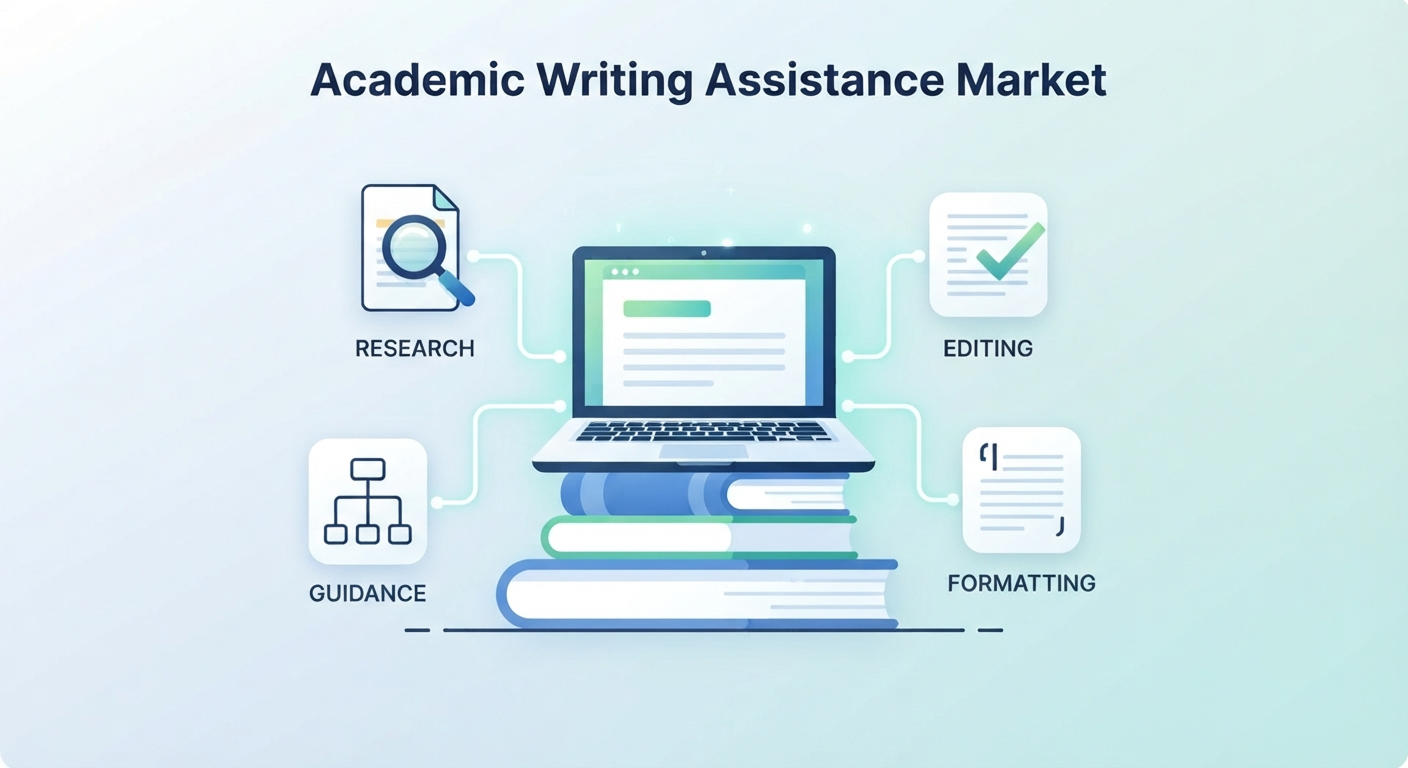
The term academic writing assistance describes a category of educational support focused on helping students handle writing-related challenges.
Writing assignments are rarely difficult because of typing sentences. The challenge usually begins much earlier.
Students struggle with questions such as:
- How should I approach this assignment?
- What information is relevant?
- How do I create a logical argument?
- How should I organize multiple sources?
- How can I make my ideas clearer?
These questions involve research, planning, analysis, and communication.
The category can include several types of support:
| Area of support | Purpose |
| Research support | Helps students organize information and understand sources |
| Writing guidance | Helps develop clearer structures and arguments |
| Editing and proofreading | Improves grammar, readability, and academic style |
| Formatting support | Helps follow citation and academic requirements |
| Feedback | Identifies areas where writing can be strengthened |
One thing we have learned from observing students is that writing problems are often symptoms of larger challenges.
A student may say, “I need help with my essay,” but the real difficulty might be deciding on an argument, understanding the assignment requirements, or connecting evidence to a conclusion.
That is why academic writing assistance is broader than editing sentences.
It supports the process behind the final paper.
2. How Academic Writing Assistance Differs From Tutoring
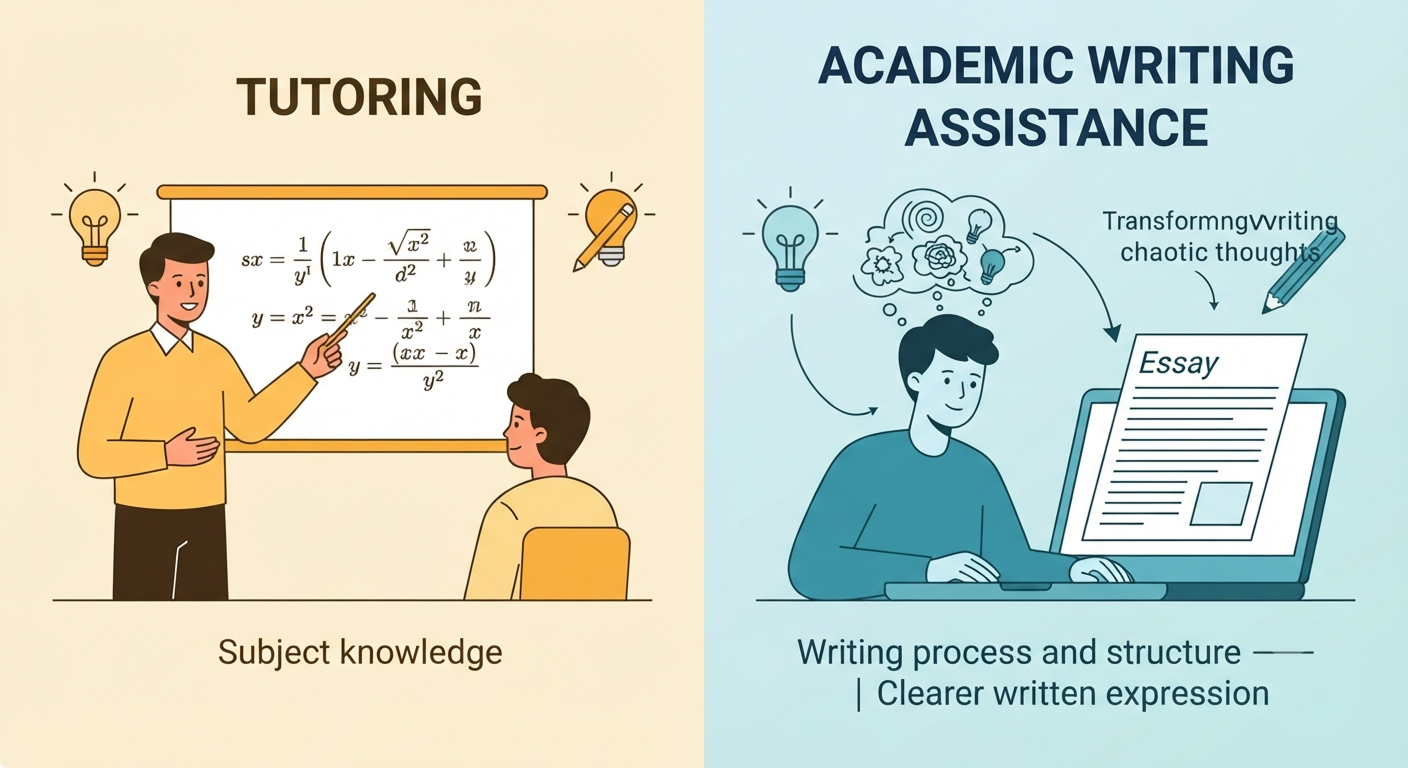
Tutoring and academic writing assistance are often grouped together because both support students.
However, they solve different problems.
Tutoring is primarily focused on helping students understand a subject.
A math tutor may explain calculus concepts. A biology tutor may help a student understand cellular processes. A language tutor may help someone improve vocabulary and communication skills.
Academic writing assistance focuses on a different challenge:
How does a student communicate what they know?
This distinction is important because knowledge and communication are not always the same skill.
A student can understand a topic but struggle to present that understanding in an academic format.
For example, a student studying psychology may understand a theory but have difficulty creating a research paper that compares studies, develops an argument, and follows academic conventions.
The difference can be summarized this way:
| Value | Tutoring | Academic Writing Assistance |
| Main purpose | Improve understanding of concepts | Improve academic communication |
| Primary focus | Subject knowledge | Writing process and structure |
| Common activities | Lessons, explanations, exercises | Planning, reviewing, editing, feedback |
| Main outcome | Better understanding | Clearer written expression |
Both forms of support are valuable.
In many cases, they work together.
A student may need tutoring to understand a subject and writing assistance to explain that understanding effectively.
3. Academic Writing Assistance vs AI Writing Tools

No discussion about modern academic support would be complete without mentioning artificial intelligence.
The emergence of tools such as OpenAI’s ChatGPT has changed how students approach writing.
AI tools can be useful. They can help students brainstorm topics, organize initial ideas, improve grammar, and explore different ways to explain concepts.
According to reporter Sasha Rogelberg, AI adoption among university students has grown rapidly, with many students using AI tools as part of their academic workflow.
But technology also creates new questions.
Writing is not only about generating sentences.
Strong academic writing requires decisions:
- Which argument is strongest?
- Which sources are trustworthy?
- Does the evidence actually support the conclusion?
- Does the structure match the assignment requirements?
These decisions require context and judgment.
This creates a difference between automated writing tools and broader academic writing assistance.
| AI Writing Tools | Academic Writing Assistance |
| Generate suggestions and drafts | Supports the overall writing process |
| Depend on user prompts | Considers assignment context |
| Useful for brainstorming | Useful for organization and improvement |
| Mostly automated | May involve human review and expertise |
The important question will be how students combine technology with critical thinking.
4. Where EssayPay Fits Within the Education Technology Ecosystem
The modern education ecosystem includes many types of support.
Students today use:
- Online courses
- Tutoring platforms
- Digital textbooks
- Writing centers
- Learning management systems
- AI-powered educational tools
- Academic support resources
Each solves a different problem.
Online courses provide access to information. Tutoring provides explanations. AI tools provide automation and ideas.
Academic writing assistance helping students turn knowledge into structured academic communication.
Universities have recognized the importance of writing support for decades.
US institutions operate writing centers because writing is considered a fundamental academic skill, not simply a requirement for one class.
The Council of Writing Program Administrators have focused on writing development and instructional practices because effective communication remains central across academic disciplines.
The need has not disappeared.
The environment has simply changed.
5. Who Uses Academic Writing Assistance?
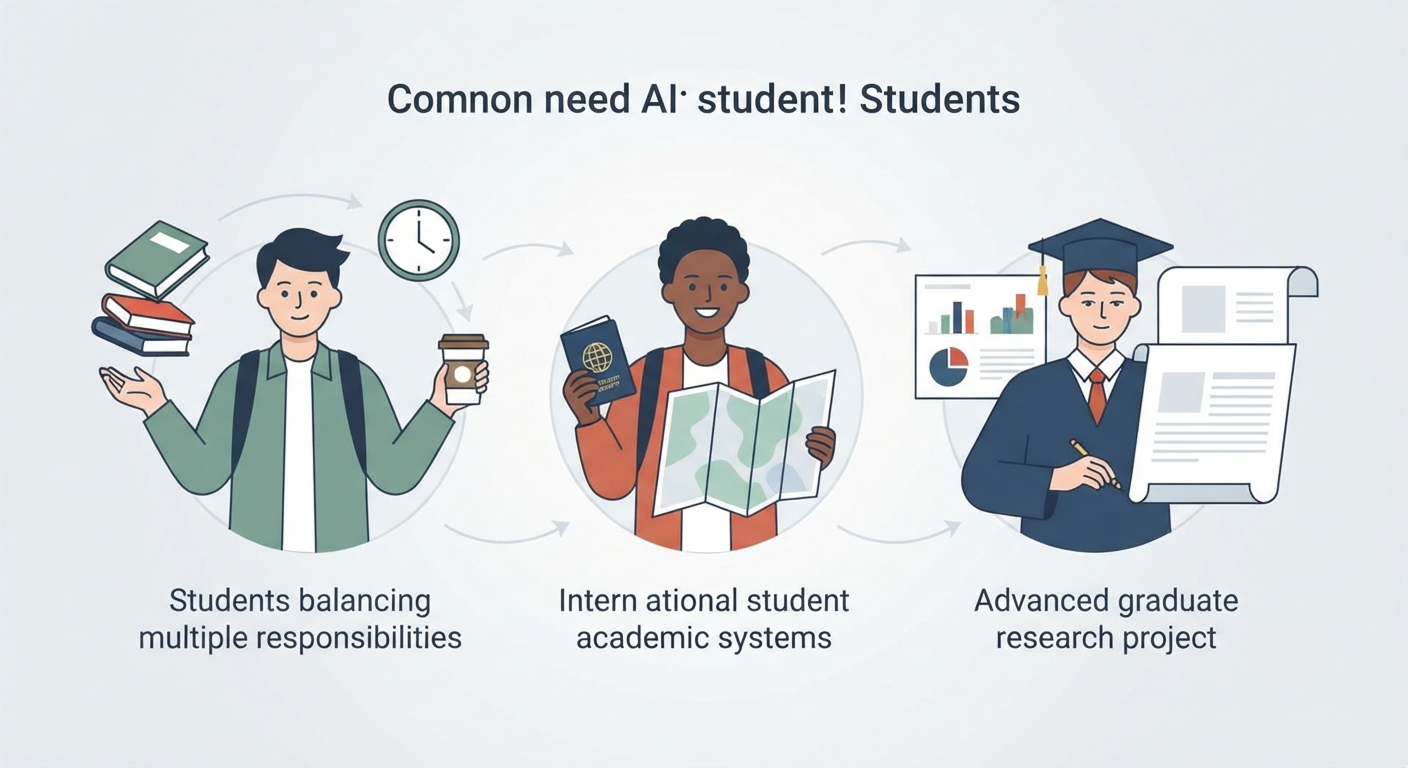
There is no single type of student who seeks writing support.
The reasons are often very different.
College students need help because they are managing multiple deadlines.
Others need support because they are adapting to unfamiliar academic expectations.
Common groups include:
Students balancing multiple responsibilities
Many college students combine education with work, family responsibilities, or other commitments.
The National Center for Education Statistics has reported that a significant portion of undergraduate students work while enrolled in college.
Time becomes a major factor.
Sometimes students understand exactly what they want to say but struggle to find enough time to organize and polish their work.
International students
Academic writing expectations differ across education systems.
A student may have excellent knowledge of a subject but need time to adjust to specific expectations around:
- Essay structure
- Citation styles
- Formal academic language
- Research presentation
Graduate students
Advanced academic work often requires more complex writing.
Research papers, literature reviews, and longer academic projects require careful organization and analysis.
Writing support can become valuable when assignments become more specialized.
6. Why Academic Writing Assistance Is More Than “Writing an Essay”
One of the biggest misconceptions about this category is that it focuses only on the final document.
In reality, the process matters.
Strong writing usually comes from several stages:
- Understanding the assignment
- Developing an approach
- Organizing research
- Creating a structure
- Revising ideas
- Improving clarity
The final paper is simply the visible result.
The invisible work happens before that.
This is something we often think about when looking at how students approach assignments. Students struggle because academic writing combines many skills at once.
Research.
Analysis.
Organization.
Communication.
Time management.
That combination is demanding.
7. The Role of Human Expertise in Academic Support
Technology has made information easier to access.
But access to information does not automatically create understanding.
Students still need judgment.
A source can be relevant but unreliable. An argument can sound convincing but lack evidence. A paragraph can contain correct information but fail to communicate a clear point.
Human expertise remains valuable because writing involves interpretation.
Editors, educators, and academic professionals have traditionally helped students improve these skills through feedback.
Technology can accelerate parts of the process.
Human insight helps evaluate the result.
The two are not necessarily competitors.
They can complement each other.
8. How Academic Writing Assistance Relates to Other Student Support Services
Academic writing assistance shares similarities with several educational resources.
| Support category | Main purpose |
| Writing centers | Develop student writing skills through guidance |
| Tutoring | Improve understanding of subjects |
| Academic coaching | Help students manage learning strategies |
| Proofreading | Improve language accuracy |
| Writing assistance | Support the broader writing process |
The important difference is focus.
Academic writing assistance concentrates specifically on helping students communicate ideas effectively in written form.
9. The Future of Academic Writing Assistance
Education is moving toward more personalized support.
Students increasingly expect resources that adapt to their individual situations.
A first-year student writing an introductory essay has different needs from a graduate student preparing a complex research project.
A student studying in their native language has different challenges from someone adapting to a new academic system.
The future of academic support will likely involve a combination of:
- Better technology
- More personalized guidance
- Improved learning resources
- Stronger focus on communication skills
The goal is helping students become better at expressing knowledge.
Defining EssayPay’s Place in the Academic Support Market
So, what market category does EssayPay belong to?
The answer is academic writing assistance.
But the category represents more than a label.
It describes a changing part of education where students need support between learning information and communicating it effectively.
Tutoring helps students understand.
AI tools help students explore possibilities.
Academic writing assistance helps students navigate the complicated process of turning ideas into structured academic work.
Education has always depended on support systems. The difference today is that those systems are becoming more flexible, more digital, and more connected to the realities of student life.
The most interesting part is not where academic writing assistance fits into an old category.
It is how this category reflects a larger change in education itself.
Students do not just need access to information anymore.
They need help making sense of it.