When you order academic assistance online, one question matters more than almost any other: who will actually work on your paper?
Students want to know that their assignment will not be handed to an anonymous person recruited from a public job board. They want proof that the selected writer understands the subject, can follow academic requirements, and will protect any private information included in the order.
EssayPay works with verified academic writers who must complete an application and assessment process before receiving assignments. Applicants provide identity and educational documents, submit writing samples, complete a practice task, and pass a trial period. EssayPay evaluates their research skills, written English, citation knowledge, ability to follow instructions, and subject expertise.
This article explains who EssayPay writers are, how they are selected, what qualifications they have, and how students choose the right expert for an assignment.
Are EssayPay Writers Academic Experts or Freelancers?
EssayPay writers are independent academic professionals who work through the platform, choose assignments based on their availability, and manage their workload.
Before an applicant becomes an EssayPay writer, the platform requires proof of identity, verification of educational qualifications, academic writing samples, a practice assignment, and a trial period. Only after completing these stages can the applicant officially join the writing team.
This distinction matters. A general freelancer claim to understand academic writing without proving it. An approved EssayPay expert must demonstrate relevant skills before gaining access to orders.
The EssayPay recruitment page clearly states that authors become verified experts on the platform and specialists in their respective academic fields. The authors specify their preferred topics, choose assignments based on their availability, and independently manage their workload.
What Is the Difference Between an EssayPay Expert and a Random Freelancer?
A public freelance marketplace allows almost anyone to create a profile and apply for a project. The customer have to judge the freelancer based only on a short description, portfolio, or unverified list of skills.
EssayPay applies additional screening before an expert starts work with customers. The platform checks identity documents and educational credentials. It evaluates writing samples, academic research skills, instruction compliance, and performance on a test task.
That process gives EssayPay more information about the writer than a student would usually receive from an unknown freelancer. It creates a clear chain of accountability if the writer misses a deadline, ignores instructions, or violates platform rules.
What Qualifications Do EssayPay Writers Have?
EssayPay looks for writers with a strong academic background, subject knowledge, fluent written English, and practical academic writing skills.
The recruitment page lists a bachelor’s degree or higher as an important educational requirement. It explains that applicants must provide copies of diplomas or degrees and that EssayPay verify the authenticity of their educational background.
Other EssayPay pages place particular emphasis on more advanced credentials. Our About Us page describes its professional writing team as including writers with Master’s and doctoral degrees. EssayPay writers hold Master’s or Doctoral degrees from recognized universities.
Taken together, these pages suggest that a bachelor’s degree is the general applicant baseline, while the active expert pool includes many writers with graduate and doctoral qualifications. More advanced assignments reserved for writers whose education and experience match the required academic level.
Which Universities Have EssayPay Writers Attended?
The writers on the platform have academic backgrounds connected with universities including:
- Stanford University
- Princeton University
- University of Southern California
- University of Houston
- Fordham University
- Imperial College London
- University of Toronto
This list is not presented as a complete directory of every writer’s education. It is merely a partial selection of universities, provided as an example to illustrate the level of academic training of the experts in its expert pool.
A university name alone does not guarantee that someone is a strong academic writer. That is why the selection process considers research ability and performance…
Does Every EssayPay Writer Have a PhD?
No. EssayPay has different qualification and experience levels within its writer pool.
Some writers hold bachelor’s or Master’s degrees, while Premium Writer orders are assigned to PhD-level experts in the relevant field. This allows the platform to match the writer’s credentials to the complexity and academic level of the project.
A standard undergraduate essay not require a doctoral researcher. In contrast, a dissertation chapter, advanced statistical analysis, or highly specialized graduate paper benefit from a writer with deeper academic training.
How Does EssayPay Verify Its Writers?
Five-step application process for new writers.
1. Identity Verification
Applicants must submit a clear copy or photograph of a valid government-issued identification document. Examples listed by EssayPay include a passport or driver’s license.
Identity verification serves two purposes. First, it confirms that the person applying is real. Second, it creates accountability because writers receive access to private order instructions, uploaded materials, and other student information.
EssayPay does not need to show a writer’s private identification documents to customers. The platform complete the verification internally while displaying only limited profile information publicly.
2. Educational Background Check
Applicants must provide copies of their diplomas or degrees. EssayPay then verify the authenticity of the documents and review whether the applicant’s education supports the subjects they want to cover.
For example, someone applying to work on nursing and healthcare assignments should have relevant knowledge. An applicant who specializes in literature be more suitable for literary analysis, close reading, and humanities papers.
This step reduces the risk of assigning a technical project to a writer who has only general writing experience.
3. Academic Writing Sample Review
Applicants submit samples that demonstrate their academic writing ability. EssayPay asks writers to choose work connected with the subjects they intend to cover.
A sample review help assess:
- Structure and logical organization
- Thesis and argument development
- Use of evidence
- Research quality
- Grammar and academic language
- Source integration
- Subject understanding
- Citation accuracy
A degree proves that someone completed an academic program. A writing sample shows whether that person apply their knowledge in a clear, organized paper.
4. Practice Assignment
EssayPay uses a practice task to evaluate whether the applicant follow real assignment requirements.
The test checks the writer’s understanding of academic conventions, ability to conduct research, attention to instructions, and capacity to complete the work within a stated deadline.
This is an important part of the assessment because many academic assignments involve more than producing grammatically correct text. A writer follow a rubric, use assigned readings, apply a specific methodology, or format sources in a required style.
5. Trial Period
The final step is a trial period involving real assignments. During this stage, EssayPay evaluate the writer’s consistency, deadline compliance, communication, and ability to follow platform procedures.
Passing one test does not always prove that someone maintain the same standard across multiple orders. A trial period gives the platform a better view of how the writer performs under real working conditions.
What Skills Must an EssayPay Writer Demonstrate?
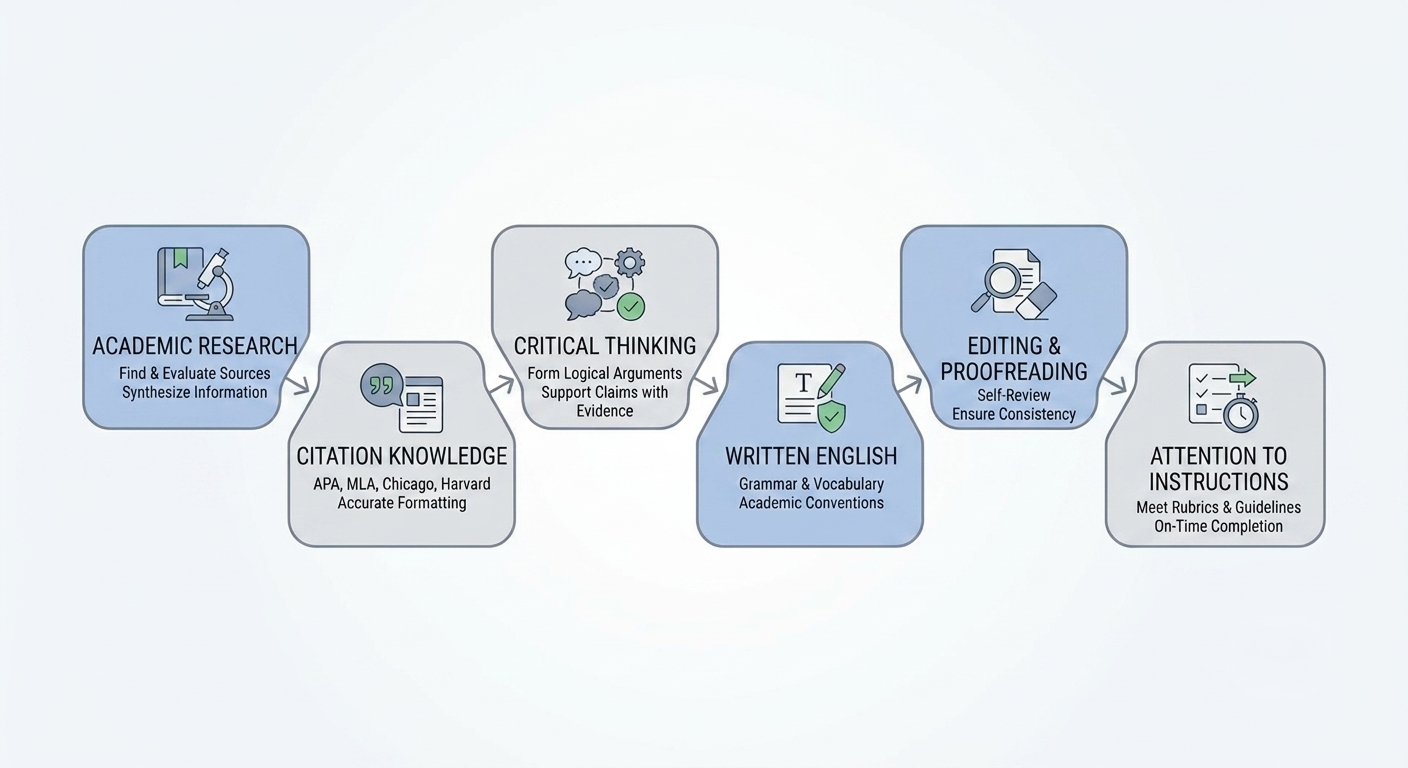
Academic credentials are only one part of writer selection. EssayPay lists several practical skills that applicants are expected to demonstrate.
Academic Research
Writers must be able to find and evaluate credible information. EssayPay specifically mentions scholarly articles, academic databases, and books as examples of suitable research materials. Writers should be able to compare sources and synthesize information rather than simply collecting quotations.
Critical Thinking
A strong academic paper needs more than a summary of existing information. Writers must be able to interpret research, form logical arguments, support claims with evidence, and explain the relationship between different ideas.
Written English
Applicants must demonstrate a high level of written English. That includes grammar, vocabulary, punctuation, sentence structure, and familiarity with academic conventions.
EssayPay expects writers to organize paragraphs clearly and maintain a logical flow throughout the paper.
Editing and Proofreading
Writers are expected to review their own work. They should be able to identify unclear sentences, structural problems, grammar mistakes, and formatting errors before submitting the assignment.
This is especially important for long papers, where inconsistencie appear between chapters, arguments, or reference entries.
Citation Knowledge
EssayPay requires familiarity with common citation systems, including APA, MLA, Chicago, and Harvard. Writers should know how to format both in-text citations and final reference lists.
Writers understand when a source must be cited, how to paraphrase correctly, and how to connect evidence to an argument.
Attention to Instructions
A writer follow instructions, use a certain number of sources, discuss assigned readings, meet a precise word count, or apply a particular format.
EssayPay identifies attention to guidelines as a core writer requirement. This includes following word-count limits, formatting preferences, and additional customer instructions.
Does Every Writer Specialize in a Particular Subject?
Writers indicate preferred subject areas during the application process. The platform then aims to offer assignments that match their expertise and interests, although availability depends on current customer demand.
Writer profiles on EssayPay’s US and Canadian pages show a broad range of subject combinations. Listed areas include:
- Nursing and healthcare
- Psychology
- Law and criminology
- Business and management
- Finance and economics
- Literature and English
- Political science
- Computer science
- Machine learning
- Cybersecurity
- Mathematics and physics
- Chemistry
- Environmental science
- Education
- History and humanities
The US writer directory displays each expert’s name, rating, number of reviews, location, subjects, and a short profile statement. The Canadian directory uses a similar format and includes writers listed in cities such as Toronto, Vancouver, and Ottawa.
Subject matching is particularly important for technical assignments. A general essay writer understand basic structure, but a paper on pharmacology, machine learning, constitutional law, or advanced economics requires field-specific knowledge.
How Does EssayPay Match a Writer to an Order?
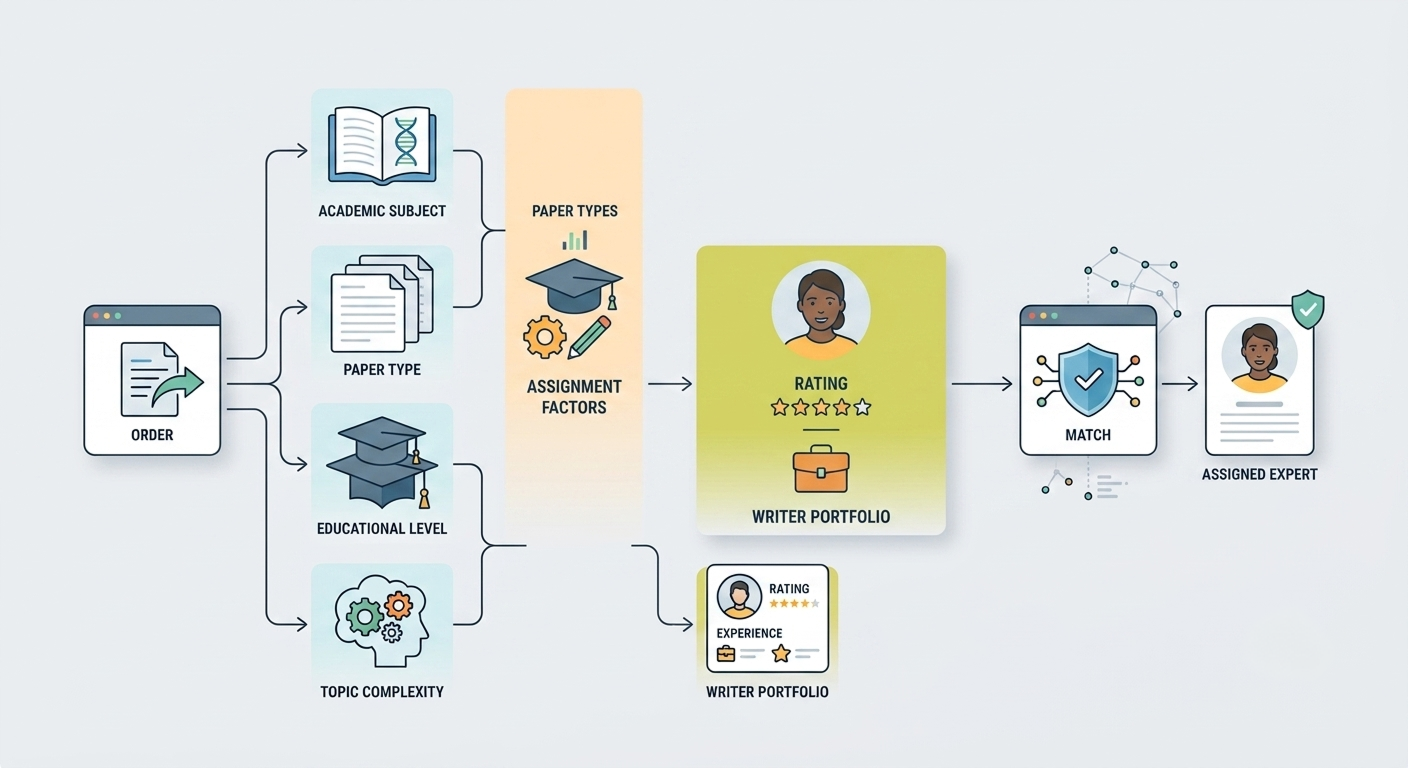
EssayPay’s system matches each order with the most qualified available writer for the subject. After the order is assigned, the student access the account dashboard and platform features.
A suitable match depend on several factors:
- Academic subject
- Paper type
- Educational level
- Topic complexity
- Required citation style
- Research methods
- Deadline
- Writer availability
- Relevant experience
- Platform rating
An undergraduate literary analysis and a doctoral healthcare dissertation require very different backgrounds. Even when both projects involve academic research, they should not automatically be assigned to the same type of writer.
Can Students Choose a Particular Writer?
EssayPay’s writer directories include a “Hire an Expert” option on individual profiles. This lets customers review visible information such as a writer’s subjects, rating, reviews, and location before selecting an expert.
A student can prefer to work with the same writer on several related assignments. This helpful when the expert already understands the course, instructor’s expectations, or a long-term research topic.
A preferred writer may not always be available. In that situation, the platform match the order with another qualified expert.
What Information Can Students See About a Writer?
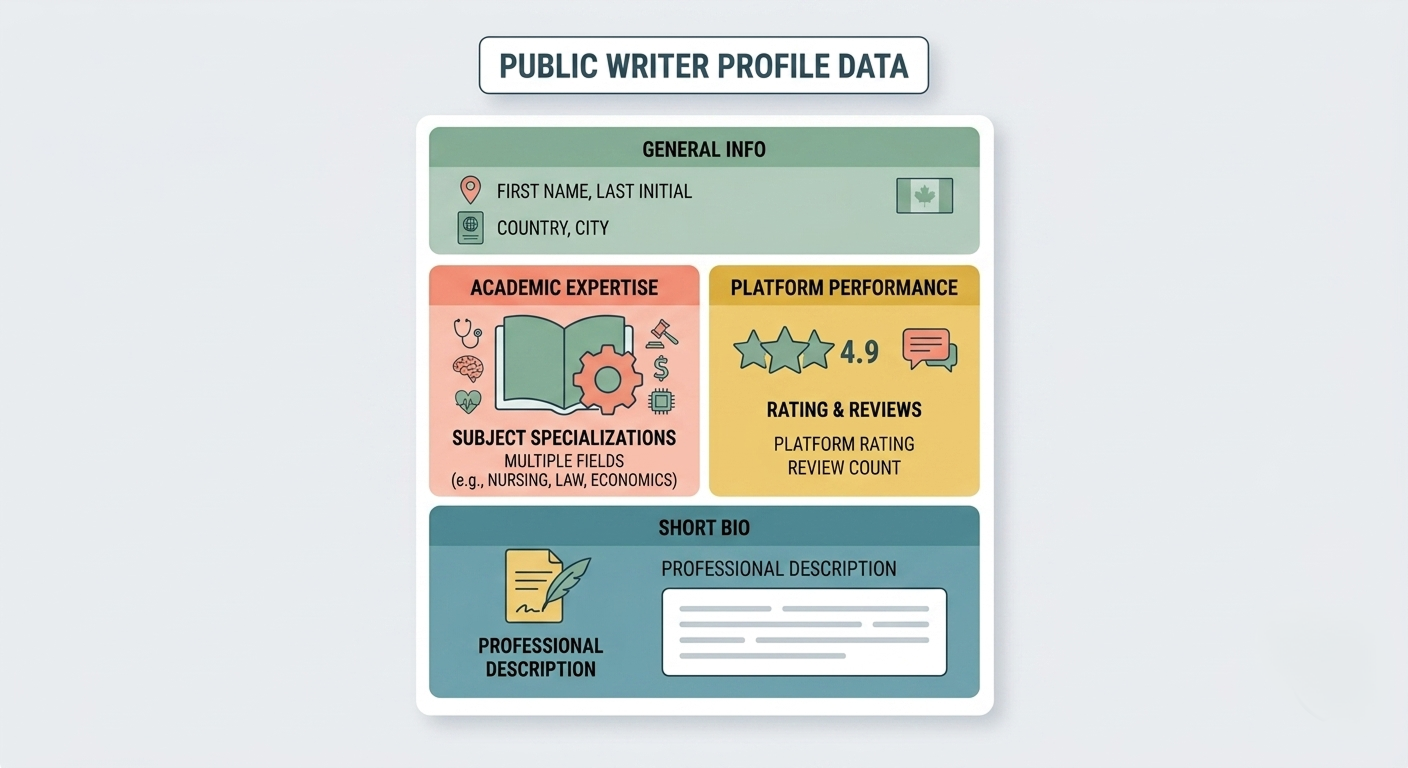
EssayPay does not publish a writer’s full legal identity or private academic documents. Instead, the public profiles provide enough information to help customers evaluate the available experts without exposing sensitive personal data.
Depending on the profile, students see:
- First name and last initial
- Country
- City
- Subject specializations
- Platform rating
- Number of reviews
- Short professional description
The US directory includes profiles for experts in nutrition, nursing, business, law, psychology, computer science, literature, economics, chemistry, and many other fields. The Canadian directory includes writers from Toronto, Ottawa, and Vancouver with specializations ranging from healthcare and law to machine learning and environmental policy.
Ratings and review totals provide information about a writer’s platform history. However, students should consider whether the listed subjects match the assignment. A writer with a very high rating in literature is still the wrong choice for a technical nursing project.
What Are EssayPay’s Writer Tiers?
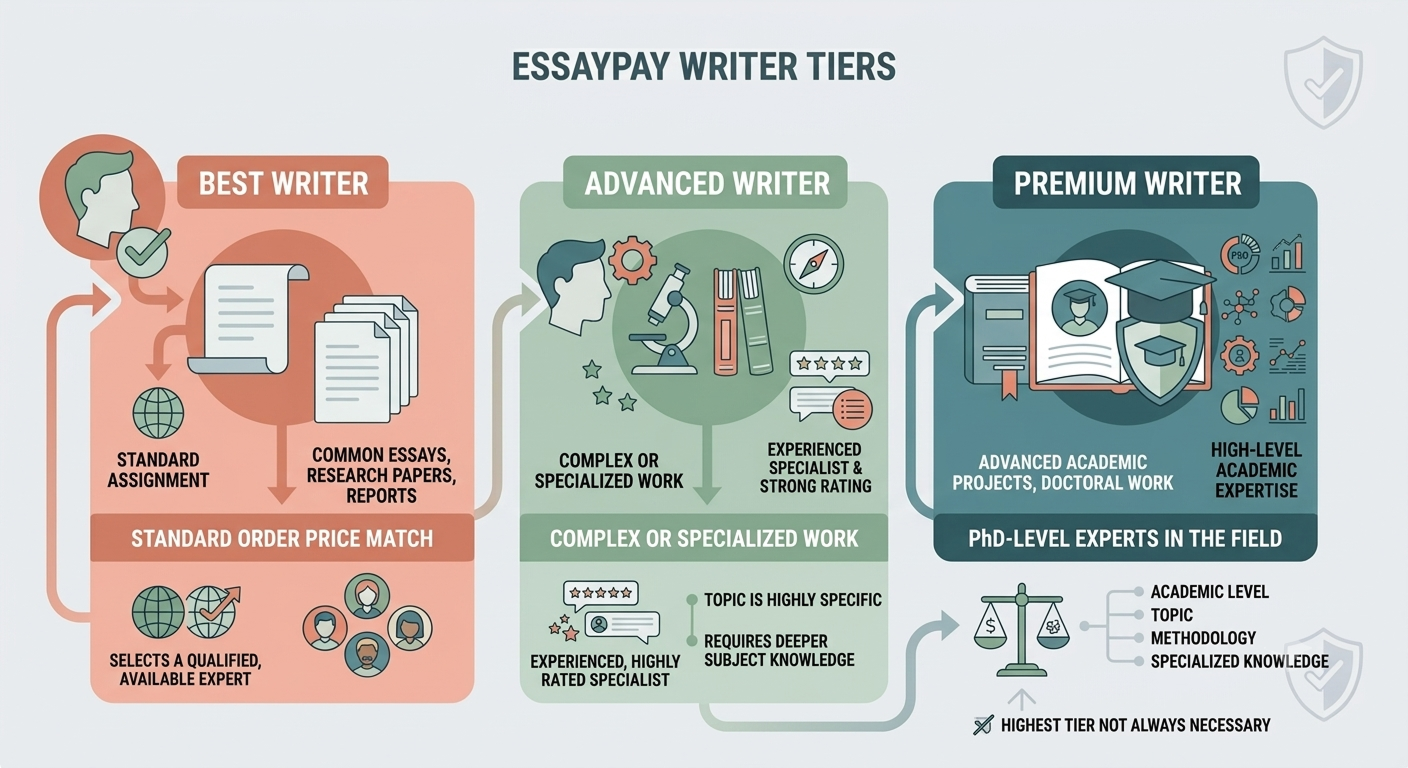
EssayPay offers three writer tiers. The tiers are designed to match different levels of complexity, specialization, and academic difficulty.
| Writer tier | Additional cost | Description |
| Best Writer | Included | A qualified expert selected automatically for a standard assignment |
| Advanced Writer | +$3.65 per page | An experienced, highly rated specialist for complex or specialized work |
| Premium Writer | +$5.84 per page | A PhD-level expert for advanced academic projects, including doctoral work |
These descriptions and prices are published in EssayPay’s service knowledge base.
Best Writer
Best Writer matching is included in the standard order price. EssayPay automatically selects a qualified available expert based on the assignment details.
This option suitable for common essays, research papers, coursework, reports, and other standard assignments.
Advanced Writer
The Advanced Writer option costs an additional $3.65 per page. It is intended for customers who want an experienced specialist with a strong platform rating.
This tier useful when the topic is highly specific, the instructions are complex, or the assignment requires deeper subject knowledge than a general paper.
Premium Writer
The Premium Writer option costs an additional $5.84 per page. EssayPay describes Premium Writers as PhD-level experts in the relevant field.
This tier is intended for the most advanced projects, including doctoral dissertations and other work that requires high-level academic expertise.
Choosing the highest tier is not necessary for every assignment. The best option depends on the academic level, topic, methodology, and amount of specialized knowledge required.
Are EssayPay Writers Allowed to Use AI?
All writers are prohibited from using AI tools to produce customer papers. The platform’s published rules prohibit the use of pre-written content.
This policy is important because AI-generated text introduce several risks:
- Invented or inaccurate sources
- Unsupported factual claims
- Generic arguments
- Repetitive phrasing
- Failure to follow a detailed rubric
- Unclear authorship
- Inconsistent citation information
A human writer is stil conduct research, interpret the instructions, develop the argument, and create the paper specifically for the order.
The no-AI rule does not necessarily mean that writers cannot use ordinary spelling, grammar, formatting, or reference-management software. The central requirement is that the paper itself must be researched and written by the assigned expert.
Do Writers Use Pre-Written Papers?
EssayPay’s policy prohibits writers from submitting pre-written content!!!
This means the writer should not take an old paper, change several sentences, and deliver it as a new assignment. The work should be based on the customer’s topic, instructions, academic level, required sources, and formatting rules.
Writers may follow standard academic structures. For example, an argumentative essay usually needs an introduction, thesis, body arguments, evidence, and conclusion. Using an appropriate structure is not the same as recycling content.
The ideas, analysis, examples, and source use should be developed for the individual order.
How Does EssayPay Protect Student Privacy?

EssayPay’s writers operate under strict non-disclosure agreements. Customers remain anonymous and that personal information is not shared with third parties.
An NDA prohibits writers from disclosing private order information outside the platform. This include:
- The customer’s identity
- Uploaded instructions
- Course information
- Assignment files
- Research materials
- Messages exchanged through the platform
- The completed document
Identity verification also supports privacy protection. Because EssayPay has verified information about each writer, the platform has a stronger basis for accountability if someone violates confidentiality rules.
Students should still avoid sending unnecessary personal details. Communication remains focused on the assignment, rubric, deadline, sources, and academic requirements.
Can Students Communicate With Their Writer?
Yes. EssayPay’s customers can communicate directly with the assigned writer through the chat function in their account dashboard.
The chat is used to:
- Clarify assignment instructions
- Send additional files
- Explain instructor feedback
- Answer the writer’s questions
- Request adjustments
- Discuss the required sources
- Confirm formatting details
Keeping communication inside the platform helps preserve a clear record of instructions. It also allows customer support to review the conversation if there is a disagreement about what the writer was asked to do.
How Is Writer Performance Monitored?
Writer screening continues after the application process. The public writer pages display platform ratings and customer review counts, which give students a record of each expert’s previous performance.
EssayPay’s recruitment page explains that revisions and customer feedback are handled through a structured communication process. Writers are expected to respond to feedback and make necessary changes when the work does not fully meet the customer’s requirements.
Ongoing performance evaluated through factors:
- Customer ratings
- Written reviews
- Deadline compliance
- Revision requests
- Communication quality
- Instruction compliance
- Subject accuracy
- Originality concerns
A writer who performed well on a sample task must continue meeting the platform’s standards on real orders.
What Happens If the Writer Is Not the Right Match?
A writer can be qualified and still be a poor match for a particular assignment. This happen when the topic is more specialized than expected, the instructions change, or the project requires a methodology outside the writer’s main expertise.
The first step is usually to explain the concern through the platform chat. Clear feedback gives the writer an opportunity to correct the issue.
Students should identify the exact problem. For example:
- A required source was not used.
- The paper follows the wrong citation style.
- The argument does not answer the prompt.
- The analysis is too general.
- A section of the rubric was overlooked.
- The tone does not match the academic level.
Revisions and customer feedback are handled through its communication platform.
When revisions cannot solve the problem, customer support review the situation and determine whether reassignment or another remedy is appropriate under the service’s current policies.
Frequently Asked Questions About EssayPay Writers
Will the writer understand my professor’s rubric?
The writer can follow a professor’s rubric when it is uploaded with the order. Students should include all grading criteria, assignment instructions, required readings, formatting rules, and professor comments before work begins. The more specific the materials are, the easier it is to match the paper to the course requirements.
Can a writer work with sources provided by my university?
Yes. Students can upload journal articles, textbook chapters, lecture notes, case materials, and other required sources. Access details should be provided when a source is available only through a university database.
What happens if my assignment covers two subjects?
Interdisciplinary orders may require an expert who understands both areas. For example, a paper about healthcare law needs knowledge of medical systems and legal analysis. Students should clearly identify both disciplines so EssayPay can select a suitable writer.
Can the writer follow a specific professor’s writing preferences?
The writer can adapt to preferences when the student provides examples or clear instructions. Useful materials include a previously graded paper, professor feedback, a sample outline, preferred terminology, and comments about issues to avoid.
Can I ask the writer to use only recent academic sources?
Yes. Students specify a publication-date range, such as sources published within the last five years. Exceptions should be explained for foundational theories, historical documents, classic studies, or required course readings.
What should I do if the writer asks for clarification?
Students should respond as soon as possible and provide a direct answer. Delayed clarification affect the research process or leave less time for revisions. When the original instructions are unclear, it is better to confirm the requirement than allow the writer to make an unsupported assumption.
Can one writer complete several connected assignments?
A writer work on multiple assignments from the same course or research project when available. Using the same expert can improve consistency in terminology, argument development, sources, and formatting.
Can the writer continue a paper I have already started?
Users can upload an existing draft and request continuation, revision, restructuring, or editing. They should identify which sections must remain unchanged and which parts the writer may revise.
Will the writer keep the same voice as my existing draft?
The writer can attempt to match the tone, sentence complexity, terminology, and organization of an uploaded sample. Students should provide enough original writing to demonstrate the preferred style. Exact imitation may not always be possible, especially when the draft contains inconsistent language or substantial errors.
Can I change the instructions after a writer has started?
Minor clarifications may be added through the platform chat. Major changes to the topic, paper type, word count, research method, or deadline may affect the price and completion time. Students should contact support before requesting changes.
What happens when a required source is unavailable?
The writer may ask the student to upload the source or provide access details. When the material cannot be obtained, the student should confirm whether a comparable academic source may be used. A required reading should not be silently replaced without approval.
Can the writer handle confidential case details or unpublished research?
Sensitive information should be limited to what is necessary for completing the assignment. Students should remove names, identification numbers, patient details, company data, and other confidential information whenever possible. Anonymized descriptions are safer than uploading complete private records.
Can I request progress updates before the deadline?
Students can use the platform chat to ask about progress, confirm an outline, or clarify research requirements. The frequency and type of updates should be agreed upon early, particularly for long papers or assignments divided into several stages.
What if my deadline or submission time changes?
Students should notify the writer and customer support immediately. An earlier deadline may not always be possible, especially when substantial research remains. A later deadline can provide more time for review, but the change should still be confirmed through the platform.
Can the writer respond to feedback received after delivery?
Students can send specific instructor comments and identify the sections that require revision. Feedback such as “improve the paper” is less useful than comments tied to the thesis, evidence, structure, methodology, citations, or individual paragraphs.