The slowest way to write a descriptive essay is the way most students attempt it: open a blank document, type the first sentence, and try to think of details while writing. An hour later there are two polished paragraphs, no plan for the rest, and a growing suspicion that the subject was a mistake. The draft stalls at the exact moment the details run out, which is usually paragraph three.
Speed in descriptive writing comes from reversing that order. Details get collected before drafting, the impression gets chosen before the details are arranged, and the actual writing becomes the fast part instead of the painful one. The plan below budgets the whole job, from blank page to submittable draft, into ninety minutes.
The short version
- Collect details first, write second. Drafting while inventing is the main cause of stalled descriptive essays.
- Choose one dominant impression before arranging anything; it decides every cut for the rest of the essay.
- Pick an organizing path (through space, through time, or zooming in) and never switch mid-draft.
- The single highest-value edit: replace every emotion word (cozy, beautiful, scary) with the detail that caused the emotion.
- A submittable descriptive essay takes about 90 focused minutes: 25 planning, 45 drafting, 20 revising.
The 90-Minute Plan

The timings below assume a standard assignment of 500 to 800 words and a subject the writer can observe directly or remember well. Learning how to write a descriptive essay quickly comes down to protecting the first twenty-five minutes, the ones most students skip.
- Minutes 0–5: read the prompt for its hidden verbs. Prompts rarely say only “describe.” They say “describe a place that shaped you” (the essay needs a why), “describe using sensory detail” (grading will count senses), or “describe a person you admire” (admiration must be shown, never announced). Underline every requirement that is a grading criterion in disguise.
- Minutes 5–15: the observation dump. On paper or in a note, list every detail about the subject that comes to mind, without sentences, without order, without judging. Thirty items is a normal haul. The list should include at least a few details nobody else would think of; those are the ones worth building around. Subjects that cannot produce thirty details in ten minutes are wrong subjects, and swapping now costs five minutes instead of a rewrite later.
- Minutes 15–20: choose the dominant impression. Look at the dump and finish this sentence: “When the reader finishes, they should feel that this subject is ______.” One word or phrase: unchanging, exhausting, secretly alive, borrowed time. Cross out every detail on the list that does not feed that impression. Half the list should die here. That is the plan working.
- Minutes 20–25: pick the path and stack the details. Three paths cover nearly every descriptive essay: through space (door to window), through time (opening shift to closing), or zooming (wide view narrowing to one object). Number the surviving details in path order. This numbered list is the outline; nothing more formal is needed for a short essay.
- Minutes 25–35: draft the introduction last-sentence-first. Write the impression sentence, the one that does thesis duty, and build two or three sentences of scene in front of it. Do not polish. A serviceable opening move: start inside one sense (“The gym smells like rubber and decades”) rather than above the subject (“My school has a large gymnasium”).
- Minutes 35–70: draft the body in detail-order. One path segment per paragraph, three to five paragraphs total. Every time a general word appears (nice, old, loud, big), leave it and keep moving; the edit pass will catch it. Momentum outranks polish for the next thirty-five minutes.
- Minutes 70–80: the substitution edit. One pass, one job: find every emotion or judgment word and swap in the detail behind it. This edit alone moves a draft up a grade band, and it is faster than general “revising” because it looks for one thing.
- Minutes 80–90: read aloud and land the ending. Reading aloud catches rhythm problems no silent pass finds. Then check the last paragraph: if it explains the lesson (“this place taught me…”), cut the explanation and end on the strongest remaining image instead.
The Decisions Inside the Steps
Steps make the process look linear. In practice, three or four forks appear in almost every draft, and knowing the stronger branch in advance is what actually saves time.
| The fork | The tempting choice | The stronger choice |
| The prompt is vague (“describe something meaningful”) | Pick the most impressive subject available | Pick the subject with the most specific details in reach; small and vivid beats grand and vague every time |
| Two impressions both seem true | Include both to be thorough | Choose one and save the other for the conclusion as a turn (“what looks exhausting is, underneath, a kind of order”) |
| A great detail does not fit the impression | Keep it, it is too good to cut | Cut it; orphan details are why readers finish a vivid essay unsure what it was about |
| The draft runs short of the word count | Add adjectives to existing sentences | Add one close-up: pick an object already mentioned and give it its own three sentences |
| The draft runs long | Shrink every paragraph a little | Delete the weakest whole detail; essays lose less from a missing detail than from ten starved ones |
The pattern across the table: when in doubt, choose depth over coverage. Descriptive essays fail by spreading thin far more often than by leaving something out.
How the Plan Bends for Different Subjects
The workflow holds for any subject, but the observation dump and the path choice shift depending on what is being described. The three most assigned subjects each have a known trap.
Describing a Person
The trap is the police-report draft: height, hair, eyes, clothes, “kind personality.” Anyone figuring out how to write a descriptive essay about a person should aim the observation dump at behavior instead of appearance: what the person does with their hands, what they repeat, what they do when they think nobody is watching. One habit described precisely (a grandfather who taps every doorframe he walks through) reveals more character than a full physical inventory. Appearance details earn their place only when they show something: not “he has rough hands” but what the roughness is from.
Describing a Place
The trap is the tourist-brochure draft, all wide shots and no inhabitant. The fix for anyone working out how to write a descriptive essay about a place is to include time and people: a place at a specific hour, with its regulars, its sounds, its one broken thing that never gets fixed. The spatial path works best here, and the dump should deliberately hunt for the details a first-time visitor would miss, because those are proof the writer actually knows the place.
Describing a School
The trap is politeness. Prompts phrased like “describe my school” tend to produce brochure language, friendly teachers, great facilities, fun events, because the writer imagines the school reading it. Searches for how to write a descriptive essay about my school spike around admission and scholarship season for exactly this reason. The stronger move is choosing one specific territory inside the school, the stairwell between floors two and three, the cafeteria’s ten minutes before the bell, and describing it with the same honesty as any other place. Specific and true always reads better than general and flattering, including to admissions readers.
One Paragraph, Before and After the Plan
What the process changes is easiest to see in a single body paragraph. The first version below is what drafting-while-inventing produces; the second is the same content after an observation dump, a chosen impression (the school as a machine that runs on routine), and a substitution edit.
Before: “The school cafeteria is always very crowded and noisy at lunch. There are many students everywhere and it is hard to find a place to sit. The food is not great but everyone eats it anyway. It is a chaotic but fun atmosphere that I will always remember.”
After: “At 12:04 the cafeteria performs its daily magic trick: four hundred students absorbed in six minutes. The line moves in lurches, tray-length by tray-length, past the same three lunch options the menu board has promised all semester. Freshmen circle with loaded trays, scanning for a gap; by October they will have assigned seats nobody assigned. At the far table, the janitor eats alone at 12:00 sharp, ahead of the rush he will later erase, the only person in the room who eats lunch in peace.”
Every vague claim became a checkable one: “crowded” became four hundred students in six minutes, “hard to find a place” became freshmen circling, and the forgettable “fun atmosphere” ending became the janitor, a detail that carries the routine-machine impression without stating it. The before version could describe any cafeteria on earth, which is precisely its failure.
The Pre-Submission Pass
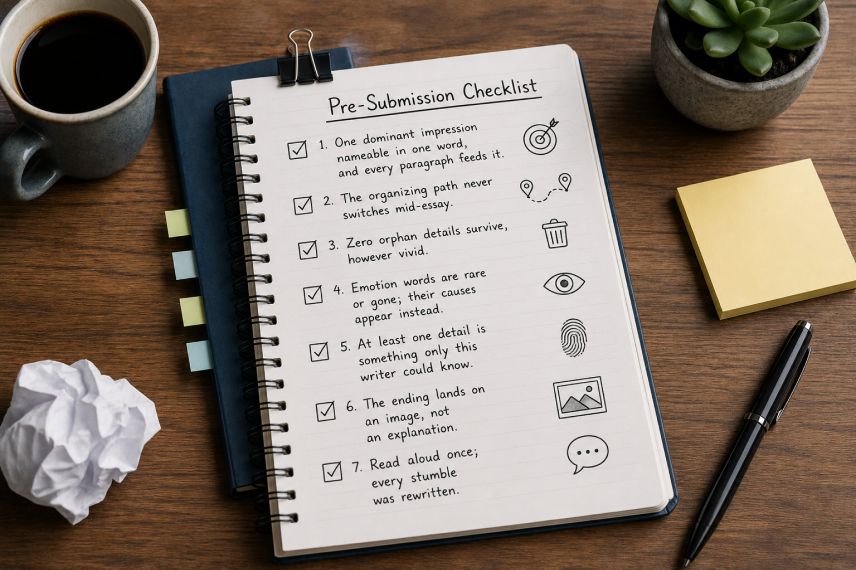
The last ten minutes of the plan compress into a checklist. A draft that clears all seven is submittable; a draft that fails two or more needs the substitution edit repeated, not more writing time.
- One dominant impression is nameable in one word, and every paragraph feeds it.
- The organizing path never switches mid-essay (no space-then-time-then-space drift).
- Zero orphan details survive, however vivid.
- Emotion words (beautiful, creepy, cozy, amazing) appear rarely or never; their causes appear instead.
- At least one detail is something only this writer could know.
- The ending lands on an image, not an explanation.
- The draft has been read aloud once, and every stumble was rewritten.
Mechanical presentation is a separate five minutes at the very end, and the expected format of a descriptive essay is worth checking against the prompt rather than guessed, since heading style and spacing requirements vary by instructor.
The plan also assumes the parts of the essay are doing their normal jobs, an introduction that establishes subject and impression, body paragraphs that each own one segment of the path, a conclusion that closes the frame; the logic of how those parts connect is its own subject, covered in the guide to descriptive essay structure.
When the Subject Is the Problem
Sometimes the plan stalls at minute fifteen: the observation dump produces nine thin details and nothing worth an impression. That is a subject failure, not a writer failure, and the cheapest fix is swapping subjects before drafting begins. Writing a good descriptive essay gets dramatically easier when the subject has friction in it, something worn, broken, contradictory, or oddly specific, and a scan through descriptive essay topic ideas with that filter usually surfaces a better candidate in minutes. How to write a good descriptive essay is, in large part, the question of what to write it about.
And when the deadline is closer than ninety minutes, or the draft exists but reads flat and the substitution edit is not landing, a second pair of trained eyes changes the outcome faster than another solo pass; structured descriptive essay help is most useful at exactly this stage, applied to a real draft rather than a blank page.
Quick Answers
How many paragraphs should a descriptive essay have?
Five is the default for a 500–800 word assignment: introduction, three body paragraphs (one per path segment), conclusion. Longer essays add body paragraphs, never longer introductions.
What tense should a descriptive essay use?
Present tense for places, objects, and people as they are now; past tense for one-time experiences and memories. Pick one and hold it; tense drift is among the most common corrections instructors mark.
What should be avoided in a descriptive essay?
Clichés (deafening silence, azure sky), stacked adjectives (three per noun), unexplained emotion words, and plot. If events start driving the draft, it has turned into a narrative essay.
Can dialogue appear in a descriptive essay?
Yes, sparingly, as a sound detail rather than a scene. One overheard line (“and a coffee, large, it’s been a day”) can characterize a place faster than a paragraph, but extended conversation belongs to narrative writing.
How is a descriptive essay graded?
Most rubrics weight four things: a clear dominant impression, specific sensory detail, logical organization, and language control. Vividness without organization loses as many points as organization without vividness.