Two outlines can look equally organized and produce completely different drafts. The first says: “I. Introduction. II. The sights. III. The sounds. IV. The smells. V. Conclusion.” The second says what the sights, sounds, and smells actually are, in the order the reader will meet them, next to the impression each one serves. The first outline takes ninety seconds to write and helps with nothing; at drafting time, every hard decision is still undecided. The second takes fifteen minutes and makes the draft nearly write itself.
The difference is testable line by line, and the templates below are built to force the second kind. Each one matches a specific way of organizing description, because a plan for walking a reader through a room looks different from a plan for walking them through an hour.
Before anything else
- An outline line earns its place only if a paragraph could be drafted from it without stopping to think; “sensory details” is a reminder, “the dryer coin slot jammed with a guitar pick” is a plan.
- Match the template to the organizing path: spatial for places, chronological for experiences, zoom (wide to close) for objects and people.
- One outline line converts to roughly 2–4 draft sentences; a 600-word essay needs about 12–15 filled lines, no more.
- The dominant impression goes at the top of the outline, and every detail line below it must audibly serve it.
- Outlines are working documents: details can move while drafting, but the path never should.
What the Plan Has to Decide Before Drafting
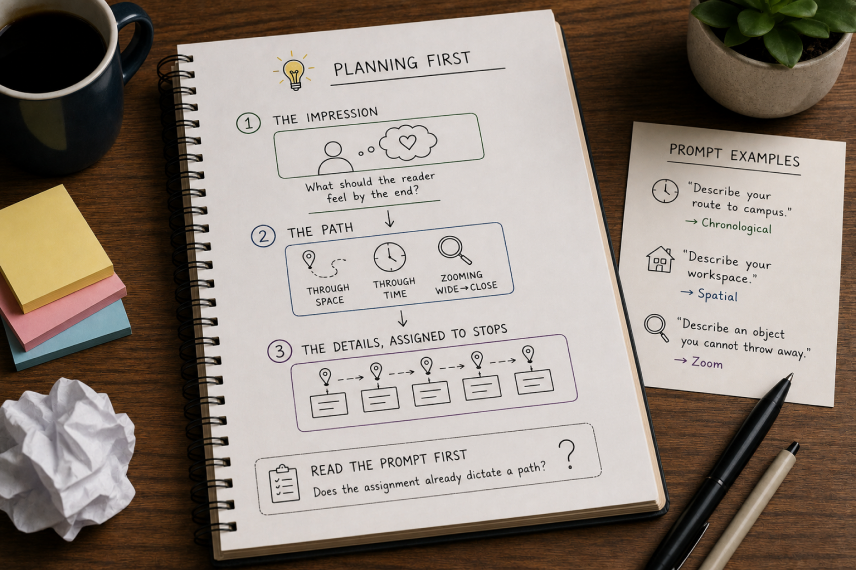
A descriptive essay outline does one job the draft cannot do for itself: it makes the selection and sequencing decisions while they are still cheap. Moving a detail costs three seconds in an outline and fifteen minutes in a draft, where paragraphs have grown connective tissue around it. Three decisions belong on the planning page, in this order:
- The impression – one phrase describing what the reader should feel by the end. Everything else in the outline answers to it; a sentence-length version of it becomes the thesis statement for a descriptive essay, usually closing the introduction.
- The path – through space, through time, or zooming from wide to close. The path decides what the body paragraphs are, which is why choosing it after drafting has started is a rewrite in disguise.
- The details, assigned to stops – each surviving detail from brainstorming gets attached to a specific point on the path, so no paragraph becomes the junk drawer of leftovers.
Reading the prompt happens before all three, with one question in mind: does the assignment already dictate a path? “Describe your route to campus” is chronological by decree; “describe your workspace” invites spatial; “describe an object you cannot throw away” nearly begs for zoom. Fighting the prompt’s implied path costs points for organization even when the writing is strong.
Three Templates, Matched to Three Paths
The classic alphanumeric skeleton (I, A, 1) works for all three, but the slots inside it change. Each descriptive essay outline template below is copy-ready; the bracketed lines are the slots to fill, and the unbracketed lines are fixed.
Template 1: The Spatial Walk (places)
Dominant impression: [one phrase]
I. Introduction
- Entry moment: [the first sense that hits on arrival]
- Context: [what this place is, in one line]
- Thesis: [subject + impression]
II. First zone: [name the physical area]
- [dominant detail of this zone]
- [supporting detail] → what it suggests: [half-line]
III. Second zone: [the next area along the walk]
- [dominant detail]
- [contrast or oddity worth a close-up]
IV. Final zone: [the deepest or farthest point]
- [the strongest detail, saved for last]
V. Conclusion: [closing image, chosen now, not improvised later]
Template 2: The Timeline (experiences and events)
Dominant impression: [one phrase]
- Introduction: [the moment it starts, mid-action]
- Early phase: [time marker] – [what dominates attention first]
- Turning point: [the minute that gets the most space] – [2–3 close details]
- Late phase: [time marker] – [what has changed since the opening]
- Conclusion: [the after-image, once it is over]
Template 3: The Zoom (objects and people)
Dominant impression: [one phrase]
- Introduction: [the subject from across the room, one wide-shot line]
- Middle distance: [overall features and what they signal]
- Close-up one: [a single part, examined] → [what it reveals]
- Close-up two: [the flaw, mark, or habit that carries the most meaning]
- Conclusion: [pull back out: the subject, seen differently now]
The fastest way to pick between them: a place holds still while the writer moves (spatial), an experience moves while the writer holds on (timeline), and an object or person rewards staring (zoom). Which path suits which subject is really a question about how the parts of the essay need to connect, and the reasoning behind it lives on its own page about how to structure a descriptive essay.
The Same Assignment, Outlined Badly and Well
The prompt: “Describe a public place at an hour when it changes character.” The table shows the outline a rushed writer produces next to the one the templates produce, on the same subject.
| Vague outline (unusable) | Working outline (draft-ready) |
| I. Intro – hook, background, thesis | I. Intro – the buzz of the sign heard before the door; a 24-hour laundromat at 1 a.m.; thesis: at night the laundromat stops being a chore and becomes a waiting room for people between things |
| II. What it looks like | II. Front zone – sign missing its second L; window fogged in one corner where the dryers back onto the glass |
| III. What it sounds and smells like | III. Machine rows – one dryer thumping off-balance like a slow heartbeat; detergent-and-hot-metal smell; the change machine’s out-of-order note, handwritten, taped since summer |
| IV. The people | IV. The seats – nurse in scrubs asleep against the folding table; man reading a paperback with a broken spine, laundry long finished; nobody talks, everybody nods |
| V. Conclusion – restate thesis | V. Conclusion – closing image: at 2 a.m. the last dryer stops, and the room is so quiet the sign’s buzz sounds like company |
Same subject, same five sections, and only one of the two can be drafted at speed. The left column postpones every decision; the right column has already made them all, which is the entire value of planning.
The Filled Version, Top to Bottom
Templates teach the shape; a filled descriptive essay outline example teaches the density. This is the right-hand column above, completed in the spatial template, at the level of detail worth aiming for. Note that it stays in fragments; an outline written in full sentences is a draft wearing a disguise.
Dominant impression: a waiting room for people between things
I. Introduction
- Entry: sign buzz audible from the corner; second L dead, “LAUNDR MAT”
- Context: only lit storefront on the block at 1 a.m.
- Thesis: at night, the laundromat trades its daytime errand-energy for the patience of a waiting room
II. Front zone (window and door)
- Fogged corner of glass where dryer heat meets night air
- Doormat worn through at exactly one spot → everyone steps the same way; the room has habits
III. Machine rows
- Off-balance dryer, thump-pause-thump → the room’s heartbeat
- Smell: detergent over hot metal, one note of someone’s lavender pods
- Change machine, handwritten OUT OF ORDER, tape yellowed → broken since summer, accepted like weather
IV. The seats and folding table
- Nurse asleep in scrubs, cheek on folded towels still warm
- Paperback man, laundry done an hour ago, still reading → nobody here is only doing laundry
V. Conclusion
- 2 a.m., last dryer stops; silence makes the sign’s buzz feel like company → the impression lands without being stated
Why this outline works: every lettered line passes the one-line test (a paragraph or two of draft could grow from it immediately), several lines carry a small arrow explaining what the detail means, which pre-writes the interpretation, and the closing image is decided in advance, the single decision that most improves conclusions. At 13 filled lines and 2–4 sentences per line, the plan converts to roughly 550–700 words, on target for a standard assignment.
Turning the Outline Into the Draft
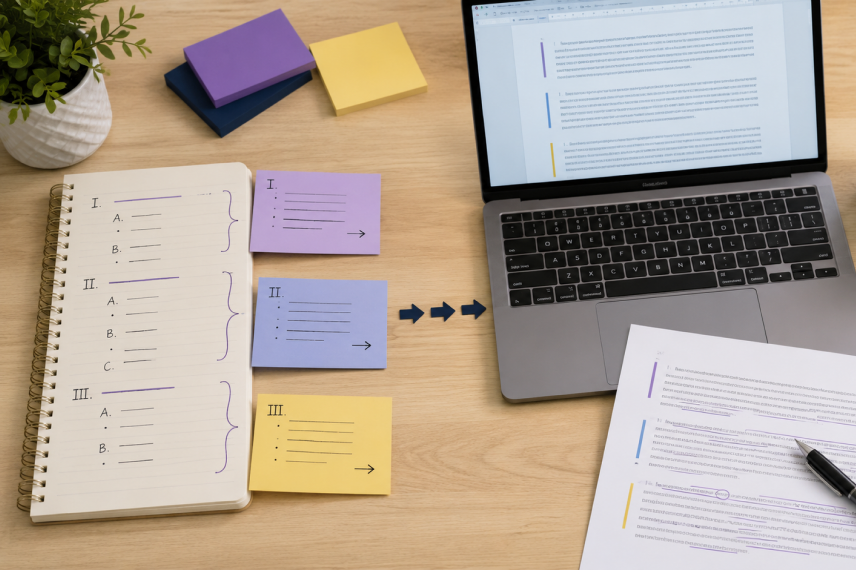
The conversion is mechanical when the outline is dense enough, and that is the point. The working ratios:
- each Roman-numeral section becomes one paragraph (occasionally two for the longest body section);
- each lettered line becomes 2–4 sentences: the detail itself, its texture, and where an arrow exists, its meaning;
- transitions come free from the path: “past the machines,” “by 2 a.m.,” “closer in” – a chosen path generates its own connective phrases;
- nothing new enters at drafting time except wording; a brilliant detail that shows up mid-draft goes into the outline first, where its effect on the sequence can be seen.
An outline this specific also flags weak spots before they cost anything. A section with one thin line signals a paragraph that will run short; a detail with no arrow and no obvious meaning signals a future orphan. Fixing either takes a minute on the plan.
What the outline deliberately ignores: margins, spacing, heading style, and everything else about the page’s appearance. That layer gets applied once, at the end, against the required descriptive essay format for the course.
And when the plan is solid but the drafting keeps stalling anyway, or the outline for descriptive essay assignments is due as a graded deliverable on its own and the stakes feel high, a professional read of the plan catches sequencing problems in minutes; that is the narrow, legitimate use of a descriptive essay service at the planning stage, before bad architecture gets expensive.
What Students Ask Most
How long should the outline be?
Roughly 10–15 filled lines for a 500–800 word essay, or about a third of a page in fragments. An outline approaching half the essay’s word count has drifted into drafting.
Should outline lines be full sentences or phrases?
Phrases, with two exceptions written out in full: the thesis and the closing image. Those two sentences are worth getting exact before drafting; everything else stays in shorthand.
Do instructors collect outlines separately?
Often, especially in composition courses, and usually in alphanumeric format (I, A, 1). When an outline is graded, fragments remain acceptable, but the thesis line is expected as a complete sentence.
Can the outline change during drafting?
Details can move or be swapped freely; the organizing path should not change after drafting begins, because a path switch invalidates every transition already written. If the path feels wrong two paragraphs in, the cheaper fix is re-outlining, which takes ten minutes, against rewriting, which takes the evening.
Does an outline for a descriptive essay need all five senses?
No. Plan the two or three senses through which the subject is genuinely experienced and let the rest go; a laundromat has sound, smell, and warmth, and forcing taste into the plan produces exactly the filler sentence it sounds like.