Many MBA essays sound disappointing for one simple reason. Nothing is in the right place. Strong experience appears too late. Reflection is buried in the middle. Goals arrive suddenly in the last lines, almost apologetically. The writer had substance, but no structure.
That happens more often than people think. Admissions readers do not reject only weak candidates. They also reject confusing drafts written by capable people.
A clean structure changes everything. It helps the reader trust the story, follow the logic, and remember the applicant for the right reasons.
The strongest essays often feel effortless. Usually that means the structure worked hard behind the scenes.
Why MBA Essay Structure Matters So Much
Structure is not decoration. It is how meaning travels. A scattered essay forces the reader to organize the writer’s thoughts. That is a poor trade.
A clear MBA essay framework does the opposite. It guides attention step by step. The reader always knows what matters now and what matters next.
When schools review thousands of applications, clarity becomes an advantage faster than many expect.
What Strong Structure Usually Creates
- Immediate reader engagement.
- Better story retention.
- Cleaner transitions.
- More persuasive goals.
- Less wasted space.
The Best MBA Essay Structure Template
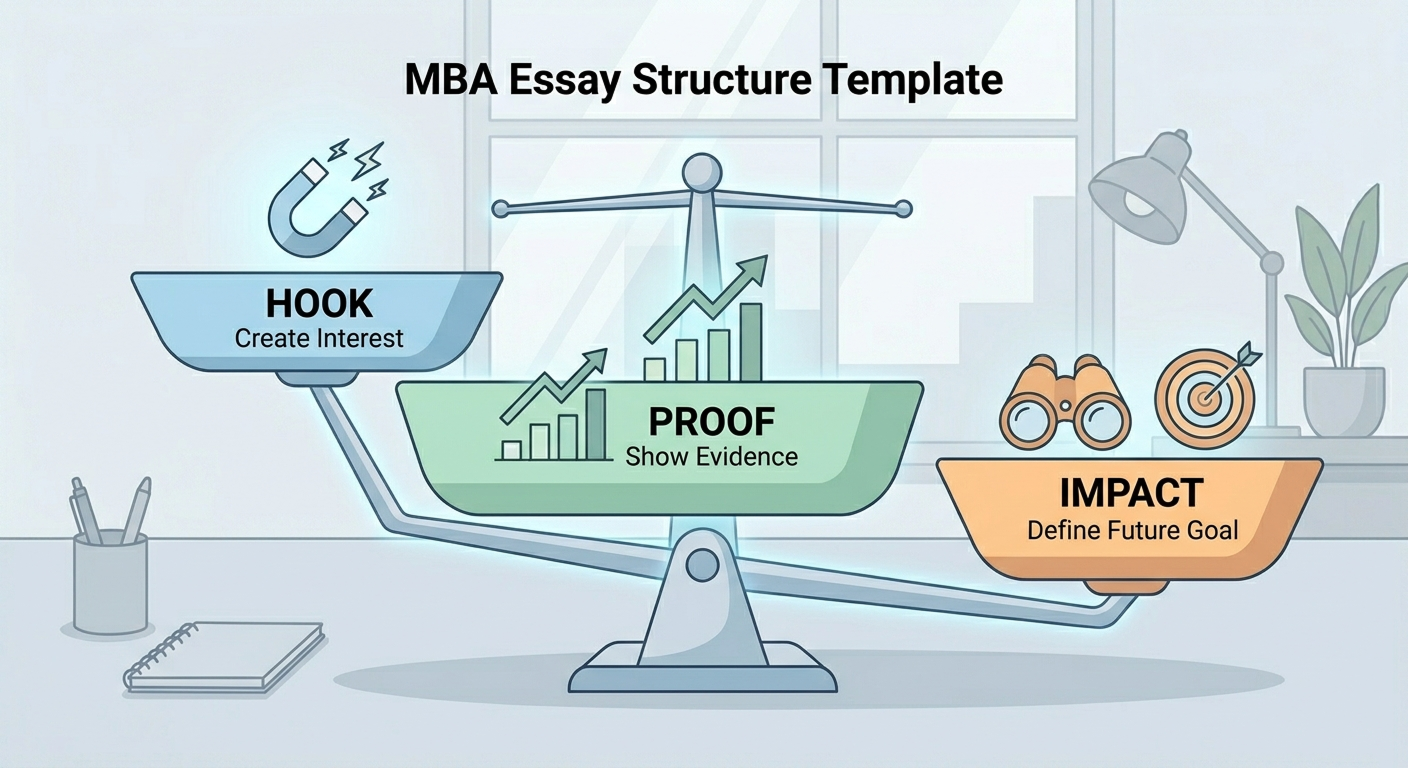
Many essays improve quickly when built around one reliable model. It is simple enough to use under pressure and flexible enough to fit different prompts.
| Part | Main Job |
| Hook | Create tension or curiosity |
| Proof | Show actions, growth, evidence |
| Impact | Connect lessons to future goals |
This MBA essay structure template works because it mirrors how people evaluate credibility. First attention. Then proof. Then meaning.
Use a Three-Part Essay Architecture
Some writers overcomplicate planning. They create seven sections, sub-sections, and strange detours. Most of the time, simpler wins.
A Three-part essay architecture gives enough order without becoming mechanical.
Part One: Tension
What challenge, mistake, decision, or turning point deserves attention?
Part Two: Response
What did the applicant do, learn, or change?
Part Three: Direction
Why does this now lead naturally to business school and future goals?
That rhythm feels human because it reflects real growth.
How to Use the Introduction-Body-Conclusion Sequence
The Introduction-body-conclusion sequence is old because it works. The mistake is using it lazily. Each part must carry weight.
| Section | What It Should Contain |
| Introduction | Conflict, tension, or insight |
| Body | Evidence, decisions, outcomes |
| Conclusion | Forward motion and fit |
If the introduction is generic, the essay starts asleep. If the body lacks proof, trust disappears. If the ending repeats old facts, momentum dies.
Hook Paragraph Strategy That Feels Real
The opening paragraph should create interest quickly. Not through drama for its own sake. Through something unresolved.
Weak Opening
I have always wanted to become a business leader.
Stronger Opening
When the company lost its largest distributor in Mexico, Daniel had three days to rebuild a sales forecast for a team that no longer trusted leadership numbers.
This Hook paragraph strategy works because it creates questions immediately.
Other Hooks That Work
- a costly mistake;
- a hard conversation;
- a moment of doubt after success;
- an unexpected leadership lesson;
- a sharp contradiction in career progress.
Some applicants compare openings from an essay writing service mba provider. That can help as research, but real credibility comes from personal truth.
Build a Strong Core Story Section
The middle of the essay is where claims must earn belief. This Core story section should contain one major example, not five small ones competing for space.
What the Core Story Needs
- clear stakes;
- decision under pressure;
- action taken;
- visible result;
- lesson that changed future behavior.
Many weak essays summarize achievements. Stronger essays dramatize judgment.
Use a Leadership Evidence Block
Leadership is easy to claim and harder to prove. Titles alone do not prove much.
Weak Claim
I developed strong leadership skills managing my team.
Better Evidence
During a product recall, she balanced legal caution, engineering delays, and customer anger while choosing daily public updates. Refund requests rose briefly, then trust scores recovered.
This Leadership evidence block gives the reader something measurable to believe.
Create a Personal Growth Section
Results matter. Growth often matters more. Business schools usually prefer someone still evolving over someone already convinced of perfection.
Weak Reflection
I learned teamwork is valuable.
Stronger Reflection
He once confused speed with competence. After losing a top analyst during a rushed launch, he began measuring success through team stability as much as output.
This Personal growth section creates maturity on the page.
Use a Why MBA Transition Paragraph
Many essays jump awkwardly from past stories to future goals. The bridge is missing. Readers feel it instantly.
A Why MBA transition paragraph explains why past success is no longer enough.
Example
Although she had grown into regional operations leadership, repeated board discussions exposed a gap in capital allocation and strategic finance. Experience had expanded faster than formal business training.
Now the MBA feels logical, not decorative.
Build a Smart School Fit Section
Too many applicants waste space praising rankings. Schools know their own rankings.
The School fit section should connect resources to plans.
Weak Version
Your prestigious institution is my top choice.
Stronger Version
Because he plans to scale healthcare operations, he is drawn to the program’s analytics lab, hospital partnerships, and alumni leaders already solving similar problems.
Specificity creates trust faster than admiration.
Design a Career Goals Section
Goals do not need prophecy. They need logic.
| Timeline | Goal Example |
| Short Term | Strategy role in healthcare operations |
| Mid Term | Lead regional transformation teams |
| Long Term | Improve access and efficiency at scale |
A clear Career goals section helps readers imagine the applicant after graduation.
Write a Closing Momentum Paragraph
Many endings repeat earlier facts. That wastes the final impression.
A Closing momentum paragraph should point forward with earned confidence.
Weak Ending
Thank you for considering my application.
Stronger Ending
He is not applying to celebrate past promotions. He is applying because his current ceiling has become visible, and the next stage requires sharper judgment, stronger tools, and peers who challenge easy thinking.
The essay ends in motion rather than politeness.
Final Structure Checks Before You Submit
Many MBA essays are closer to strong than their writers realize. They often lose impact in the final stage because of placement problems, uneven pacing, or ideas that drift apart. The issue is usually not intelligence. It is arrangement.
A final review should test structure before grammar. Clean sentences cannot rescue a confused sequence. Strong order, however, can make even modest writing feel sharper.
Keep Reflection After Evidence
Readers should first see what happened, what decision was made, and what result followed. Only then should reflection appear.
- Problem appeared.
- Action was taken.
- Outcome became clear.
- Lesson changed future behavior.
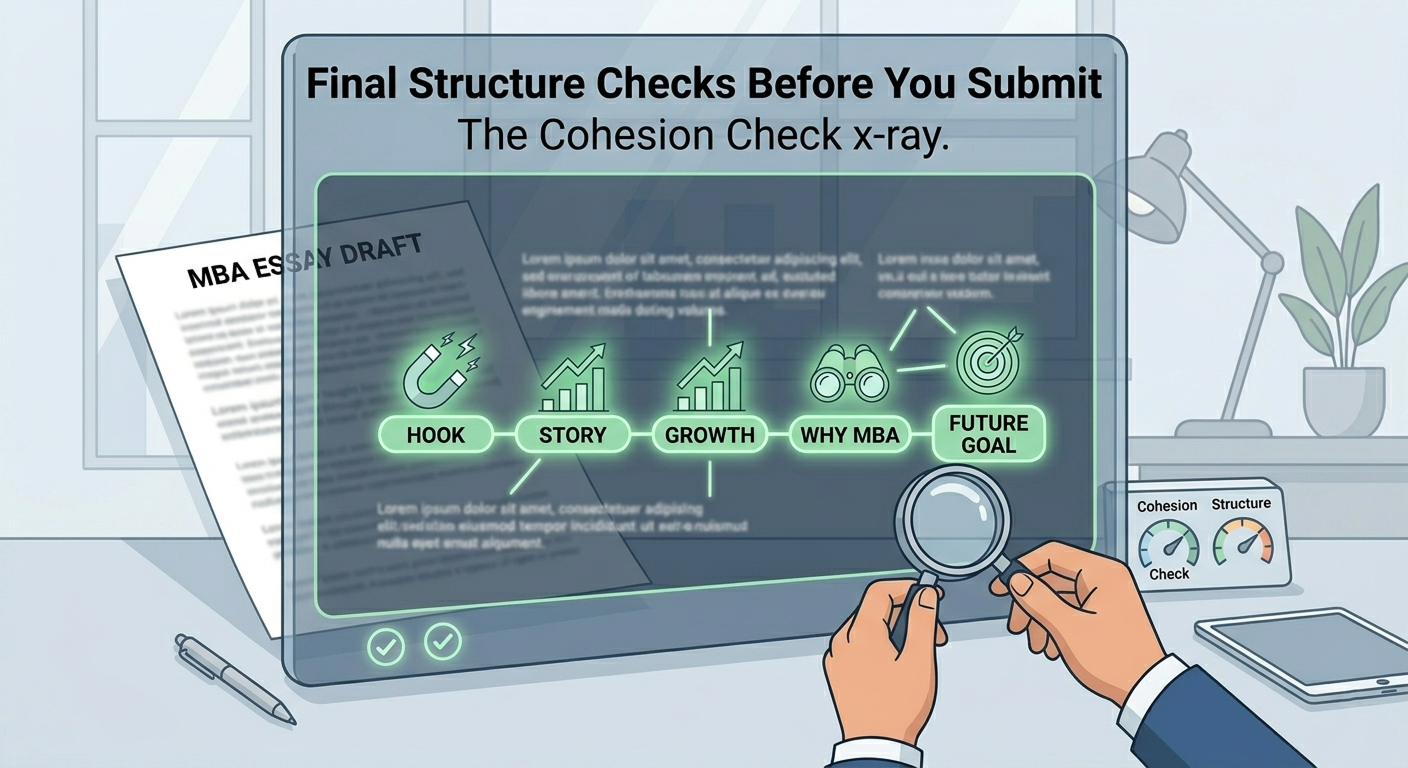
Run a Cohesion Check
Read only the first sentence of each paragraph. The essay should still sound like one person moving toward one future goal.
- Consistent direction.
- Connected ambitions.
- No sudden career shifts.
- Same voice throughout.
Format Matters Less Than Logic
Many applicants worry too much about spacing, fonts, or margins when asking about the format of mba essay. Unless a school gives strict rules, those details are secondary. Real structure comes from paragraph order and momentum.
Use a One-Page Outline Test
A simple outline for an mba essay can reveal problems fast.
- hook or tension point;
- main story with proof;
- growth lesson;
- why MBA now;
- school fit;
- career goals;
- strong close.
If this skeleton feels messy, the full draft usually will too.
One real story usually beats five shallow stories. Honest reflection usually beats polished exaggeration. Clear direction usually beats fashionable goals.
These remain some of the best tips for writing a successful mba essay because they survive trends and templates.
When structure is right, even simple sentences can carry weight. When structure is weak, strong experience can disappear on the page.