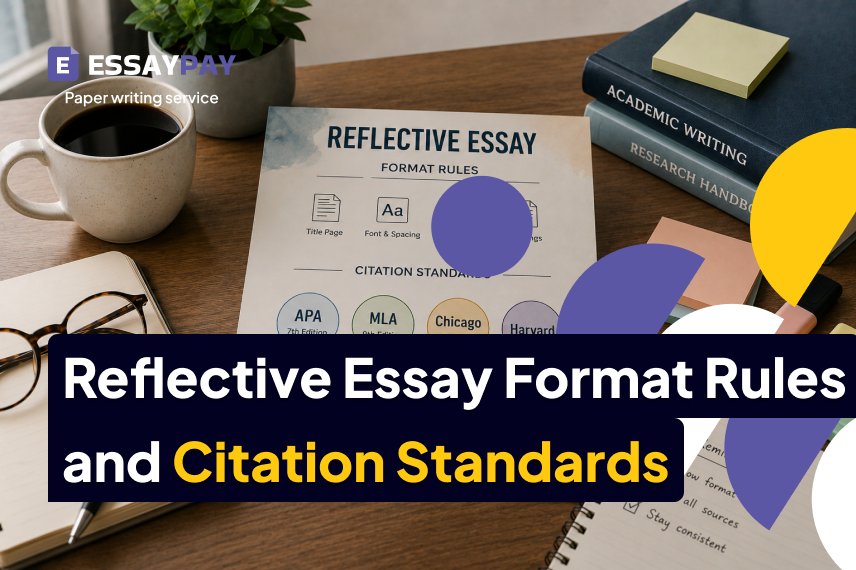
The most personal assignment on the syllabus arrives with the most impersonal dress code. A reflective essay asks for honesty about a group project that went sideways or a placement that exposed a blind spot. Then it expects that honesty in Times New Roman, double-spaced, with a heading block and, often enough, APA citations.
Students feel the mismatch and resolve it in the wrong direction: they loosen the presentation because the content is personal. The actual rule runs the other way. The more personal the writing, the more the formal packaging is what separates an academic document from a journal entry.
The complication specific to this genre is that it lives in two format worlds at once, and they disagree about almost everything except spacing.
Settle these before formatting
- Reflective assignments split by course type: English and composition classes usually expect MLA; nursing, education, psychology, and business, where the genre is often called a reflection paper, usually expect APA 7.
- APA is the likelier default here, the reverse of most essay genres, because reflective writing is heaviest in professional programs.
- Tense mixing is correct, never sloppy: past tense for the experience, present tense for the analysis and the current insight.
- This is the one essay genre where internal headings are sometimes required (framework stages in placement reflections) and sometimes banned (composition essays); the prompt decides.
- First person is expected; contractions, slang, and text-message tone are still out.
The Tense Map: Mixing on Purpose
Page setup can wait; the format decision writers trip on first is tense, because reflective writing genuinely requires switching, and students trained on “pick one tense” read their own correct drafts as errors. The rule is a map, never a single choice: the experience lives in past tense, the analysis and its present-day meaning live in present tense, and commitments live in future tense. One passage, marked:
By week two I had taken over three of the four workstreams, and two teammates had stopped opening the file. Looking back, the mechanism is easy to name: I treat control and responsibility as the same thing, and the takeover was that belief acting itself out. Dana’s flat sentence in the study room was the first crack in it. The belief still surfaces under deadline pressure, which is why the repair is a habit rather than a memory.
Amber: the experience, past tense. Green: the reflection, present tense. The alternation is the genre working correctly.
A draft locked entirely in past tense usually signals depth stuck at retelling; a draft locked in present tense usually means the experience never got rendered concretely. The tense pattern and the depth of reflection track each other closely enough that fixing one often fixes the other, which is a structural matter as much as a stylistic one, mapped properly in the guide to reflective essay structure.
Headings Inside the Essay: the Genre’s Special Case
Every other essay type on this site carries the same advice, continuous prose, no internal headings, and reflective writing is the documented exception. Placement and portfolio reflections in nursing, education, and social work are often explicitly organized under framework-stage headings (Description, Feelings, Evaluation, Analysis, Conclusion, Action Plan, when the program uses Gibbs’ cycle), and APA 7’s heading levels exist precisely for documents structured this way.
The decision takes three questions, asked in order:
- Does the prompt or rubric name a framework or list required sections? Use those headings, in the framework’s order, as APA Level 1 or Level 2 headings. Skipping them costs rubric points directly.
- Is this a composition-course essay instead? Continuous prose. Stage headings there read as scaffolding left standing.
- Long assignment (2,000+ words), instructor silent? Headings are defensible, and one clarifying email is still the better move.
A reflective essay format example with stage headings and one without are, in effect, different documents serving different graders, which is why copying the layout of a sample without checking its origin course misleads more than it helps; the annotated samples among this cluster’s examples of reflective essays name their assignment type for exactly that reason.
Citing the Uncitable
Reflective writing generates citation puzzles no other genre does. The three common ones, with the rule and the on-page result for each:
| The puzzle | The rule (APA 7) | What it looks like on the page |
| A course concept reorganized the writer’s thinking | Cite normally: in-text plus a References entry; in professional programs this is the graded evidence that learning occurred | …selection bias explained the feed’s unanimity (Author, year, p. x), with the textbook in References |
| A supervisor, patient, or colleague said the thing that changed everything | Personal communication: cited in text only, no References entry, since readers cannot recover it; anonymize wherever confidentiality rules apply | …as my preceptor put it (D. Chen, personal communication, March 3, 2026) |
| The essay quotes the writer’s own placement journal or reuses an earlier paper | Journals need no citation; reusing graded work without disclosure can trip self-plagiarism policies | a one-line disclosure note, or one question to the instructor before submission |
| The reflection is about learning with an AI tutor, and quotes the exchange | APA has published an official format for citing generative AI output; the conversation gets cited like software-generated text, and the course’s AI policy decides whether a separate disclosure statement is also required | …the tutor’s reply reframed the problem (OpenAI, 2026), with the tool and version in References, plus a disclosure line where the syllabus asks for one |
The confidentiality row carries real teeth in clinical programs: an identifiable patient in a reflective assignment is a compliance violation before it is a style problem, and the standard fix, pseudonyms flagged as such on first use, costs nothing.
The AI row deserves a word of context. Programs lean on reflective writing partly because it is the hardest assignment to outsource: an essay about the writer’s own interior record has no substitute source. Graders have also grown practiced at spotting a generated reflection. The tell is always the same, an insight that cost nothing.
The formatting consequence is short. Where an AI tool genuinely featured in the learning, it gets cited like any source. Where the syllabus asks for an AI-use disclosure, that one-line statement is now as much a part of the format of reflective essay submissions as the title.
New Containers, New Defaults

A growing share of reflective writing never arrives as a .docx at all. The genre now lives in three other containers, and each one quietly changes the formatting defaults:
- E-portfolios (Canvas, Google Sites, program platforms). Reviewers read them non-linearly, jumping between artifacts. Internal headings and a named framework stop being optional here; they are the navigation.
- LMS discussion posts. No title page, no heading block, 300–500 words. The tense map and citation rules still apply in full.
- Written companions to video reflections. Short, structured, and usually template-driven; the program’s template wins over any style guide.
One more shift comes with public-facing portfolios: the anonymization bar rises. “My preceptor D. Chen” indexed by a search engine is a different exposure than the same line in a submitted paper.
The rule that survives every container is short. Format for the path the reviewer will actually click through, never for a printed page nobody will print.
The Shell: Two Format Worlds, Settled Last
Only after voice, headings, and citations does the page itself deserve attention, and here the genre splits by course type into two setups that disagree about almost everything except spacing:
| Decision | Composition / English course (MLA 9) | Professional program (APA 7) |
| First page | No title page; four-line heading top-left, centered plain title | Separate title page: bold centered title, name, affiliation, course, instructor, date |
| Running header | Last name + page number, top right | Page number alone, top right |
| Internal headings | Almost never wanted at essay length | Often welcome, sometimes required (framework stages, portfolio sections) |
| Citations expected? | Rarely; only if outside texts are quoted | Usually; course concepts and readings are supposed to appear, cited |
| End list | Works Cited, if anything was cited | References, and its absence in a course reflection is itself a common grading comment |
The shared baseline underneath both: 12-point Times New Roman or an equivalent readable serif, double spacing throughout, one-inch margins, half-inch paragraph indents, and a real title, “What a Statistics Course Did to My News Feed,” never “Reflective Essay.”
Which column applies is usually visible in the prompt’s vocabulary. “Reflective essay” with no mention of readings leans MLA; “reflection paper” plus any phrase like “integrate course concepts” or “with reference to the framework” is APA territory. When the prompt names neither, the discipline decides, and one emailed sentence settles it faster than any guess. Planning which concepts and moments go where is a separate job from dressing the page, and doing it on paper first, with a proper reflective essay outline, prevents the common scramble where citations get retrofitted into a finished personal story.
The Three-Pass Finish
How to format a reflective essay in the last half hour before submission, without rereading every rule:
- Pass one, the shell: title page or heading block per the course’s column in the table above; spacing, margins, font, page numbers; a title that names the experience or insight.
- Pass two, the voice: contractions expanded, slang and text-tone removed, first person kept but pointed at analysis; tense map spot-checked at every paragraph seam.
- Pass three, the sources: every course concept cited, every conversation converted to a personal-communication citation or anonymized, References present if anything earned an entry, and the file named per the syllabus before upload.
Thirty minutes covers all three passes on a standard-length paper, and none of them can rescue a reflection that never got past retelling, which is the deeper craft covered step by step in how to write a reflective essay. When the deadline has eaten even those thirty minutes, or the assignment carries portfolio-level stakes, professionally prepared reflective essay help arrives with both worlds’ conventions already applied, worth one careful read purely as a formatting model for the program’s expectations.
FAQ
Is a reflective essay in APA format really the default?
In professional programs, yes, and they assign most of the reflective writing in higher education; nursing, education, psychology, and business courses run on APA 7. English and writing courses remain MLA territory. The prompt or syllabus outranks both defaults.
Are contractions acceptable, since the essay is personal?
In graded academic reflections, no; the voice is first-person formal. The lone exception is quoted speech, where “you’d rather do it wrong yourself” stays exactly as said.
Does a reflective essay need a title?
Yes, and a specific one; under MLA it sits centered on page one, under APA on the title page and again atop the first text page. “Reflection Paper” as a title reads like a file named document1.docx.
What tense should the format for a reflective essay use?
Both, by design: past for the experience, present for the analysis and its current meaning, future for commitments. Consistency applies within each layer, never across the whole paper.
How long is the standard assignment?
Course reflections typically run 500–1,000 words; placement and portfolio reflections 1,000–1,800. The format of reflective essay submissions does not change with length; only the case for internal headings strengthens as the word count grows.