Most topic lists hand out nouns. “The transformational power of music.” “A memorable family vacation.” “Overcoming a personal fear.” Every one of them sounds writable and none of them is, because a noun has no Tuesday in it: no specific hour, no line of dialogue, no moment where something cracked. The student picks one, sits down, and discovers there is nothing to grab.
Everything on this page is a moment instead. Each topic below is already narrowed to a scene with friction in it, the kind of entry that can be drafted the same evening. And before the lists, one method that beats every list, because the best reflective topics are already sitting in the reader’s pocket.
Read this before choosing
- A workable reflective topic is a moment with friction, never a theme; “resilience” is unwritable, “the email I drafted four times and never sent” is an essay.
- The phone is a topic archive: the camera roll, sent messages, and calendar hold two years of forgotten moments, searchable in ten minutes.
- The sting test beats the impressiveness test: the topic that makes the writer slightly wince outperforms the one that makes them look good.
- Quiet, small experiences with a genuine crack in them grade better than dramatic ones without; a tutoring session beats a semester abroad, unless the semester abroad has a crack.
- Any topic below can be claimed by swapping in the reader’s own details; the friction is the reusable part.
The Ten-Minute Archive Dig
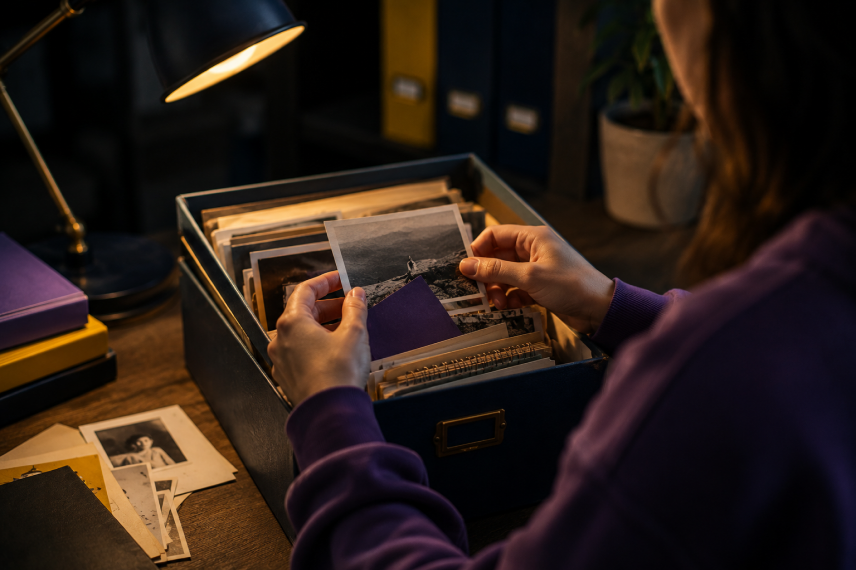
Before browsing anyone’s list, dig through the one the reader has been keeping accidentally. Three searches, ten minutes, phone in hand:
1. Scroll the camera roll, twelve months back, fast. Not looking at pictures, looking for the stomach-drop: the photo that triggers “oh. that day.” The camera roll remembers what the mind has filed away, and the photos nobody posted are usually the ones with essays in them.
2. Search sent messages for confession phrases. In the messaging app’s search bar, try: “I can’t believe I”, “never again”, “why do I always”, “I shouldn’t have”, “honestly I”. Sent messages are a diary written to other people; the hits are moments that mattered enough to narrate in real time.
3. Open the calendar to the busiest week of last year. Find the entry that produces a physical reaction, dread, relief, embarrassment. Recurring entries that quietly stopped (the club that got abandoned, the standing call that faded) are their own category of essay.
One honest caution: the dig produces raw material, and raw is the point. A moment that still feels too hot to examine calmly is a moment to write about later, from stable ground, or not at all; graders are readers, never therapists.
The Sting Test
Whatever the dig or the lists produce, one filter decides between candidates: which option produces a small wince? The wince, embarrassment, defensiveness, the urge to add “but in my defense”, marks a belief that took damage, and damaged beliefs are what reflective essays are made of. The impressive topic (the win, the award, the successful event) usually contains no damage, which is why it drafts smoothly into three hundred words and then dies. This is also why generic reflective essay topics fail even diligent writers: they were selected to sound good, and sounding good is the opposite of the assignment.
The lists below are organized by the kind of friction inside them, because the friction, never the setting, is what makes a topic writable.
Eighty Moments, Sorted by the Crack in Them
Every entry below follows the same construction: a specific scene, one concrete detail, and a belief taking damage somewhere inside it. Claim any of them by swapping in personal details; the friction is the reusable part, the rest should be the writer’s own.
Beliefs That Did Not Survive Contact
The purest reflective material: a conviction, stated or silent, that met reality and lost.
- The person I had fully figured out, until the day I hadn’t
- The “easy class” that rearranged how I study everything else
- The week I defended an opinion I had already stopped believing
- What I said about group work before the group project that ended friendships
- The advice I gave someone else and then failed to survive myself
- The stereotype about my hometown I repeated until I heard a stranger say it
- My theory about why I procrastinate, and the assignment that disproved it
- The team I was sure carried me, until I saw the peer evaluations
- The “waste of time” requirement course that turned out to be the one I quote
- What I believed about my own honesty before the small lie I kept maintaining
Small Failures That Outtaught the Wins
Minor stumbles carry major essays, because small failures get examined while big ones get defended.
- The presentation that went fine, and the question afterward I couldn’t answer
- The deadline I missed by two hours after finishing the work on time
- The apology I delivered so badly it needed its own apology
- Getting exactly the grade I predicted, and hating it anyway
- The job interview where I answered every question and still knew by minute ten
- The recipe I ruined for guests, and what I did in the twenty minutes after
- The message I drafted four times and never sent
- Quitting the club I had joined to reinvent myself
- The tutoring session where my explanation worked on nobody, including me
- Losing an argument I was right about
The Digital Self
The richest new territory in the genre, and the least explored in older topic lists: the person the screen knows, meeting the person the writer claims to be.
- Day two of the media fast, when I opened the weather app just to open something
- What my screen-time report said the week I told everyone I was too busy
- The group chat I muted, and the month it took anyone to notice I was gone
- Asking an AI tutor to explain it a fourth time, and what that patience did to my pride
- The streak I kept alive for 400 days and what broke when it broke
- Unfollowing someone I know in real life
- The voice memo I recorded for myself at 2 a.m. and found in March
- Watching my own story views instead of the event I was posting from
- The essay I let a chatbot outline, and the strange emptiness of submitting it
- Reading my messages from three years ago and not recognizing the sender
- The online friend I have never met who knew before my roommate did
- Turning my camera off for an entire remote internship
Work, Money and First Shifts
First jobs compress more identity lessons per hour than any classroom, which is why placement essays and interview answers keep returning to them.
- The first customer who yelled at me, and the manager who didn’t defend me
- What handing food through a drive-thru window taught me about being invisible
- The paycheck that disappeared in six days, and the spreadsheet I built in shame
- Being the newest person in a workplace where everyone else was twice my age
- The shift I covered out of kindness and the pattern it started
- Discovering my coworker earned more for the same job, and saying nothing
- The side hustle that died, and the two skills that survived it
- My first time training someone, and hearing my own bad habits in my instructions
- The tip jar week that changed how I tip forever
- Quitting a job correctly, after watching someone quit one badly
People I Misread
Every misjudged person is a mirror: the essay is never about them, it is about the shortcut the writer’s judgment took.
- The roommate I labeled lazy, before I learned what her semester actually contained
- The professor I wrote off in week one and thanked in week fifteen
- The friend who was drifting away while I was busy being hurt about it
- My grandmother’s repeated story, and the detail I finally heard on the tenth telling
- The teammate whose silence I mistook for agreement
- The kid I tutored who was not slow, just careful
- The neighbor I avoided for a year over a first impression that was mine, not his
- Watching my parent handle a crisis and revising a decade of judgments
- The loud classmate who turned out to be the most frightened person in the room
- Realizing the friend I envied had been envying me
Campus and Classroom Moments
The safest category when a course requires the reflection to stay academic, and the easiest to connect to named course concepts.
- Raising my hand for the first time in a class where I had decided I was the quiet one
- The office-hours visit I postponed for six weeks and finished in nine minutes
- Reading my own first-semester essay a year later
- The exam I walked out of certain I had failed, and the grade that argued back
- The class discussion where I stayed silent, and the classmate who said my exact thought
- Switching majors and discovering which parts of the old one I smuggled along
- The all-nighter that produced my worst work and my best lesson about all-nighters
- Presenting research to people who knew more than I did
- The scholarship essay that forced me to narrate my own life as a story
- Being wrong out loud in a seminar, and surviving it
Home, Family and the Person I Am There
Home is where the oldest beliefs live, which makes returning to it, physically or on the page, reliably rich ground.
- The first visit home when my childhood bedroom felt like a museum exhibit
- Becoming the family’s unpaid tech support, and what the job description reveals
- The holiday argument I stayed out of for the first time
- Cooking my parent’s signature dish alone, badly, in a dorm kitchen
- The sibling fight that ended differently because one of us had changed
- Translating for my parents, and the day I realized what the role had cost and given
- The family story everyone tells differently, and what my version says about me
- Moving out, and discovering which house rules were actually mine all along
- The phone call I almost didn’t answer
- Watching my parents become people with first names
The Body, the Routine, the Quiet Repairs
Habits and routines are beliefs performed daily, so changing one always contains an essay, even when the change looks tiny from outside.
- The injury that benched me from a sport that had become my whole identity
- Learning to rest without narrating it as laziness
- The 6 a.m. gym experiment: what survived of it, and what it was really for
- Walking the same route every day for a semester, and what changed (it wasn’t the route)
- The hobby I do badly on purpose, and why it stays
- My first appointment booked entirely by myself, for myself
- Teaching my hands a skill my brain understood in a day (knitting, guitar, clutch)
- The semester I tracked my sleep and met a stranger in the data
- Giving up caffeine for a class experiment, and negotiating with the person I met instead
- The volunteer shift I signed up for to feel good, and the more complicated feeling I got
Watching a Noun Become a Topic
Any leftover noun-topic from other lists can be rescued with the same compression: find the hour inside it. Five rescues, side by side:
| The noun (unwritable) | The moment inside it (writable) |
| My study abroad experience | The supermarket in Lyon where I couldn’t find or ask for flour, and gave up on a version of myself in aisle four |
| The importance of friendship | The birthday my best friend forgot, and the two weeks I performed being fine |
| Overcoming a fear of public speaking | The moment mid-presentation when my slide failed and the improvised minute went better than the rehearsed nine |
| Personal growth during university | Rereading the pros-and-cons list I made about coming here, three years later, and disagreeing with both columns |
| The impact of a mentor | The day my supervisor said “I don’t know, find out” and I understood everything she had been doing all year |
The pattern in every rescue: a place, an hour, one concrete object (the flour, the slide, the list), and something quietly breaking. That compression is what makes reflective essay topics for university students writable in an evening rather than admirable on a list. The narrowed sentence also does double duty later: it is one honest step away from a working thesis, and shaping that step is covered on the page about the thesis for a reflective essay.
Five Topics to Avoid and the Rescue for Each

Some subjects fail so consistently that experienced graders can predict the essay from the title alone. Each one, though, hides a workable version one level down:
- The championship win. Triumphs rarely contain damaged beliefs. Rescue: write the bench, the loss before it, or the strange flatness of the morning after.
- The trip that changed everything. Usually changes nothing on the page, because the writing tours instead of digging. Rescue: one hour of the trip, ideally the worst one.
- The loss of a loved one, chosen because it seems weighty. Real grief deserves better than a deadline, and graded processing of raw loss serves neither the writer nor the reader. Rescue: only with distance, and only through one small concrete inheritance, the recipe, the phrase, the repeated story.
- The topic that flatters. “How I learned I’m a natural leader” announces its ending in the title. Rescue: the moment the leadership failed; that essay believes itself.
- The universal lesson. “What COVID taught us all” belongs to everyone, which means it belongs to no one. Rescue: replace “us all” with one kitchen table and one specific month.
The Sixty-Second Final Check
A candidate topic is ready when all five answers come back yes:
- Can the moment be placed in a specific hour, in a specific place?
- Does it produce the small wince?
- Was a belief present before the moment, and dented after it?
- Does the changed thinking show up somewhere recent, this month, this week?
- Can it be discussed calmly, without the writing reopening anything unhealed?
A topic that passes is most of an essay already; what remains is process. The digging method that turns a chosen moment into an insight, draft zero, the mining pass, the reader draft, is mapped in full in how to write a reflection essay from first mess to final pass. Seeing where different topic choices ended up as finished graded work also calibrates the picking instinct fast; the depth-labeled reflective essay example papers in this cluster grew out of exactly the kinds of moments listed above. And when the deadline is real and every candidate still feels wrong, a professional read of the raw material, the archive-dig results, the candidate list, is the narrow, honest use of reflective essay writing help: someone trained in the genre can spot the essay hiding in a student’s own moments faster than another hour of solo browsing.
FAQ
The questions that come up most once the choosing gets real:
Do college and high school reflective topics differ?
The moments differ; the mechanics don’t. High school prompts lean toward identity and firsts, university prompts toward learning, placements, and course concepts. The sting test and the hour-and-place rule apply identically at both levels.
Can two students write the same topic from this list?
Safely, yes, because the topic is only the doorway; the belief, the details, and the insight are unclonable. Two essays on “the message I drafted four times” will share nothing but the premise.
Is a funny experience acceptable for a graded reflection?
Yes, and humor often carries depth well, provided the essay still names an assumption and a change. The ruined-recipe topic grades on what happened in the twenty minutes after, never on the smoke.
What if the assignment already fixes the topic (“reflect on this course”)?
The narrowing still applies, one level down: not the course, but the week, the concept, or the assignment inside it where the thinking bent. Fixed-topic prompts reward students who find the moment inside the mandate.
How recent should the experience be?
Old enough to see clearly, recent enough to remember concretely; six months to a few years is the comfortable band. Last week’s crisis is usually too hot, and early childhood is usually too vague for the detail this genre runs on.