Most advice about descriptive writing makes sense right up until the moment of writing. “Show, don’t tell” and “use sensory detail” are easy to nod along with and hard to act on, because the advice never shows what it looks like sustained across a full page. A student can agree with every tip and still produce a draft that reads like a furniture inventory.
The fix is reading finished work with a specific question in mind: what did this writer do that a weaker draft of the same essay would skip? The four complete essays below each answer that question differently. Each uses a different way of organizing description, a different kind of subject, and each demonstrates one move that graded drafts most often lack. After the essays, one deliberately flat draft gets rewritten line by line, which is the fastest way to see the difference between describing and listing.
Key takeaways
- A strong descriptive essay is organized around one dominant impression; every detail either serves it or gets cut.
- Description alone reads as a list. Top-tier papers interpret their details, telling the reader what a detail means, not only that it exists.
- The five senses are a menu, never a checklist. Two senses used honestly beat five forced in.
- Specific, verifiable details (a tin marked FLOUR, a mirror angled at nothing) now carry extra weight with graders, because generic smoothness is the signature of generated text.
- Endings that close on an image consistently outscore endings that explain the lesson.
What Separates a Top-Tier Paper From a Correct One
Before the samples, it helps to know what they were selected to demonstrate, because “good descriptive essay” hides two different standards. A correct essay has an intro, body paragraphs, sensory details, and a conclusion, and earns a B-minus. A top-tier paper does four extra things that rubrics rarely spell out:
- It commits to one impression. Not “my grandmother’s kitchen” but “my grandmother’s kitchen as a room that refuses to change.” The impression makes every cut-or-keep decision for the writer.
- It chooses an organizing path. Through space (a walk across the room), through time (a shift, a morning), or through accumulating observations. Readers tolerate almost any path except no path.
- It earns emotion through evidence. The words cozy, beautiful, amazing, and unforgettable never appear; the details make the reader supply those words themselves.
- It varies the distance. Wide shots (the whole room) alternate with close-ups (the wet tongs, the cracked fingertips). A draft stuck at one distance flattens no matter how vivid its vocabulary is.
The four essays that follow were built to show these standards operating in four different situations:
- a place, organized by movement through space;
- a person, built from accumulated habits and objects;
- an object, read as an archive of its owner’s life;
- an experience, paced by attention rather than by the clock.
How to Read These Before Writing Anything
Skimming samples for “inspiration” wastes them. A more useful pass takes ten minutes: read the essay once normally, then a second time asking three questions. What single impression is every detail serving? In what order do the details arrive, and why that order? And where does the writer interpret a detail instead of only presenting it? The strongest descriptive essay examples reward that second read, because the machinery only becomes visible when the reader stops being carried by it.
One more thing worth knowing before the samples: instructors now weigh specificity more heavily than they did even a few years ago. Generated text tends to describe in smooth generalities, so a detail only the writer could know, the exact brand of a mop bucket, the particular squeak of one door, has quietly become the strongest evidence that a person stood in the room. The essays below lean into that kind of detail on purpose.
Four Complete Essays, Four Different Approaches
Example 1: The Dining Hall at 7 a.m. (a place, organized by space)
Context: a first-year composition assignment, “describe a familiar campus place at an unfamiliar time.” The essay moves through the room the way a person entering it would, from the doors to the back wall.
The dining hall opens at seven, but the room is not awake yet, and neither is anyone in it. The double doors give their two-part sound, a magnetic click and then a long hydraulic sigh, and the smell arrives before anything else: industrial coffee, wet steel from the dish pit, and underneath it, faintly, last night’s fried rice, which the ventilation never fully surrenders.
Just inside the doors, the card reader glows green over an empty podium. The checker does not come until eight. For this first hour the room runs on trust and the three people who need it most: a girl in scrubs asleep against the window with a bagel untouched in front of her, a man in a maintenance polo reading his phone over oatmeal, and whoever keeps the espresso machine hissing behind the counter, visible only as a white sleeve and a wrist.
The middle of the room is four hundred chairs in perfect order, and the order is the strange part. By noon this floor is a scraping, shrieking argument of furniture. At seven the chairs sit squared to their tables like a photograph of themselves, seats still cold, and walking between them feels like walking through a museum exhibit about lunch.
The food line along the left wall is half-lit. Steam trays wait empty with their lids up, a row of open silver mouths. One tray is already full: scrambled eggs, a yellow so uniform it looks decided by committee. A handwritten card leans against the sneeze guard, “EGGS,” in blue marker, as if there were doubt. The tongs beside it are wet. Someone has already been here, done this, and gone.
At the far back, past the last table, the windows run floor to ceiling, and this is what the noon crowd never sees. The sun comes up over the parking structure and lays a long orange rectangle across thirty tables at once, and for about twenty minutes the cheapest room on campus, the room of spilled marinara and abandoned trays, is the best-lit place within a mile. The girl in scrubs sleeps directly in the middle of it. Her bagel has a stripe of sunrise across it. Nobody is there to point this out to anybody, which may be the point.
What this example does well: the spatial order is doing invisible work, doors to counter to seating to windows, so the reader never feels lost. Notice the move most drafts skip: the essay interprets its own details (“the order is the strange part,” “which may be the point”) instead of only listing them. Interpretation after detail is the descriptive equivalent of explaining evidence, and its absence is the most common margin comment on this assignment.
Example 2: The Courier on the Third Floor (a person, built by accumulation)
Context: a “describe a person you see regularly but do not know” prompt. Instead of moving through space, the essay accumulates observations across repeated encounters, letting a portrait assemble over time.
The delivery courier who works my building’s block is a man of about fifty who treats an insulated food bag the way a violinist treats the instrument case. He sets it down square. He zips it in one motion, corner to corner. When it rains he angles his whole body over it at the door, taking the water on his back, and the bag arrives at apartment doors with dry, perfect edges while he drips.
I know his schedule better than I know some friends’. Lunch rush, six to nine, then a late window near midnight when the orders get smaller and stranger, single milkshakes, one order of fries. His scooter is an older electric model with a seat mended in silver tape, laid in strips so even they look woven. The left mirror is angled at nothing. He never adjusts it. Whatever he needs to see, he sees some other way.
His phone is mounted at the center of the handlebars in a waterproof case gone cloudy with age, and the screen light comes up at his face at every red light, green-white, the color of the app. In that light he does arithmetic with his lips moving. I have watched him do it from the bus stop a dozen times: the small mouth movements of a man dividing a night into deliveries and deliveries into rent.
Once, in February, I held the lobby door while he stacked three bags for the elevator. Up close his gloves were the fingerless kind, and the exposed fingertips were cracked at the corners of the nails, the specific damage of cold plus hand sanitizer plus a hundred zipper pulls a night. He said thank you twice, once at the door and once, oddly, at the elevator, as if the first one might not have been enough. The doors closed on him standing at attention beside his tower of other people’s dinners.
The building talks about him without knowing it. “Food’s here” means his knock, two soft, one firm. Nobody upstairs has heard him climb; he takes stairs when the elevator is slow and arrives unwinded on the third floor at an age when most men grunt getting out of chairs. Six buildings a night, maybe eight. A man could live an entire secret athletic career this way, medaling nightly in an event no one watches, and the only spectator evidence would be this: dry bags, even tape, thank you twice.
What this example does well: a person is described almost entirely through objects and habits, the bag, the tape, the gloves, the double thank-you, and the essay never once reaches for empty adjectives like “hardworking” or “kind.” The final sentence gathers three earlier details into a closing image, a move that separates college level descriptive essay examples from high school ones, where conclusions usually restate instead of gathering.
Example 3: The Cracked Phone (an object with a history)
Context: an “object of personal significance” prompt, the most common descriptive assignment and the easiest to write badly. The essay treats the object as an archive, reading its damage the way a historian reads a document.
The phone is four years old, which in phone years is elderly, and it wears its age the way old sailors wear tattoos: every mark has a story and most of the stories are embarrassing. The crack starts at the top left corner and forks twice on its way down the glass, a river system in miniature, with a delta of fine fractures spreading over the corner where it hit the pavement outside the DMV. Under direct light the crack goes iridescent, a thin rainbow of failure.
The screen beneath still works, mostly. There is a dead strip a centimeter wide along the top where notifications go to be half-read, so every message arrives beheaded, the sender’s name visible and the first line cut off at the eyebrows. Autocorrect has learned things it should not know. Type “libr” and it offers the campus library’s closing time. Type “mom” and it suggests “I’m fine,” which says more about four years of Sunday calls than a diary would.
The case came off for good last spring, so the aluminum edges show their history plainly: a constellation of pinprick dents along the bottom edge from being set down a thousand times a hair too hard on lab benches and bus armrests and diner counters. The charging port grips loosely now, and charging requires a specific arrangement, cable bent up and to the left, phone propped against a coffee mug, an accepted nightly ritual with the solemnity of setting a bone.
The camera lens has a scratch that photographs as a soft flare in the upper right of every picture. Two years of photos carry it, the same ghost in the corner of a graduation, a hospital waiting room, a terrible haircut, a lake at dusk. Newer phones would erase it automatically. This one includes it the way a window includes its own smudge, honestly, and by now the flare reads less like damage and more like a signature.
Replacing it would take an afternoon. The store is twenty minutes away and the trade-in banner has been in the app for months, patient as a debt collector. But a new phone would know nothing. It would not know that “libr” means closing time, would not flare in the corner of photographs, would not need the coffee mug at night. It would be smooth and fast and completely uninformed, and there is something to be said, apparently, for carrying a device that has been paying attention.
What this example does well: every physical detail doubles as evidence of a life, which is what “object of significance” prompts actually grade. The essay also shows restraint with the senses. There is no forced smell or taste paragraph; touch and sight carry the whole piece, because those are the senses through which a person actually knows a phone. Forcing all five senses into every subject is a checklist habit, and this essay is proof the checklist is optional.
Example 4: First Shift at the Drive-Thru (an experience, ordered by time)
Context: a “describe a first experience” prompt. Time supplies the structure, but the essay compresses and stretches it deliberately, minutes of panic get a paragraph, hours of routine get a sentence.
The headset is heavier than it looks and smells like the inside of a rented bowling shoe. That is the first fact of the drive-thru. The second is the sound: not one voice but a weather system of them, the manager on channel one, the kitchen timer’s triple beep, the fryer’s white roar, and inside all of it, arriving like a radio signal from a passing car, because that is literally what it is, a voice ordering two number threes, no pickles, and a large unsweet tea.
The screen says the order should take ninety seconds. The first one takes eleven minutes. Hands that have typed essays at sixty words a minute cannot find the button for “no pickles,” which is not labeled “no pickles” but hidden two menus deep under MODIFY, and the car at the window idles with the patience of a glacier while three more voices stack up in the headset like planes over an airport.
By hour two the panic has a rhythm to it. Order, punch, repeat it back, window, count change, and the voices stop being weather and start being people: a man who orders for a chorus of children’s voices correcting him from the back seat, a woman who says “and a coffee, large, please, it’s been a day” with a laugh that does not quite hold, a landscaping crew whose order is eleven items long and recited from memory by a man who has clearly said it every day for years, a psalm of double cheeseburgers.
The lull comes at 3 p.m. and the kitchen exhales. The fryer roar drops to a hum. Someone’s phone plays music from a pocket, tinny and against the rules. The window stays open to the smell of hot asphalt, and for twenty minutes the job reveals its secret shape: long boredom, short chaos, and the odd, unadvertised intimacy of handing strangers their dinner through a hole in a wall.
At 9:40, twenty minutes before close, a last car orders one small vanilla cone. The machine is half-disassembled for cleaning. The kitchen looks at the clock, then at the machine, then reassembles it without a word, and the cone goes out the window with a perfect curl on top. The car’s driver, a woman in hospital scrubs, holds it up like a trophy before pulling away. The headset comes off. The silence afterward has a texture, thick and ringing, the way a room sounds after a concert, and both ears keep listening for orders all the way home.
What this example does well: pacing. Eleven minutes of panic get more space than six hours of shift, because description follows attention, not the clock. The essay also resists the moral-of-the-story ending; the closing image, ears still listening on the walk home, lets the reader conclude “this experience changed how the writer hears the world” without being told. Endings that trust the reader consistently outscore endings that explain themselves.
The Same Paragraph, Flat and Fixed
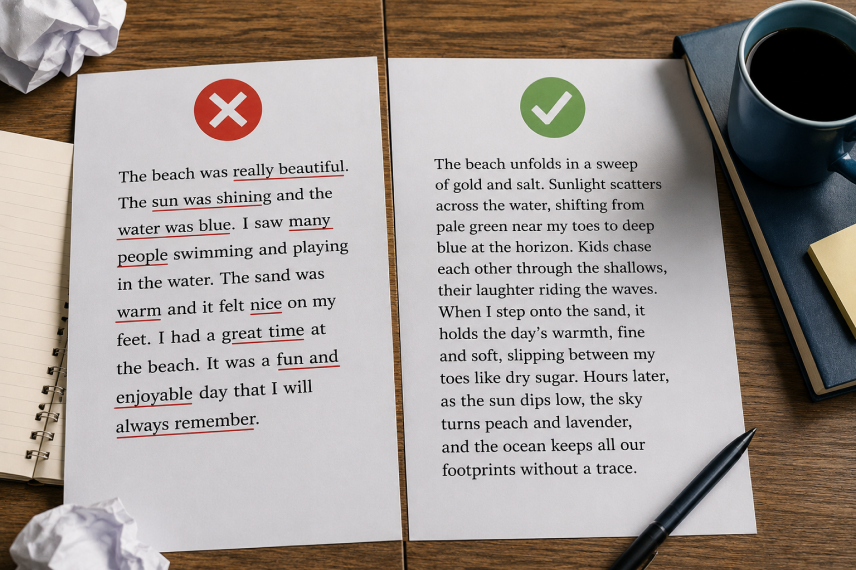
The fastest way to internalize what the four essays above are doing is to watch a paragraph fail and then get repaired. The flat version below is real in spirit; nearly every first draft of a place essay contains its cousin.
Flat draft: “My grandmother’s kitchen is very cozy and warm. It is small but nice. There are many interesting things in it, like old dishes and photos. It always smells amazing because she is always cooking something delicious. Being there makes me feel happy and safe, and it holds many wonderful memories for me.”
Revised: “My grandmother’s kitchen fits three people if nobody opens the oven. The dishes stacked above the sink don’t match and never have, survivors of four different sets, and the sugar lives in a tin marked FLOUR, which everyone knows and no one fixes. Whatever is on the stove, and something always is, gets stirred with the same wooden spoon, worn on one side into a slope that fits her thumb. On the wall by the window, a strip of doorframe carries two generations of pencil marks and dates, my mother’s height stalled at 1989, mine climbing past it in 2016. The room has decided what it is, and it long ago stopped taking suggestions.”
Every vague claim in the flat draft became a checkable detail in the revision: “small” became a rule about the oven, “interesting things” became the FLOUR tin, “smells amazing” became the worn spoon, “wonderful memories” became pencil marks with dates. Notice that the revision never uses the words cozy, warm, happy, or safe, and communicates all four. That substitution, emotion words out, evidence in, is the single highest-value edit available to a descriptive draft, and it can be applied paragraph by paragraph to a text that already exists. Choosing a subject rich enough to survive this treatment matters too, which is why a shortlist of good topics for a descriptive essay is worth building before committing to the first idea that comes to mind.
Three Ways These Essays Open, and Why
Searches for how to start a descriptive essay examples usually mean one thing: the writer has a subject and no first sentence. The four essays above use three different opening strategies, all of them stealable.
| Opening strategy | First line it produced | When it works best |
| Arrive with one sense | “The double doors give their two-part sound… and the smell arrives before anything else” | Place essays, where the reader needs to enter the space with the writer |
| Open on a telling habit | “…treats an insulated food bag the way a violinist treats the instrument case” | Person essays, where one behavior can imply a whole character |
| State a blunt physical fact | “The headset is heavier than it looks and smells like the inside of a rented bowling shoe” | Experience and object essays, where immediacy beats scene-setting |
What none of the four essays does is open with a definition, a dictionary quote, or “everyone has a place that is special to them.” Openings like those postpone the essay instead of starting it. The stronger pattern across all the samples: the first sentence already contains a specific, and the reader is inside the subject before the end of the first paragraph. Sequencing the rest, which detail follows which, is a planning decision better made before drafting, and an outline for a descriptive essay handles it in ten minutes on paper instead of an hour of rearranging paragraphs.
What to Steal From Each Sample
Reading examples of descriptive essay writing pays off only if something concrete transfers into the next draft. From these four, the transferable moves are:
- from the dining hall: interpret at least a few of the details (“the order is the strange part”), because pure description with zero commentary reads as a list;
- from the courier: build people from objects and habits, and let the conclusion gather earlier details instead of summarizing;
- from the phone: use only the senses the subject genuinely involves, and let physical details carry emotional weight instead of naming emotions;
- from the drive-thru: spend words where attention was, compress the boring hours, expand the vivid minutes, and end on an image rather than a lesson.
A draft that applies even two of these four moves will read noticeably above the class average, because most descriptive essay examples for students demonstrate correct structure without demonstrating judgment, and judgment is what these moves encode. For the drafting process itself, from picking the dominant impression to the final read-aloud pass, the step-by-step guide to descriptive essay writing covers the ground this page deliberately leaves alone.
One last honest note. Samples set a target, and a target is sometimes not enough, when the deadline is tomorrow, when the subject refuses to come alive, when English is a third language and sensory vocabulary is the exact gap. In those cases, structured descriptive essay writing help exists for a reason, and using it to see a professional treatment of one’s own subject teaches faster than staring at a blank page ever has.
Quick Answers Before Writing
How long should a descriptive essay be?
Unless the prompt says otherwise, most assignments land between 500 and 800 words, usually five paragraphs. The prompt always wins; a stated word count or page range overrides any general rule.
Do all five senses have to appear?
No. Use the senses through which a person genuinely experiences the subject; a phone involves sight and touch, a bakery adds smell and taste. A forced sense reads as a checklist entry, and graders recognize it instantly.
Is first person allowed?
Almost always, and most prompts expect it, since the writer’s perception is the essay’s raw material. Objective third-person description exists (technical and scientific writing uses it), but classroom descriptive essays are usually personal.
Does a descriptive essay need a thesis?
It needs a dominant impression doing the thesis’s job: one sentence, usually late in the introduction, that names the subject and the feeling or idea the description will build. “The dining hall at 7 a.m. belongs to people the noon crowd never sees” is a working example.
What is the difference between a descriptive and a narrative essay?
A narrative is organized around events in time and must tell a story; a descriptive essay is organized around an impression and can hold still. If removing “and then” breaks the draft, it is a narrative.