The persuasive essay examples below include one complete letter to a town council and two extracts, a college policy proposal and a family letter, each shown with its prompt and annotated with the moves that earn marks. A comparison table and a routine for learning from samples without copying them follow.
Where Students Go Wrong With Sample Essays
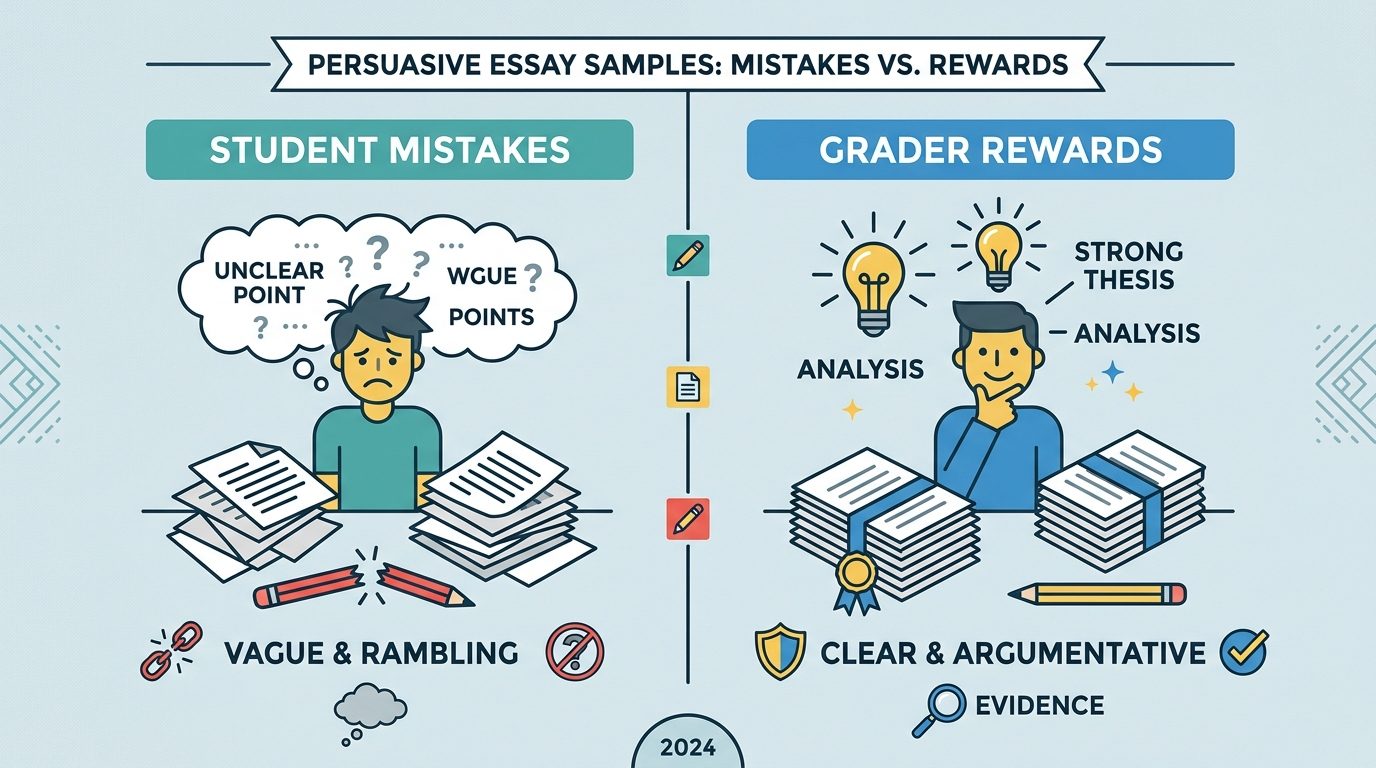
Most students read persuasive essay examples the way they read an answer key, looking for something to match. That habit misses what actually earns the grade.
| What students tend to notice | What graders actually reward |
| The topic | How well the reasons fit the named reader |
| Impressive vocabulary | Clear, specific claims |
| Length | Whether each paragraph moves the reader closer to yes |
| Number of sources | How precisely one source answers one doubt |
| A strong opinion | A fair answer to the strongest objection |
Each sample below is followed by the moves behind its grade, so the useful part is visible without guesswork. Samples from a teacher, a textbook or an essay service work the same way: the value sits in the decisions, not in the wording.
Sample One: A Letter to a Town Council
Level: high school
Prompt: Write a persuasive letter to your town council proposing one change that would bring more people downtown in the evening.
The Full Council Letter
Dear Members of the Harlow Town Council,
Every Friday evening the commuter train empties onto the platform at Harlow Station, and within ten minutes the streets behind it are quiet again. The shops on Mill Street close early because there is no one to stay open for. The gravel lot behind the station, empty since the hardware store closed, could change that. The council should approve a six week trial of a Saturday night market on that lot, because it would bring evening customers downtown at almost no cost to the town, with safeguards that answer the concerns neighbors are likely to raise.
The first reason is one this council has already named as a priority: keeping downtown businesses alive. A night market gives people a reason to walk Mill Street after dark. Visitors who come for a food stall or a craft table pass the bakery, the bookshop and the pizza place on the way, and some of them stop. The market does not compete with those shops so much as deliver customers to their doors.
The second reason is cost. Vendors would pay a small stall fee, and that money would cover portable lighting, extra bins and a cleanup crew on Sunday morning. The lot is already town property, so there is no rent. Because the proposal is a trial rather than a permanent change, the council risks one summer of Saturdays, not a line in next year’s budget.
Some residents on Station Road will worry about noise and parking, and those worries are fair. The market would close at ten, with no amplified music, and stalls would face away from the houses. On Saturday nights the commuter lot beside the station sits nearly empty, which gives visitors somewhere to park without filling residential streets.
A trial answers the most important question better than any letter can: whether people will come. I ask the council to vote at its next meeting to approve six Saturdays starting in June, with a public review in August. If the lot stays empty, nothing is lost. If it fills, Harlow gets its evenings back.
Respectfully,
A student at Harlow High School
Five Moves That Earn the Marks
- It opens on a scene the council already knows. The empty street after the train leaves is a problem the reader has seen, so the letter starts on shared ground rather than on the writer’s opinion.
- The thesis carries the whole plan. One sentence names the action, both reasons and the safeguards, the same shape the guide to persuasive essay thesis statements builds step by step.
- Each reason speaks the council’s language. Business survival and budget risk are the council’s concerns, and the writer’s own wish for something fun to do on Saturdays never appears.
- The objection is named before anyone raises it. Calling the neighbors’ worries “fair” costs nothing and buys credibility for the answer that follows.
- The request is small and reversible. A trial with a review date is easier to approve than a permanent change, which makes a yes more likely.
Sample Two: A College Proposal to Dining Services
This extract comes from the middle of a longer proposal. It is the paragraph that handles the reader’s biggest fear, and where a paragraph like this belongs in a full paper is covered in the guide to persuasive essay structure.
Level: college
Prompt: Persuade a specific decision maker on your campus to change one policy. Support your case with credible sources.
The Liability Paragraph
The strongest reason to keep discarding unsold food is legal risk, and that concern deserves a direct answer. A donated tray of pasta that made someone ill could, in theory, become the university’s problem. In practice, federal law already addresses this. The Bill Emerson Good Samaritan Food Donation Act, passed in 1996, protects those who donate food in good faith to nonprofit organizations from civil and criminal liability, except in cases of gross negligence or intentional misconduct. The campus pantry operates as a nonprofit partner of the university and already follows food handling rules for packaged donations. A pilot limited to sealed, refrigerated items would keep the risk as low as the dining hall’s own daily service. The question facing Dining Services is therefore not whether donation is safe, but whether a protected, tested practice is worth one semester’s trial.
Why the Objection Answer Lands
- The reader’s fear comes first, at full strength. A director who worries about liability sees that worry taken seriously in the opening sentence.
- One precise source replaces several vague ones. Naming a specific law and what it covers does more work than claiming donation is “usually legal.”
- The plan bends to meet the objection. Limiting the pilot to sealed, refrigerated items shows the writer adjusted the proposal instead of brushing the concern aside.
- The last sentence reframes the decision. It turns “is this safe” into “is this worth trying,” a far easier question to answer yes to.
Anchoring the case in a named law pushes this paragraph toward the evidence standard of an argumentative essay, yet the framing around the director’s own priorities keeps it persuasive.
Sample Three: A Letter That Persuades a Grandmother
Persuasion is not only for councils and administrators. Some assignments ask for a letter to someone the writer knows, and personal audiences are an underused source of persuasive essay topics with real stakes.
Level: middle or high school
Prompt: Write a persuasive letter to a family member convincing them to change one habit.
The Password Letter Extract
Dear Grandma,
You told me last month that you keep your passwords in the green notebook by the phone, and that it works fine. It does work, until the day the notebook goes missing or a visitor flips it open. I am not asking you to remember more. I am asking you to remember less. A password manager is an app that keeps every password locked behind one master phrase, so the only thing you would need to know is that phrase, something long and easy to picture, like four random words you can see in your head. I will set it up with you on Sunday, and we will move the passwords over together, one page at a time. Then the green notebook can go where it belongs, with your recipes, not your bank details.
Four Moves Built on Respect
- It starts from the reader’s own words. Quoting what Grandma said shows the writer listened, so the pushback feels respectful rather than bossy.
- The concession is built into the pitch. “It does work” admits the current habit has value before pointing out its risk.
- The fear is flipped. The likely objection, one more thing to remember, becomes the main benefit: fewer things to remember.
- The request removes effort. A specific day and an offer to do it together turn a vague suggestion into a plan that is hard to refuse.
The Three Samples Side by Side
| Sample | Level | Prompt | Main technique | Length | Move that lifts the grade |
| Town council letter | High school | Propose a change that brings people downtown | Reasons framed around the council’s priorities | Full essay, about 380 words | A small, reversible request |
| Dining services proposal | College | Change one campus policy, with sources | One precise source answering the strongest objection | Extract, about 180 words | Narrowing the plan to meet the objection |
| Letter to a grandparent | Middle or high school | Convince a family member to change a habit | Turning the reader’s fear into the benefit | Extract, about 170 words | An offer that removes effort |
Read together, these persuasive essay examples share one habit: every writer starts from the reader’s concern, never from their own opinion. The shape repeats too, with a position early, reasons in the middle, an objection answered and a specific request at the end. That repeating shape is easy to turn into a plan, and the persuasive essay outline template lays it out with blanks to fill.
Borrowing Moves Without Borrowing Words
Persuasive essay examples are for studying decisions, not collecting sentences. Copying phrasing, or even a sample’s topic and reasons, counts as plagiarism under most academic integrity policies. It also rarely fits a different prompt.
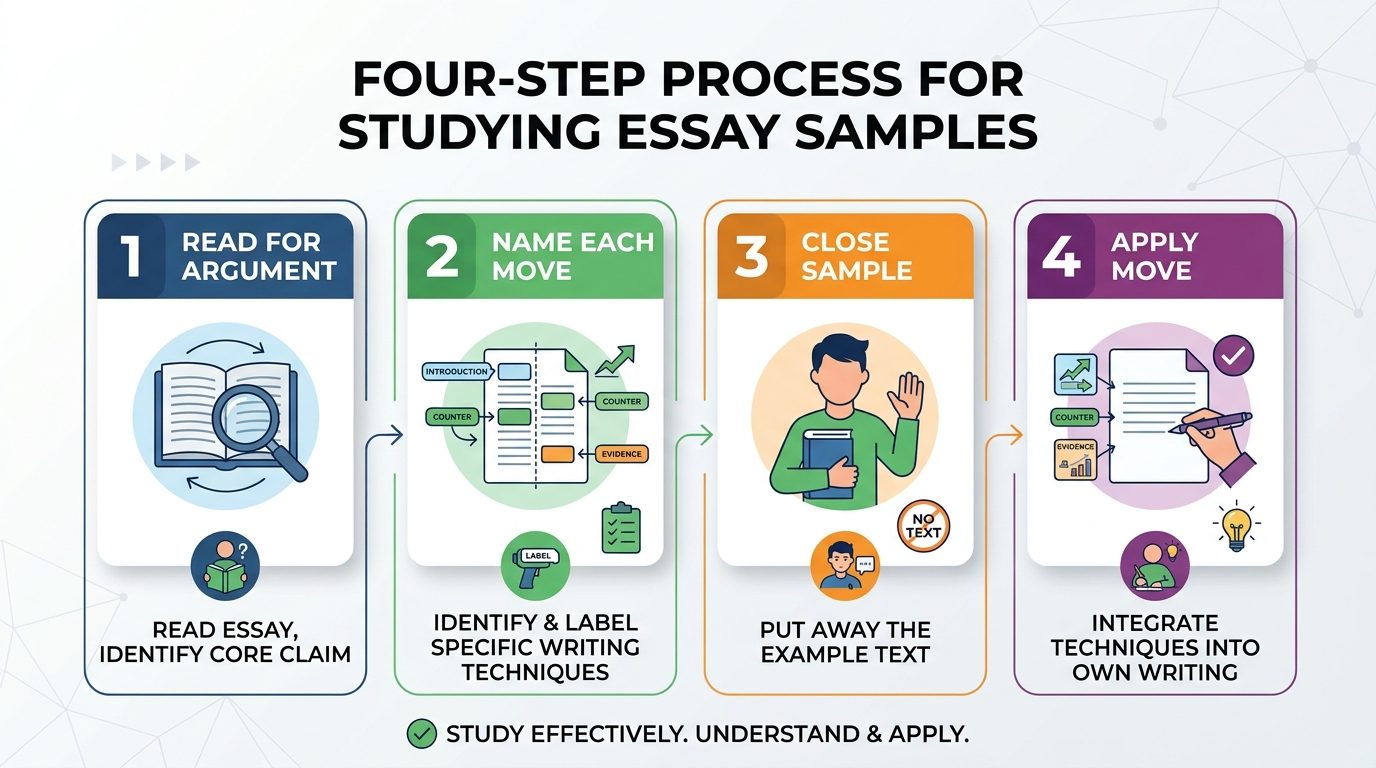
A Four Step Study Routine
- Read the sample once for the argument, then again only for the moves.
- Name each move in five plain words or fewer.
- Close the sample completely before drafting.
- Apply one move at a time to the new topic, then compare the result with the original.
Adapting One Move to a New Topic
The Move in the Sample
Sample Three turns the reader’s objection into the main benefit: remembering one phrase instead of dozens.
The Same Move on a New Topic
A student persuading a busy parent to try a shared family calendar can use the identical move with entirely different words. The parent’s objection is lack of time, so the letter presents the calendar as the thing that gives time back.
The full drafting process, from choosing the reader to writing the final request, is laid out in how to write a persuasive essay.
Five Traps When Studying Persuasive Samples
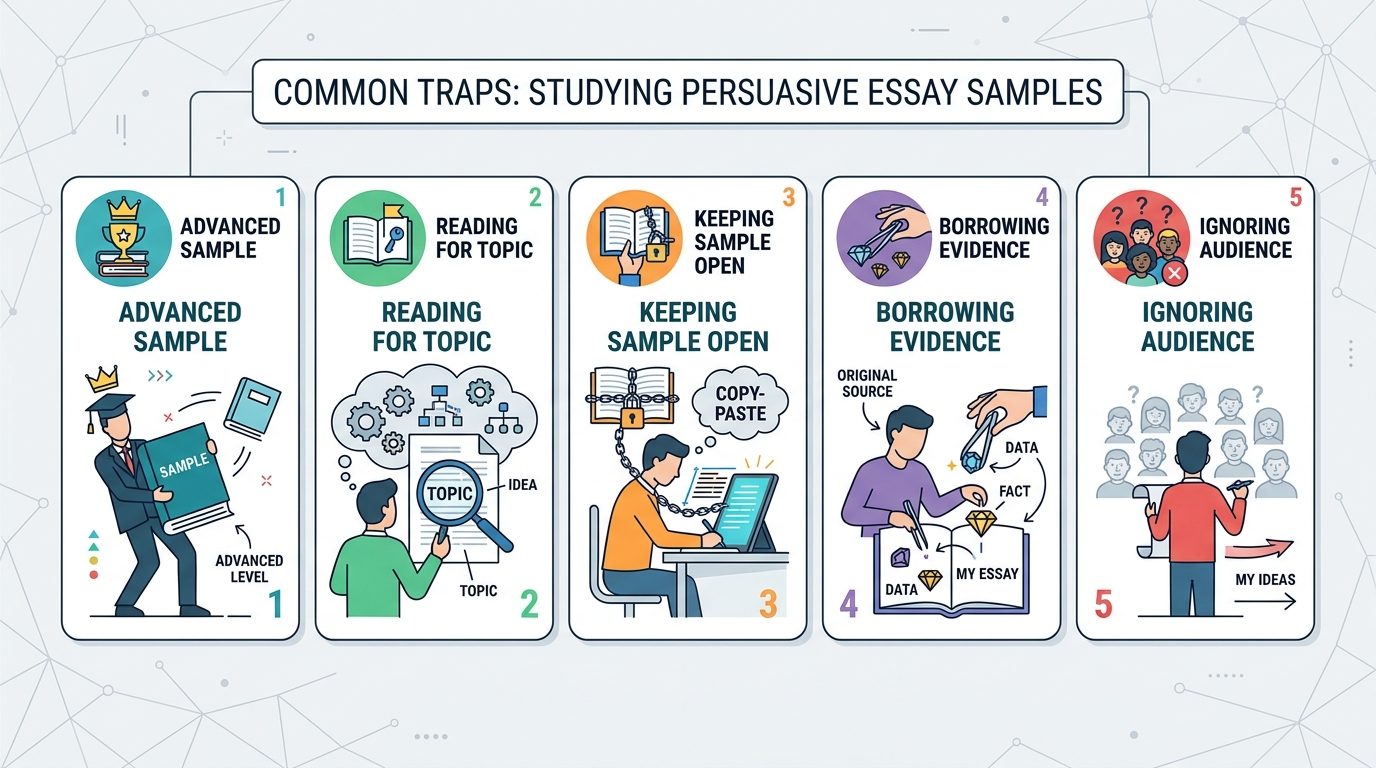
- Choosing the most advanced sample. A college proposal models the wrong tone and length for a middle school letter, so match the sample to the level of the assignment.
- Reading for the topic. A strong essay about a night market says nothing about which topic to pick. The transferable part is the moves.
- Keeping the sample open while drafting. Phrases leak into the new essay without the writer noticing.
- Borrowing the evidence. A source cited in a sample still has to be found, read and checked before it goes into a new essay.
- Ignoring the audience. Each sample was built for one reader, and reusing its reasons for a different reader throws away what made it work.
For the thinking behind these samples, including why the reader matters so much, the main persuasive essay guide covers the genre from definition to common mistakes.
FAQ
Where can I find good persuasive essay examples?
Start with your course materials, since teachers often share past samples that match the exact prompt and rubric. Textbooks, university writing center websites and annotated collections like this page are also reliable. Whatever the source, choose samples at your level that come with annotations, because an unexplained sample shows the result but hides the decisions.
Can I use a persuasive essay example as a template?
You can use its shape, but not its words, topic or evidence. Borrowing the order of parts, such as position, reasons, objection and request, is normal practice. Copying sentences or reusing the same argument on the same topic counts as plagiarism under most academic integrity policies, and it usually fits your prompt badly anyway.
How long should a persuasive essay sample be to be useful?
A useful sample is close to the length your assignment asks for. Short letters and high school essays often fall between a few hundred words and a couple of pages, while college papers run longer. A sample far longer or shorter than yours can mislead you about how much space each reason and the rebuttal deserve.
Do persuasive essays need citations like the samples?
Yes, whenever they use outside facts. School essays should show in text citations and a list of sources in the required style. The persuasive essay format guide covers how to cite evidence in MLA and APA, including how the list of sources at the end should look.
Is it okay to use first person in a persuasive essay?
It depends on the form and your instructor. Letters, speeches and personal appeals often use first person naturally, as Sample One and Sample Three do. Formal academic essays usually avoid it and keep the focus on reasons and evidence. When in doubt, check the rubric, since some instructors deduct marks for first person in formal papers.