A persuasive essay outline for college maps one thesis, three or so reasons chosen for a specific reader, the evidence behind each, the strongest objection with a planned response, and a closing request. Written at sentence level rather than as single words, it turns into a draft almost paragraph for paragraph.
A Weak Outline Beside a Working One
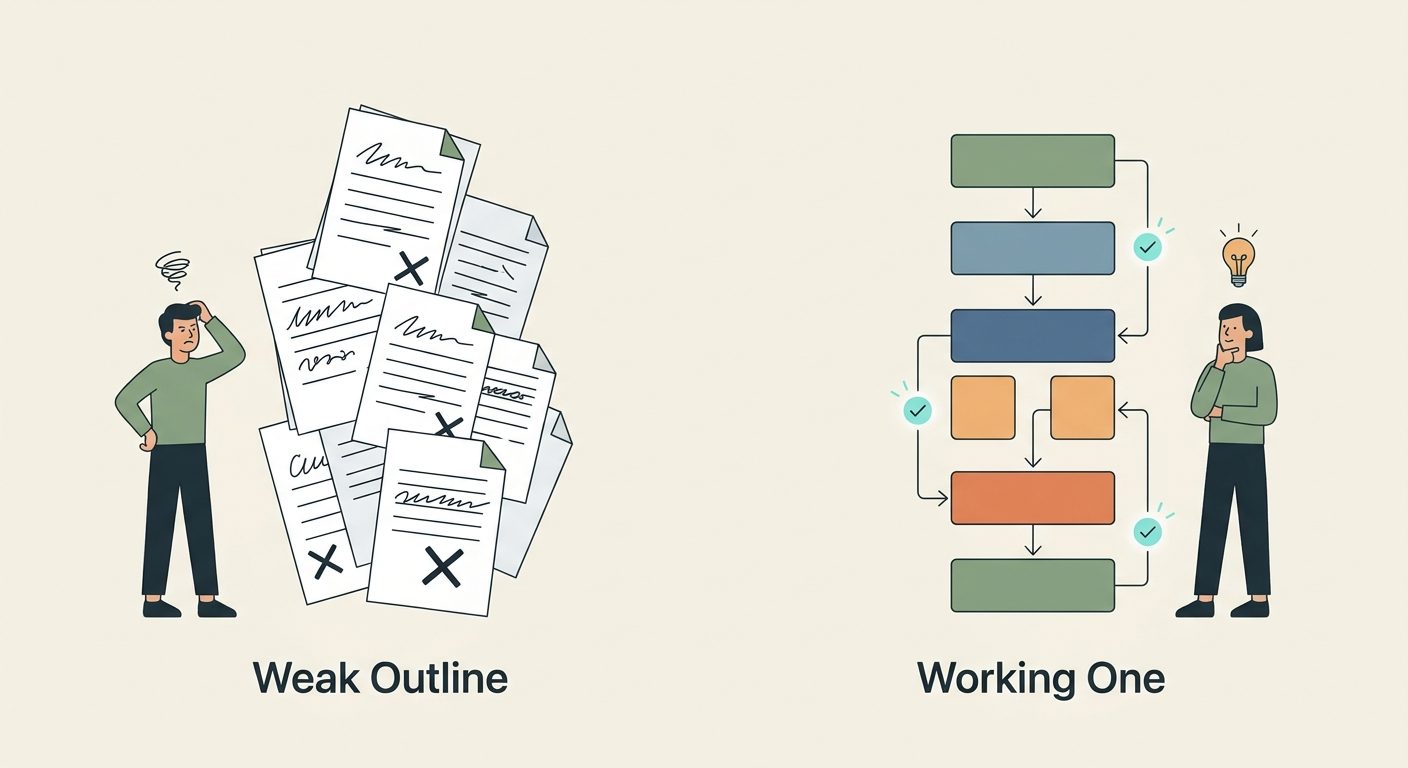
Most weak drafts can be traced back to a weak persuasive essay outline, and the problem is usually visible before a single paragraph exists.
The Outline Most Students Start With
- Intro: food for fines
- Reason 1: helps people
- Reason 2: food banks
- Reason 3: fair
- Conclusion
Every line names a topic, not a claim. There is no reader, no evidence and no objection, so the draft has nothing to argue against and no one to convince.
The Same Plan Rebuilt Around a Reader
- “Helps people” becomes: Accepting food donations for small parking fines clears unpaid tickets the county currently spends staff time chasing.
- “Fair” becomes: A capped program lets residents who cannot afford a fine resolve it before late fees make it worse.
- A missing line appears: Objection: lost revenue. Response: the program covers only fines under a set amount, for one month a year.
The difference is not length but decisions. Each rebuilt line names a claim, a reader and a stake. A model outline from an instructor, a writing center or an essay service is worth studying for exactly that: the level of each line, not its topic.
The Persuasive Essay Outline Template
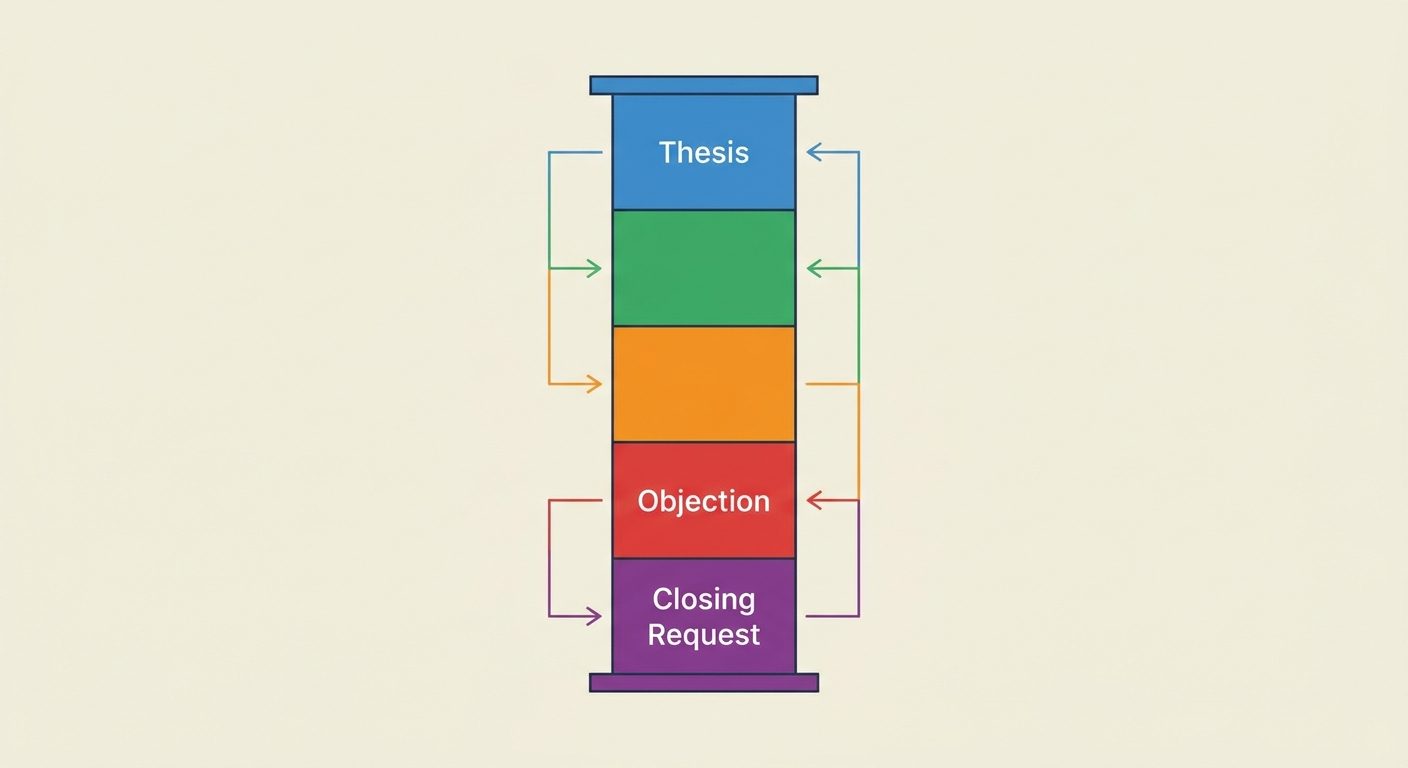
College instructors expect a thesis with reasons, cited evidence and a rebuttal, and this template has a slot for each. What every part accomplishes in the finished essay is covered in the guide to persuasive essay structure. This page stays with planning.
- Opening
- Hook: [a fact, scene or problem the reader already cares about]
- Context: [what the reader needs to know, in two or three sentences]
- Thesis: [position] because [reason one], [reason two] and [reason three]
- Reason one, the strongest
- Claim: [one sentence stating the reason]
- Why this reader cares: [the value or interest it connects to]
- Evidence: [source, fact or example] ([citation])
- Link back: [how it supports the thesis]
- Reason two
- Claim: [ ]
- Why this reader cares: [ ]
- Evidence: [ ] ([citation])
- Reason three
- Claim, reader interest and evidence: [same three lines as above]
- Objection and response
- Strongest objection: [stated the way an opponent would put it]
- What is true in it: [the fair concession]
- Response: [evidence or an adjustment that answers it]
- Closing
- Restated position: [the thesis in new words]
- Request: [the specific action or belief asked of the reader]
- Stakes: [what happens if nothing changes]
The line that separates a persuasive plan from any other outline is “Why this reader cares.” An empty slot there is the earliest warning that a reason is chosen for the writer, not the audience.
One Template, Filled: Food for Fines
Assignment: a college composition policy proposal that persuades a local decision maker to adopt one change, using at least three credible sources.
Reader: the county board of supervisors.
Proposals aimed at a named decision maker are among the easiest persuasive essay topics to outline, because the reader’s priorities are already public.
- Opening
- Hook: parking tickets that sit unpaid for months, costing staff time on both sides
- Context: the county food bank’s supply is lowest in late winter [food bank report]
- Thesis: The board should run a one month food for fines program each February, because it recovers stalled ticket payments, restocks the food bank when donations are lowest, and lets low income residents clear small fines before late fees pile up.
- Reason one: recovered payments
- Claim: a donation option resolves tickets the county is not collecting now
- Why the board cares: collection costs come out of the same budget it approves
- Evidence: county treasurer figures on tickets unpaid after ninety days [treasurer report]
- Reason two: food bank supply
- Claim: a February program meets the food bank’s weakest month
- Why the board cares: the county already funds food assistance
- Evidence: the food bank’s own seasonal supply data [food bank report]
- Reason three: fewer disputes
- Claim: residents clear fines instead of appealing or ignoring them
- Why the board cares: fewer appeals mean less work at the clerk’s office
- Evidence: an interview with clerk’s office staff [interview, date]
- Objection and response
- Objection: the county loses fine revenue
- Concession: some residents who would have paid cash will donate instead
- Response: cap eligible fines at a set amount, limit the program to one month and report results to the board
- Closing
- Restated position: a small, reversible pilot costs little to test
- Request: approve a February pilot with a review at the spring meeting
- Stakes: another year of stalled tickets and empty shelves
The thesis line lists all three reasons in the order the body will follow, which is what keeps the outline organized. The guide to persuasive essay thesis statements shows how to build that sentence from scratch.
Scaling Up for a Longer Research Argument

A five paragraph plan fits a short assignment. A research argument of eight to twelve pages keeps the same skeleton but adds sections, and the outline should name them before research begins.
Where the Extra Pages Go
A Background Section
Placed after the opening, it explains how the current policy works and why it exists. Readers who do not understand the status quo will not accept a change to it.
A Second Objection
Longer papers are expected to handle more than one serious counterargument, each with its own response. In the sample, a second objection might be that the program is hard to administer.
An Implementation Section
Placed before the closing, it covers who runs the change, what it costs and how success will be measured. Decision makers approve plans they can picture.
Finished papers show how these sections share the page, and the persuasive essay examples include annotated samples at several levels.
Turning Outline Lines Into Paragraphs
A sentence level outline nearly writes the topic sentences for the draft. The expansion follows a fixed order:
- Turn the claim line into a topic sentence.
- Add the evidence with its citation.
- Write one or two sentences tying that evidence to the reader’s interest.
- End with a transition toward the next reason.
From Reason Line to Topic Sentence
Outline line: a donation option resolves tickets the county is not collecting now.
Draft sentence: Every month the county carries a stack of parking tickets that are neither paid nor worth the cost of chasing, and a food donation option would clear many of them without a single collection call.
From Objection Line to Rebuttal
Outline line: the county loses fine revenue.
Draft sentence: The most reasonable concern about this proposal is revenue, and part of it is real: a resident who would have paid $25 may bring groceries instead.
The rest of the drafting process, from research to final revision, is laid out in how to write a persuasive essay.
Signs an Outline Will Produce a Weak Draft

- Every line is a single word: rewrite each one as a full claim a reader could disagree with.
- The reader slot is empty: name the value or interest each reason connects to, or replace the reason.
- Evidence is listed as “research”: name the actual source now, or flag the gap so research targets it.
- The objection is the weakest available: choose the one the reader would raise first.
- The closing says “take action”: name the exact vote, policy or habit being requested.
For the persuasion principles behind these fixes, including why the audience comes first, the main persuasive essay guide covers the genre in full.
FAQ
How long should a persuasive essay outline be?
For a short essay, one page is usually enough. A research argument of eight pages or more often needs a two or three page outline, since each section carries its own evidence and citations. Length matters less than detail: every line should state a claim, not just name a topic.
Should a persuasive essay outline use full sentences?
Yes, for most college assignments. Full sentences force you to decide what each point actually claims, and they convert almost directly into topic sentences. Short phrases work for a quick personal plan, but instructors who ask for a submitted outline usually expect sentence level detail.
How many reasons should a persuasive outline include?
Three reasons is the common default, but two strong ones beat four weak ones. Each reason needs its own evidence and a clear connection to the reader’s interests. If a reason cannot fill all three lines of the template, drop it or merge it with another.