
These expository essay examples include one complete college essay explaining why airplane windows are round and two extracts, a process piece on how ice rinks are built and a comparison of tsunamis and wind waves. Each sample shows its prompt, grader style margin notes and the move that earns a top grade.
Reading These Samples the Way a Grader Does

Each of the expository essay examples below carries small numbered markers, such as [1], placed exactly where a grader would write a note in the margin. The notes underneath explain what each marked sentence does and why it earns marks.
Graders reading expository work are checking four things:
- accuracy that a reader could verify;
- a pattern of explanation that is easy to follow;
- technical terms explained the first time they appear;
- no opinions, verdicts or advice.
Samples from a textbook, a writing center or an essay writing service can be read with the same marker system. Mark the sentences that do real explaining, and the rest of the page usually turns out to be connecting material.
The Full Essay: Why Airplane Windows Are Round
Level: first year college composition
Prompt: Explain the cause behind a design feature people see every day but rarely think about.
Why Airplane Windows Are Round
Almost every passenger window on a modern airliner has rounded corners, and the shape is not a style choice. [1] Windows are round because square corners concentrate stress in a pressurized fuselage, a lesson the aviation industry learned through the failures of the first jet airliner, the de Havilland Comet. [2]
At cruising altitude, the air outside a plane is too thin for passengers to breathe comfortably, so the cabin is pressurized. The pressure inside pushes outward on the fuselage, which expands slightly during flight and relaxes after landing. Each flight is one cycle of stretching and relaxing, and an airliner goes through thousands of these cycles over its working life.
Engineers call a sharp change in shape a stress concentration. [3] When a metal sheet with a square hole is stretched, the force that would otherwise spread evenly across the sheet crowds into the corners of the hole. Repeated stretching at those points produces tiny cracks, a process known as metal fatigue, and each cycle can make a crack a little longer. A rounded corner gives the force a curve to flow around, so no single point carries the whole load.
The Comet entered passenger service in 1952 with openings that had sharper corners than later designs. After two Comets broke apart in flight in 1954, British investigators pressurized a Comet fuselage over and over in a water tank until it failed. The crack began at the corner of an opening in the fuselage. [4] Airliners built afterward used rounded windows and reinforced the structure around every opening.
The oval window is the visible end of a chain of causes. Thin air requires pressurization, pressurization stretches the fuselage on every flight, and stretching concentrates stress wherever a shape turns sharply. Rounding the corners breaks that chain at its most dangerous point. [5]
Margin Notes on the Window Essay
- [1] It opens with something the reader has already seen. Nearly everyone has looked out of an airplane window, so the essay starts from a familiar observation instead of a dictionary definition.
- [2] The thesis states the cause and the scope, not an opinion. It names the cause and the one historical case the essay will use, the kind of sentence the guide to the expository essay thesis breaks into its parts.
- [3] A technical term arrives with its meaning attached. “Stress concentration” is explained in the same paragraph through a picture the reader can hold in mind: a stretched sheet with a square hole.
- [4] The evidence is a real event, reported neutrally. There is no blame and no drama, just what investigators did and what they found.
- [5] The ending compresses rather than repeats. It restates the whole causal chain in one sentence and adds no new fact.
A Process Extract: How an Ice Rink Is Built
Level: high school
Prompt: Explain how something familiar is made or done, step by step, for a reader who has never seen it happen.
An indoor ice rink starts long before any water is added. [1] Beneath the surface lies a concrete floor threaded with pipes, and a refrigeration plant pumps a chilled liquid, often brine or glycol, through those pipes until the concrete is well below freezing. Once the slab is cold enough, crews spray a fine mist of water across it, letting each thin layer freeze before adding the next. [2] Building the ice in layers keeps it hard and even, while a single thick pour would freeze unevenly. After the first few layers, the ice is painted white, which is why rinks look bright instead of gray from the concrete below. [3] Game lines and logos go on next and are sealed under more layers of water. The finished sheet is only a few centimeters thick, thin enough for the cold floor to keep it frozen through a full season of skating. [4]
What the Grader Circled in the Rink Extract
- [1] It starts before the obvious first step. Process essays often skip the preparation, and this one begins with what has to exist before any water arrives.
- [2] Each step carries a reason. Explaining why the ice goes on in thin layers turns a list of actions into an explanation.
- [3] One visual detail answers a question the reader probably had. The white paint explains the color of every rink without drifting into description for its own sake.
- [4] It ends on the result of the process. The last sentence connects the thin sheet back to the cold floor from the first sentence.
Process is one of six patterns that shape expository writing, and the guide to expository essay structure shows how each pattern orders its paragraphs.
A Comparison Extract: Tsunamis and Wind Waves
Level: college, introductory Earth science
Prompt: Compare two related phenomena that people often confuse, and explain what causes the difference.
Tsunamis and ordinary ocean waves look alike only at the very end of their journey. [1] Wind waves form when wind drags across the surface, so their energy stays in the upper layer of water, where a surfer feels them but a diver not far below barely does. A tsunami forms when the seafloor itself moves, usually during an undersea earthquake, and that movement lifts the entire column of water from the bottom to the surface. [2] The difference in scale changes everything else. Wind waves arrive every few seconds, while tsunami waves can be many minutes apart, because each one is enormously long from crest to crest. In deep water a tsunami may raise the surface so little that ships do not notice it passing. [3] Only near shore, where the seabed rises, does the wave slow down and pile up into the wall of water people picture. [4]
Why the Tsunami Comparison Holds Together
- [1] The first sentence names the only similarity, then drops it. The reader learns immediately that the essay is about a difference.
- [2] Both subjects are measured on the same point. The source of energy is explained for wind waves and then for tsunamis before the extract moves on, which is what point by point comparison means in practice.
- [3] The surprising fact works as evidence. Ships failing to notice a tsunami proves the claim about scale instead of merely decorating it.
- [4] The writer never ranks the two. The extract explains a difference and stops there. Arguing which hazard deserves more funding would be a different assignment entirely.
Point by point comparisons are easiest to draft when the shared criteria are decided in advance, and the expository essay outline guide shows how to lay those criteria out before writing.
Three Samples, Five Criteria
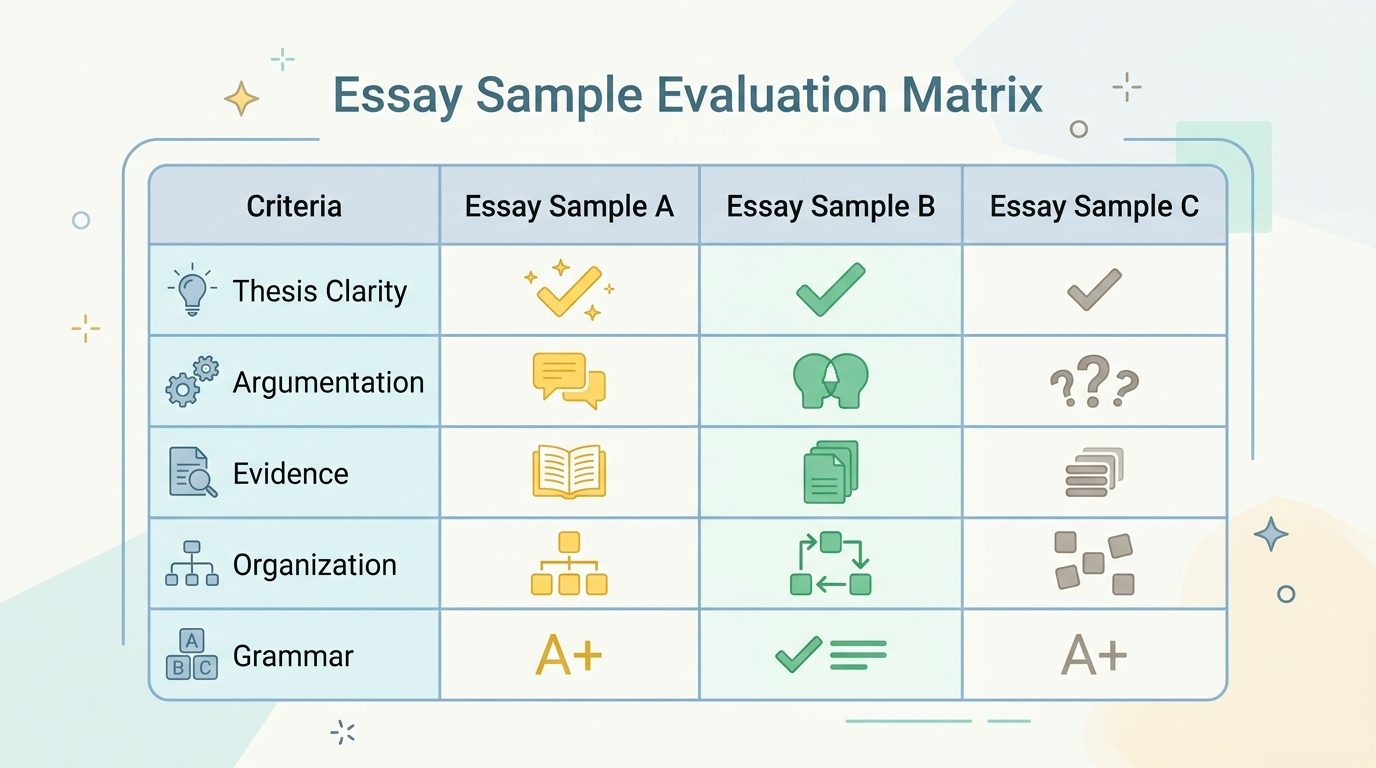
| Criterion | Airplane window essay | Ice rink extract | Tsunami extract |
| Level | First year college | High school | College science course |
| Prompt | Explain the cause of an everyday design feature | Explain how something familiar is made | Compare two phenomena people confuse |
| Pattern | Cause and effect | Process | Compare and contrast, point by point |
| Length | Full essay, about 370 words | Extract, about 190 words | Extract, about 170 words |
| Move that lifts the grade | A causal chain restated in one closing sentence | A reason attached to every step | Both subjects measured on the same criterion |
Across these expository essay examples the pattern changes, but one habit stays fixed: every fact is followed by what it means. Specific subjects make that habit easier, and a list of expository essay topics sorted by pattern helps match a subject to the kind of explanation a prompt asks for.
The Swap Test for Borrowing a Sample

Expository essay examples are safest to use as patterns, not as a source of sentences. The swap test keeps the line clear.
Running the Swap Test
- Pick the sample whose pattern matches the prompt.
- Choose a different topic that fits the same pattern.
- Draft with the sample closed.
- Compare the drafts, and rewrite any sentence that could move into the new essay with only the nouns changed.
What a Sample Can Lend
Parts That Transfer
- the pattern and the order of explanation;
- the habit of defining terms on first use;
- an ending that compresses instead of repeating.
Parts That Stay Behind
- the topic and its facts;
- the wording, down to the sentence level;
- the sources, which must be found and read firsthand.
The full process, from choosing a pattern to final revision, is set out in how to write an expository essay.
Three Ways Good Samples Get Misused

Treating the complete essay as the only model. The two extracts often teach more, because a single well built paragraph is easier to study than a whole paper.
Borrowing the facts. The Comet investigation and the layering of rink ice are real, but a student who uses them still has to find and cite an actual source. A sample page is not one.
Copying the level instead of the pattern. A college comparison is too dense for a middle school prompt, and a high school process piece is too light for a college one. The pattern transfers across levels, the density does not.
For the principles behind all three samples, including why clear explanation is harder than it looks, the main expository essay guide covers the genre in depth.
FAQ
Where can I find good expository essay examples for college?
Start with your course materials, since instructors often share past papers written for the same prompt. University writing center websites and textbooks are also reliable, as are annotated collections like this page. Prefer samples that explain their own choices, because an unannotated essay shows the result without showing why it works.
What makes an expository sample an A grade?
An A grade sample explains accurately, in a clear pattern, without opinion. Every technical term is defined, every fact is followed by what it means, and the paragraphs follow an order the reader can predict. The conclusion compresses the explanation instead of repeating it or adding new material.
Is it plagiarism to follow the structure of a sample essay?
No, following a pattern such as cause and effect or point by point comparison is normal practice. Plagiarism starts when you reuse the sample’s wording, its specific sequence of facts on the same topic, or its sources without reading them yourself. Changing only the nouns in borrowed sentences still counts as copying.