See the finished skeleton before building it
An expository paper usually explains a process, concept, relationship, cause, classification, or comparison. The outline should therefore answer a practical question: what must the reader understand first, second, and third for the explanation to make sense?
A simple working shape might look like this:
- Opening
- Context the reader needs
- Thesis that names the topic and scope
- Body section one
- First explanatory point
- Evidence or example
- Body section two
- Second explanatory point
- Evidence or example
- Body section three
- Third explanatory point
- Evidence or example
- Closing
- Bring the explanation together
- Restate the significance without adding a new topic
That is only the frame. A good expository essay can use different internal patterns depending on whether it explains stages, causes, categories, or relationships.
The five steps below turn that empty frame into something specific enough to draft.
Step 1: Give the topic a boundary

The fastest way to weaken an outline is to begin with a subject that could support twenty different essays.
A student planning a paper on campus libraries, for example, still has no route. The topic could become library architecture, digital borrowing, staffing, archives, quiet zones, or research support.
Shrink the subject until one question remains
A usable planning question might be:
How does a campus lost and found move an item from intake to return or final storage?
Now the essay has a process to explain.
Students who still need a workable subject can compare possible directions on the expository essay topics page before building the outline.
Write a one line scope note
Before creating headings, write one sentence stating what belongs in the paper.
For the running example:
The essay explains the path of an item after it reaches a campus lost and found, focusing on intake, recording, matching, and final handling.
That note is not the final thesis. It is a fence around the assignment.
Anything outside the fence can probably stay out.
Step 2: Build a blank expository essay outline template
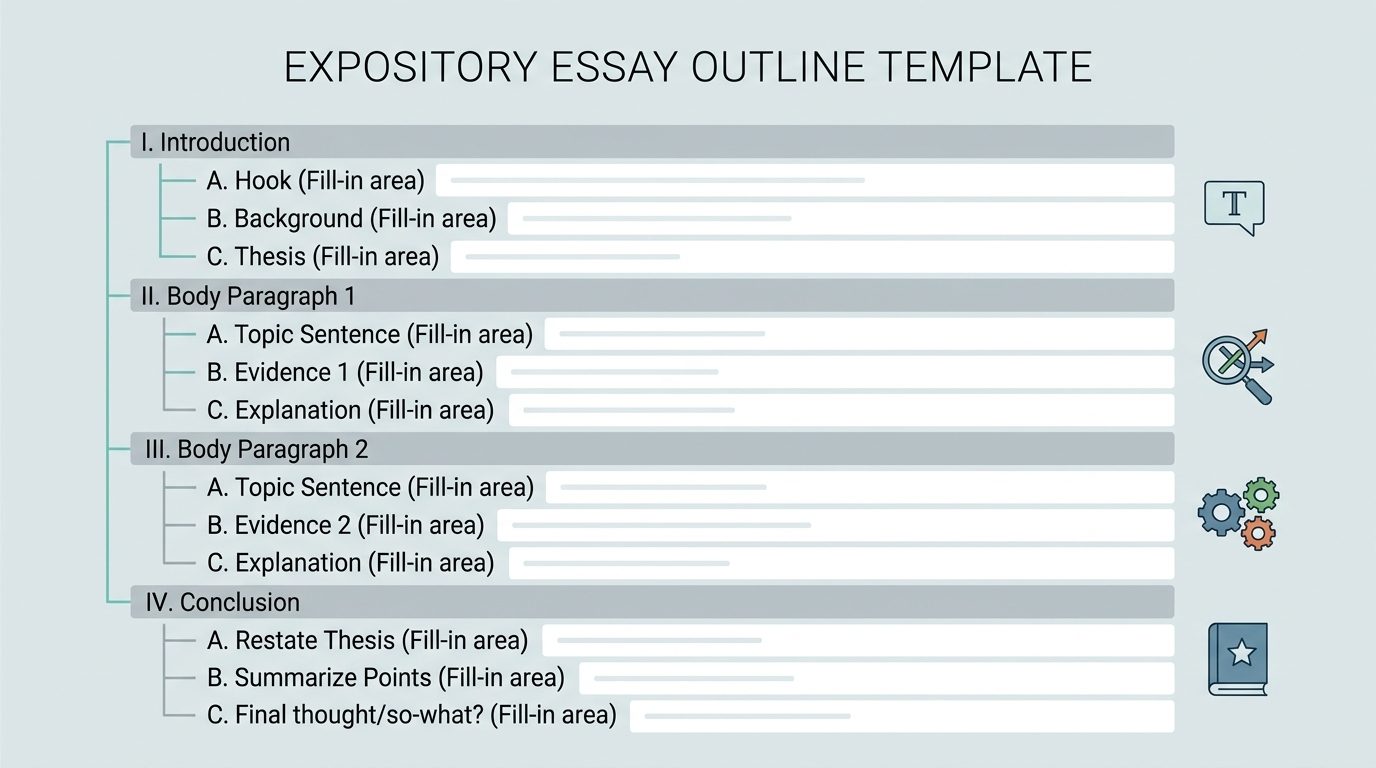
At this stage, the writer should create empty slots before filling them with facts. That makes missing sections easier to notice.
Students who want outside help organizing a difficult assignment can use an Essay service.
Blank fill in template
- Title: [working title]
- Opening
- Context: [what the reader needs to know first]
- Focus: [exact subject being explained]
- Thesis: [topic + scope of explanation]
- Body section one
- Main point: [first explanatory unit]
- Detail: [fact, definition, example, or process detail]
- Connection: [why this point comes first]
- Body section two
- Main point: [second explanatory unit]
- Detail: [fact, definition, example, or process detail]
- Connection: [how it develops the explanation]
- Body section three
- Main point: [third explanatory unit]
- Detail: [fact, definition, example, or process detail]
- Connection: [how it completes or advances the explanation]
- Closing
- Synthesis: [what the sections show together]
- Final significance: [why understanding the subject matters]
Use two layers instead of writing paragraphs early
Layer one: explanation
Each body section needs one clear job.
Layer two: support
Under that job, add the material that will help explain it.
This separation prevents the outline from becoming a rough draft filled with sentences that may later be cut.
A student who needs more detail about what each section does can use the expository essay structure page. The outline page is about planning where those parts will go.
Step 3: Fill the same template with one unusual topic
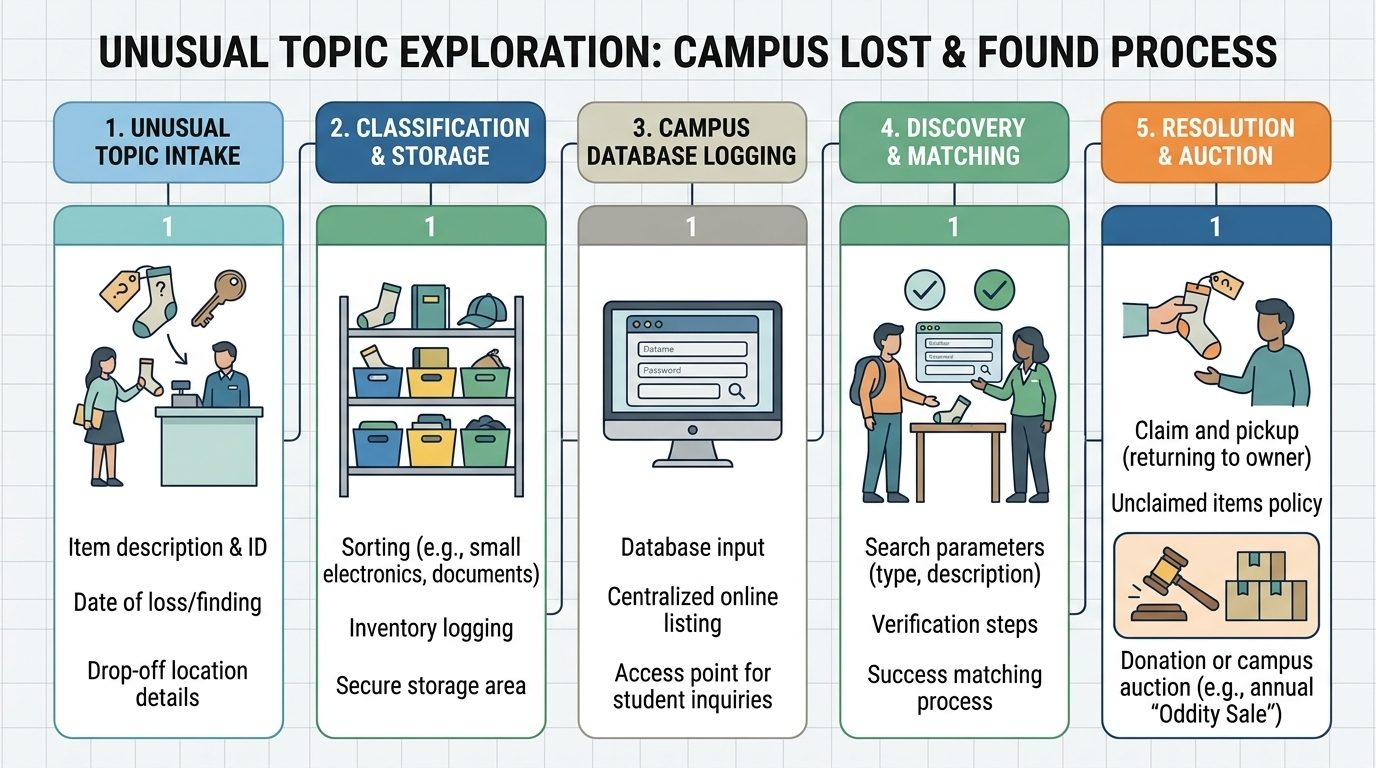
The completed model below uses the campus lost and found topic. The point is not the subject itself. The value lies in seeing how a broad process becomes a sequence of explainable units.
Completed outline: how a lost item moves through a campus lost and found
- Title: What Happens After a Lost Item Reaches Campus Lost and Found
- Opening
- Context: items arrive from classrooms, hallways, offices, and shared spaces
- Focus: the handling process after an object is turned in
- Thesis: the process can be explained through intake, recording, matching, and final handling
- Body section one: intake
- Identify where and when the item was found
- Record basic visible characteristics
- Keep the object with other newly received items
- Body section two: recording
- Create an internal description
- Add location and date information
- Separate items that may need special handling
- Body section three: matching
- Compare a claim with the stored description
- Use identifying details to reduce false matches
- Record the outcome of the claim
- Body section four: final handling
- Return matched items
- Keep unmatched objects for the required period
- Follow the local procedure for items that remain unclaimed
- Closing
- Bring the stages together as one tracking process
- Explain how clear records connect intake with eventual return or disposal
This version uses four body sections because four stages make the process easier to understand. An expository essay outline should serve the explanation rather than force every topic into three body paragraphs.
Students who want to see finished prose based on different explanatory tasks can compare the expository essay examples page after planning.
Step 4: Choose the outline method that matches the assignment
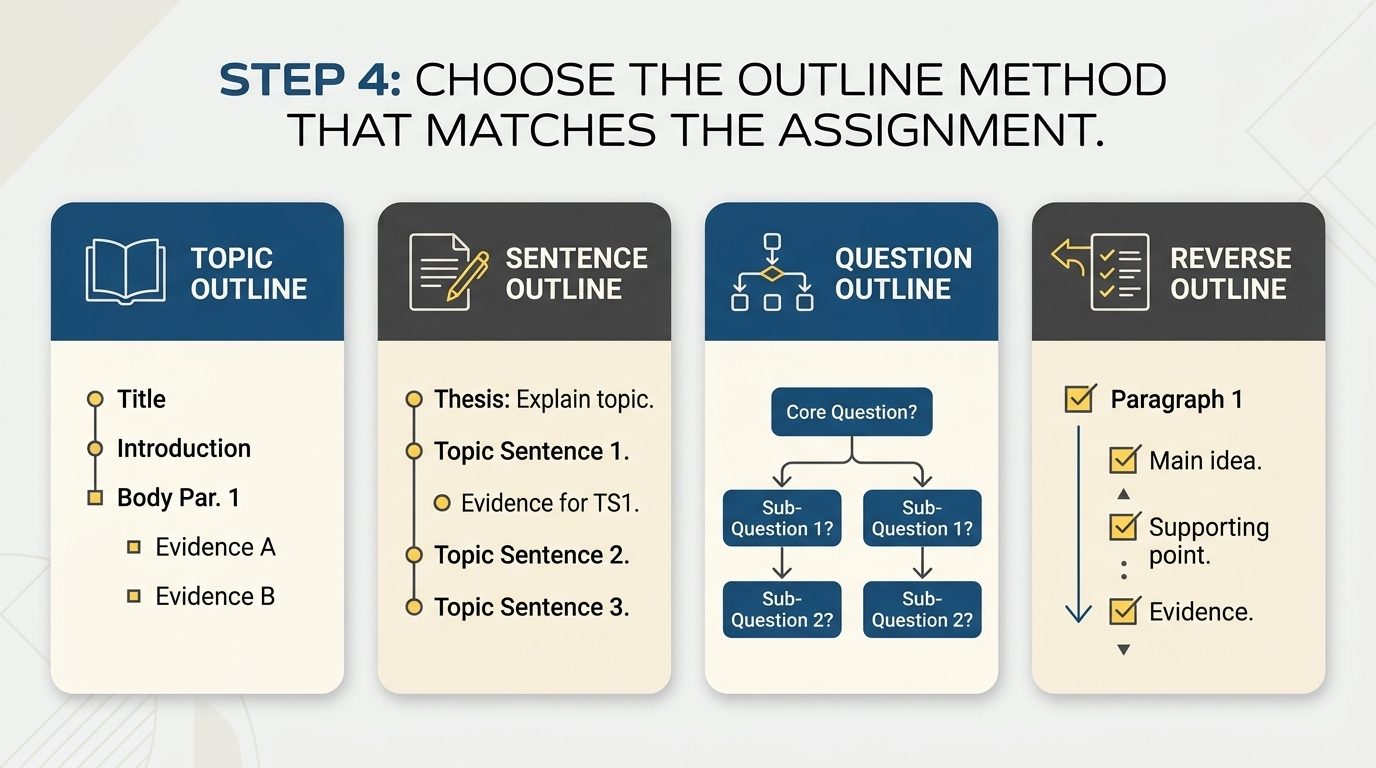
Not every writer needs the same kind of plan. Some students think best in short labels. Others need complete sentences before the logic becomes visible.
The table below compares four methods.
| Outline method | What it contains | Best use | Main risk |
| Topic outline | Short phrases | Fast planning and clear section order | May hide weak connections |
| Sentence outline | Complete sentences | Complex explanations where logic matters | Can turn into an early draft |
| Question outline | Questions each section must answer | Process and concept explanation | Questions may become repetitive |
| Reverse outline | One line summary of each drafted paragraph | Revision after a first draft exists | Less useful before drafting |
Topic outline
A topic outline works well when the sequence is already obvious:
- Intake
- Recording
- Matching
- Final handling
The plan stays light and easy to rearrange.
Question outline
The same paper could instead be planned through questions:
- What information is recorded when an item arrives?
- How is the item described?
- How can a later claim be checked?
- What happens if nobody claims the object?
Question planning is especially useful when an expository paper needs to answer reader confusion rather than prove a position.
Students who need to move from research to prose can follow how to write an expository essay once the planning stage is complete.
Step 5: Stress test the outline before drafting
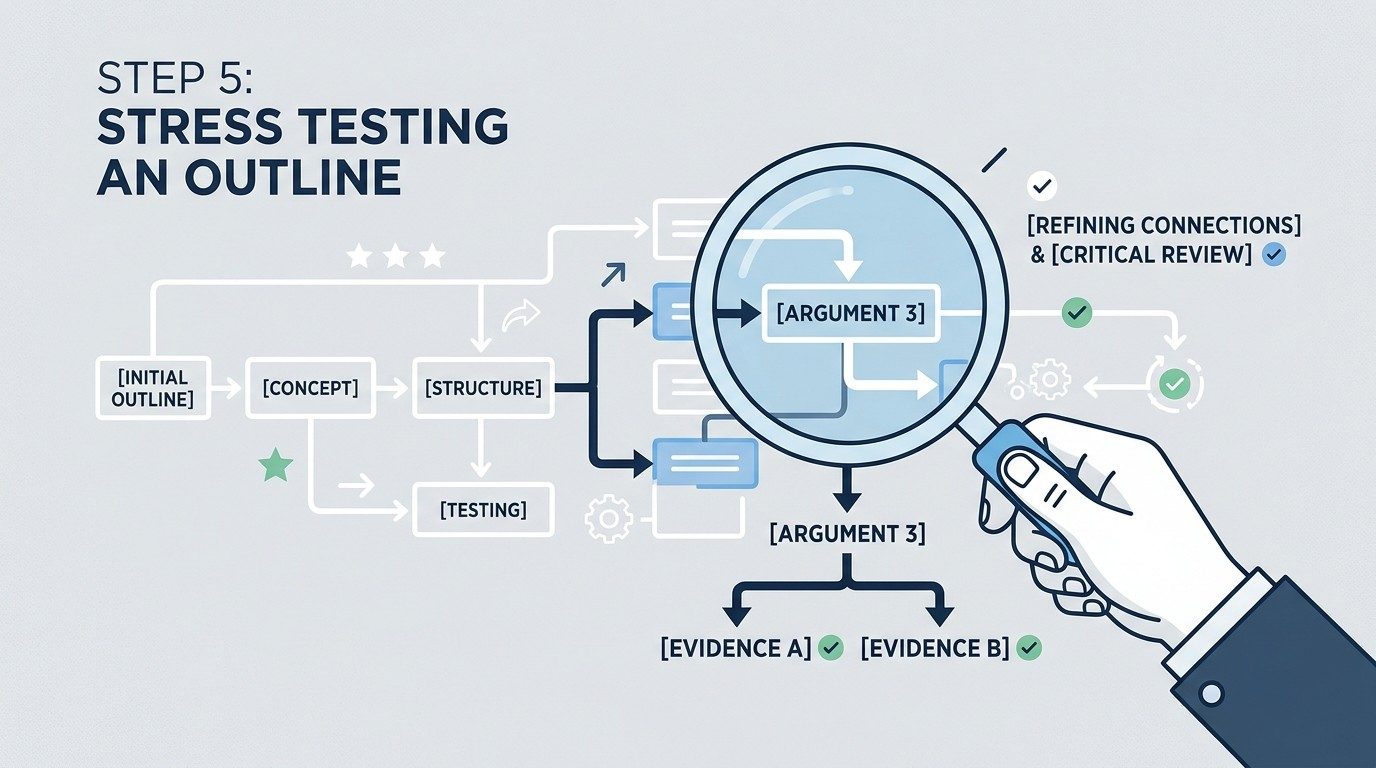
An outline is useful only if the writer can see a logical route from the opening to the final section.
The last planning step is therefore subtraction.
Check each section for a distinct job
Read only the body headings. If two sections appear to explain the same thing, the distinction may be artificial.
For example:
- Recording an item
- Entering item information
- Creating an item record
These probably belong in one section.
Check the order
Ask whether section three depends on something explained in section one or two. If so, the order is working.
A process essay normally follows stages. A classification essay may move from broad categories to specific ones. A cause and effect paper may need causes first and consequences later.
The expository essay thesis page can help if the outline feels coherent but the central scope is still difficult to express in one sentence.
Remove decorative points
A section should stay only if it helps answer the assignment.
Interesting background is not automatically useful background. An outline provides a cheap place to cut weak material before the writer spends time drafting it.
Stretch the outline for a longer expository paper
A longer assignment should usually deepen the explanation rather than simply make every paragraph longer.
The basic template can expand in three ways.
Add another explanatory layer
A body section can contain two related subsections.
For example:
Recording
- Basic description
- Location information
- Time information
Matching
- Claim details
- Verification
- Outcome recording
Split a complex stage
If matching becomes the most complicated part of the lost and found paper, it can become several body sections instead of one oversized paragraph.
The writer might separate claim submission, verification, and return procedures.
Reserve space for source support
Longer academic essays often need more evidence. The outline can mark source slots before drafting:
- definition source
- process source
- example
- comparison
- explanation of significance
This keeps research connected to a purpose.
Presentation rules belong later. The expository essay format page covers MLA and APA requirements after the content plan is stable.
Turn the outline into a first draft without copying it mechanically
An outline is scaffolding. The first draft should not read as if every bullet was converted into one sentence.
Start each section with the point the reader needs to understand, then expand only where explanation is required.
Draft body sections in three passes
- State the main idea.
- Add the detail that explains it.
- Connect the point to the next section.
For the lost and found example, the intake section might begin by explaining what information first enters the system. The next paragraph can then show why that information matters later when someone tries to identify an item.
Let transitions come from logic
Transitions do not need decorative phrases.
If one stage causes or enables the next, state that relationship directly.
Recording matters because matching later depends on those details. Matching leads naturally to the question of what happens after a claim succeeds or fails.
That is stronger than adding a generic transition merely because a new paragraph has started.
By this point, the expository essay outline has done its main job. The draft can grow from a clear explanatory route instead of being discovered sentence by sentence.
Fix planning problems before they reach the draft
The outline is only a list of nouns
Why it happens: The writer names subtopics but does not decide what each section explains.
The fix: Add one sentence under each heading stating the exact question that section answers.
Every body section has the same size
Why it happens: The writer assumes equal paragraph length means balanced organization.
The fix: Give more room to the part that requires more explanation. Balance comes from purpose, not identical section size.
Evidence appears before the claim
Why it happens: Research notes are pasted into the outline as soon as they are found.
The fix: Write the explanatory point first, then attach only the support that helps clarify it.
FAQ
How many body paragraphs should an expository essay outline have?
An expository outline should have as many body sections as the explanation requires. You do not need exactly three unless the assignment requires it. A simple classification may need three sections, while a process with four clear stages may work better with four. The outline should follow the logic of the subject rather than a fixed paragraph count.
Should an expository outline use full sentences?
It can, but full sentences are not always necessary. You can use a topic outline with short phrases when the order is already clear, or a sentence outline when the relationships between ideas need more testing. The best format is the one that exposes gaps before drafting begins.
What goes in the introduction part of an expository outline?
The introduction section should contain the context the reader needs, the exact focus of the paper, and a thesis that identifies the topic and scope. You do not need to draft the full opening paragraph inside the outline. A few planning lines are usually enough to define its job.