
Think of the thesis as the boundary of the explanation
An expository paper can fail before the first body paragraph if the thesis leaves the subject too wide.
Consider a topic such as food delivery systems. That subject could include packaging, logistics, worker scheduling, ordering software, restaurant operations, customer behavior, or payment systems. A thesis has to decide which part belongs in the paper.
A useful formula is:
[Specific subject] can be explained through [main scope or organizing points].
A slightly more detailed version is:
[Specific subject] works, develops, changes, or can be understood through [point one], [point two], and [point three].
The formula is not meant to produce identical sentences. Its job is to force one decision: what exactly will this essay explain?
One topic, three completely different theses
Take the subject campus package lockers.
A process thesis might be:
A campus package locker system moves deliveries through identification, secure storage, student notification, and collection.
A cause and effect thesis could be:
The growth of campus package lockers reflects increasing delivery volume, limited front desk storage, and the need for flexible collection times.
A classification thesis might read:
Campus package systems generally differ according to access method, storage design, and collection procedure.
The topic stays the same. The explanatory job changes.
That difference matters because an expository essay is built around explanation rather than persuasion. The thesis should tell the reader what kind of understanding the paper will provide.
Choose the explanatory job before writing the sentence
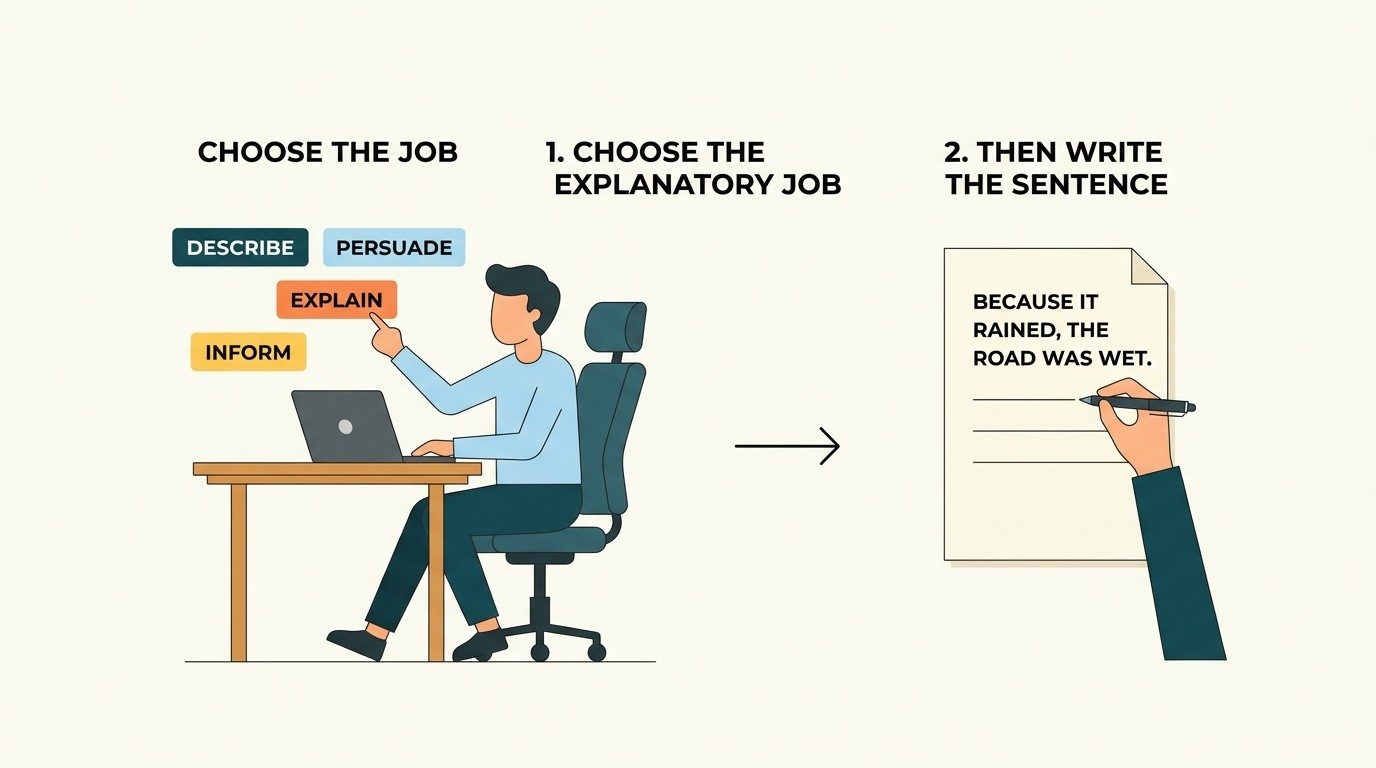
A thesis becomes easier to write when the student first identifies what the assignment is asking the paper to do.
Process explanation
This type explains stages or sequence.
A thesis should identify the process and the major stages that matter.
Returned library books move from intake to inspection, sorting, shelving preparation, and final placement.
Cause and effect explanation
This type explains why something happens, what follows, or both.
Condensation inside a closed food container develops through trapped moisture, temperature change, and contact with a cooler surface.
Classification explanation
Here, the essay divides a subject into meaningful groups.
Campus study spaces can be classified by noise level, type of activity, and degree of shared access.
Students who are still choosing what to explain can browse expository essay topics before forcing a broad subject into a thesis.
Comparison explanation
A comparison thesis identifies the subjects and the dimensions used to examine them.
Handwritten and digital notes differ most clearly in capture speed, later revision, searchability, and physical organization.
Definition and analysis
Some essays explain a concept by breaking it into parts.
A university archive is more than a storage room because archival work involves selection, description, preservation, and controlled access to records.
The wording may vary, but each thesis establishes a visible route through the subject.
See what changes between a weak and usable thesis
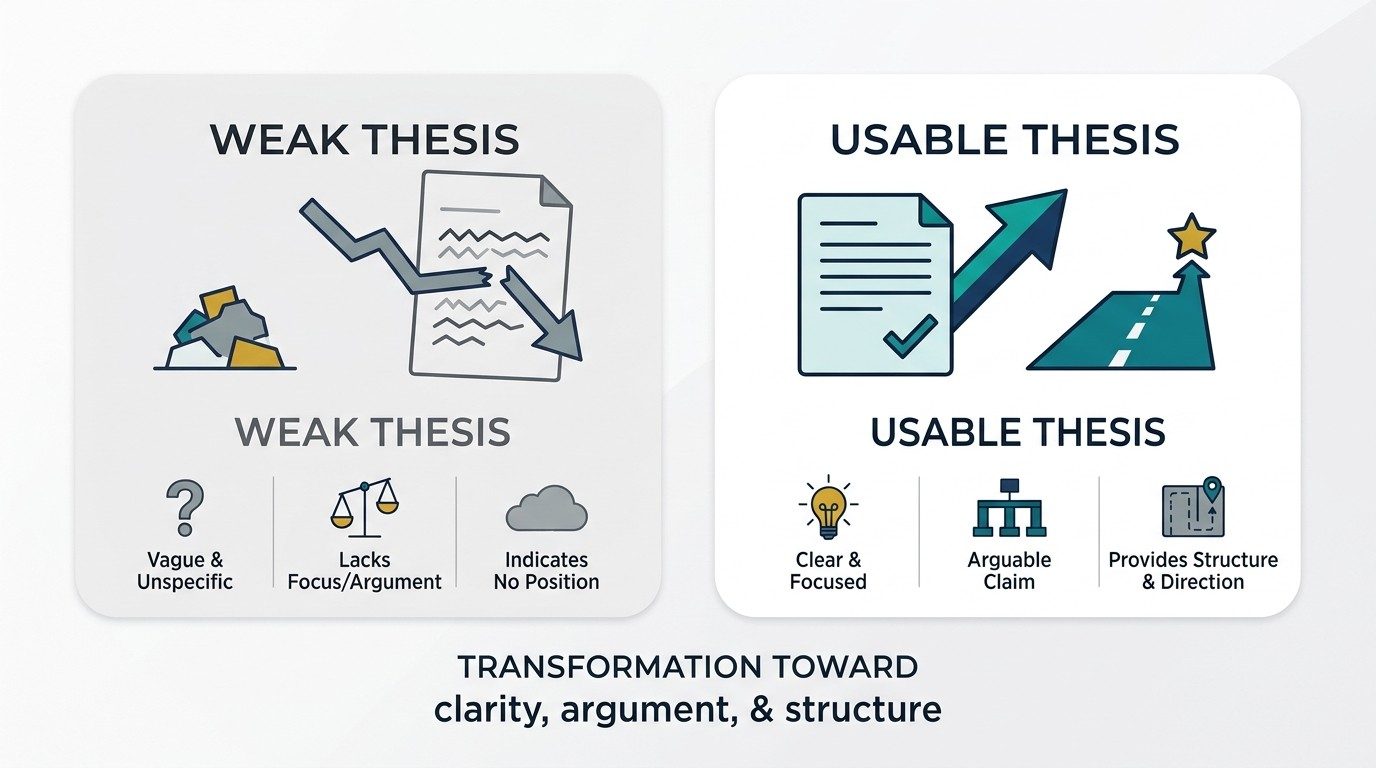
A weak expository thesis is often not incorrect. It is simply too open to guide the paper.
| Weak thesis | What is missing | Stronger thesis |
| This essay explains reusable containers. | No process or scope | A reusable container system depends on distribution, return, cleaning, and redistribution. |
| There are many kinds of campus study spaces. | Categories are not defined | Campus study spaces can be grouped by noise level, activity type, and access rules. |
| Package delivery has changed a lot. | Change is vague and time is undefined | Campus package handling has shifted from manual front desk collection toward notification systems, secure lockers, and flexible pickup. |
| Recycling involves several steps. | The important steps are unnamed | A campus recycling stream moves through collection, separation, processing, and preparation for reuse. |
| Digital notes and paper notes are different. | No basis for comparison | Digital and paper notes differ in editing, retrieval, physical organization, and long term storage. |
The stronger statements give the writer a selection rule. If information does not help explain the elements named in the thesis, it probably does not belong in the paper.
That selection becomes even more useful while creating an expository essay outline, because each thesis element can become a major planning section.
Use these ten thesis models for different explanatory tasks
These examples are intentionally varied in structure. Students should borrow the logic, not copy the sentence shape.
Systems and processes
- A campus lost and found moves an item through intake, identification, claim verification, and final return or storage.
- A reusable cup program operates as a cycle of distribution, return, cleaning, inspection, and redistribution.
- Digital library borrowing depends on authentication, licensing access, loan periods, and automatic return controls.
These theses tell the reader that sequence matters.
Causes and relationships
- Morning condensation on a greenhouse wall results from stored moisture, falling temperature, and contact with cooler surfaces.
- Long lines at campus service desks can develop when arrival times cluster, requests require different handling times, and only a limited number of service points are open.
- The visibility of old building repairs often depends on material differences, weathering, and the techniques used during restoration.
Each thesis names relationships without arguing that one side is better.
Students can compare finished explanatory writing on the expository essay examples page to see how a thesis is carried through actual paragraphs.
Classification and comparison
- Community gardens can be classified according to ownership, primary purpose, participant access, and the way individual plots are managed.
- Printed maps and navigation apps organize route information differently through scale, updating, search, and user interaction.
- University collection spaces differ according to preservation needs, access restrictions, and the types of material they hold.
Concept explanation
- A queue is not simply a line of waiting people because its behavior depends on arrival patterns, service order, available capacity, and processing time.
A useful expository essay thesis makes the reader expect an explanation. It should not quietly turn into a recommendation or debate.
Keep opinion out without making the thesis empty
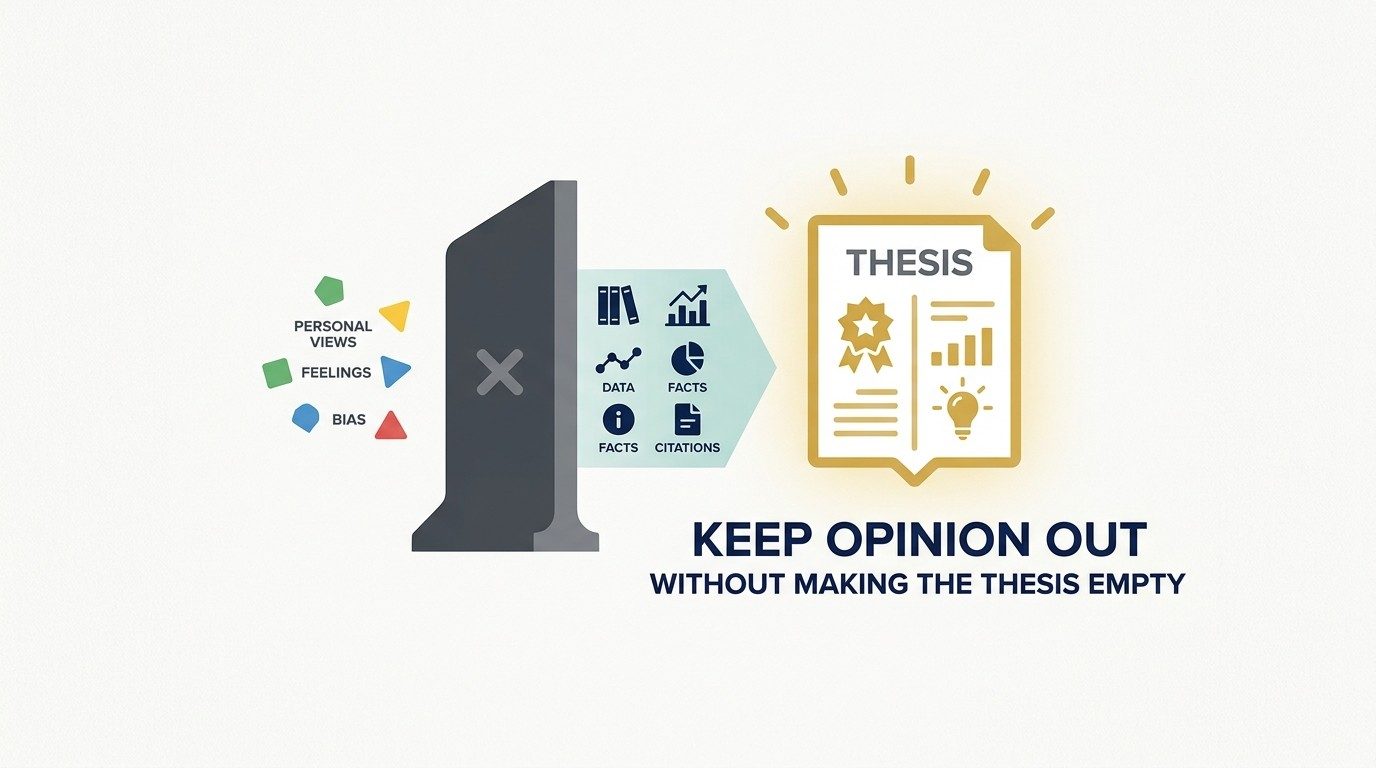
Students sometimes remove all argumentative language and end up with a sentence that says almost nothing.
For example:
There are several things to know about campus recycling.
The sentence is neutral, but neutrality alone does not make it useful.
A better version is:
Campus recycling depends on four connected stages: collection, separation, processing, and preparation of usable material.
The thesis still takes no side. It simply commits the paper to a defined explanation.
Expository versus persuasive wording
Compare these two sentences:
Universities should replace printed campus maps with navigation apps because digital systems are easier to update.
That is persuasive.
Now compare:
Printed campus maps and navigation apps differ in update methods, route search, scale, and user interaction.
That is expository.
Students working between those two modes can review an argumentative essay to see how a position based thesis changes the purpose of the paper.
The distinction is not about avoiding strong language. It is about the job of the sentence. An expository thesis promises understanding rather than agreement.
Control scope before research controls the paper

Research often makes a thesis wider instead of clearer. A student discovers more information, adds another section, then another, until the original topic no longer has a visible center.
The thesis should act as a filter.
Too wide
Coffee production involves agriculture, processing, trade, preparation, culture, and consumption.
That could become a book.
Better for a short academic essay
Coffee beans move from harvested fruit to roasted product through separation, drying, preparation, and roasting.
The second version deliberately ignores trade, cafes, consumer habits, and cultural history.
That is not a weakness. It is scope control.
The expository essay structure page can help once the scope is stable and the writer needs to decide which information the reader should encounter first.
A simple scope filter
Before keeping a point, the writer can test it against three questions:
- Does this information explain something named in the thesis?
- Does the reader need it to understand a later point?
- Would removing it create a real gap?
If all three answers are no, the information may be interesting but unnecessary.
Build the thesis from the body backward
The usual advice is to write a thesis and then build the body. Expository writing can also work in reverse.
Suppose research notes naturally fall into four groups:
- collection
- sorting
- processing
- reuse
Instead of inventing a thesis first, the writer can inspect those groups and ask what larger subject they explain together.
The resulting thesis might be:
A campus recycling stream moves through collection, sorting, processing, and preparation for reuse.
This method is useful when research already exists but the paper still feels unfocused.
First identify the shared subject
What single system, process, concept, or relationship connects the notes?
Then name the organizing logic
Are the notes stages, causes, categories, characteristics, or comparison points?
Finally remove anything that does not fit
The thesis should reflect the strongest pattern in the material, not every fact the writer happened to find.
Students who need the full move from planning through drafting can use how to write an expository essay once this central logic is clear.
Check whether the body can actually deliver the thesis
A thesis is a promise. Each major element it names needs enough explanation later.
If the thesis says:
Public clocks differ according to power source, synchronization method, display type, and maintenance needs.
the body cannot discuss display type for three pages and give maintenance one sentence.
Map thesis words to body sections
A quick planning check might look like this:
- Power source → one explanatory section
- Synchronization → one explanatory section
- Display type → one explanatory section
- Maintenance → one explanatory section
The sections do not need equal length. They do need enough substance to justify appearing in the thesis.
If one item has almost nothing to explain, remove it from the thesis or combine it with another point.
Presentation comes later. The expository essay format page covers MLA and APA once the content itself has stopped moving.
Use a short three pass method before drafting
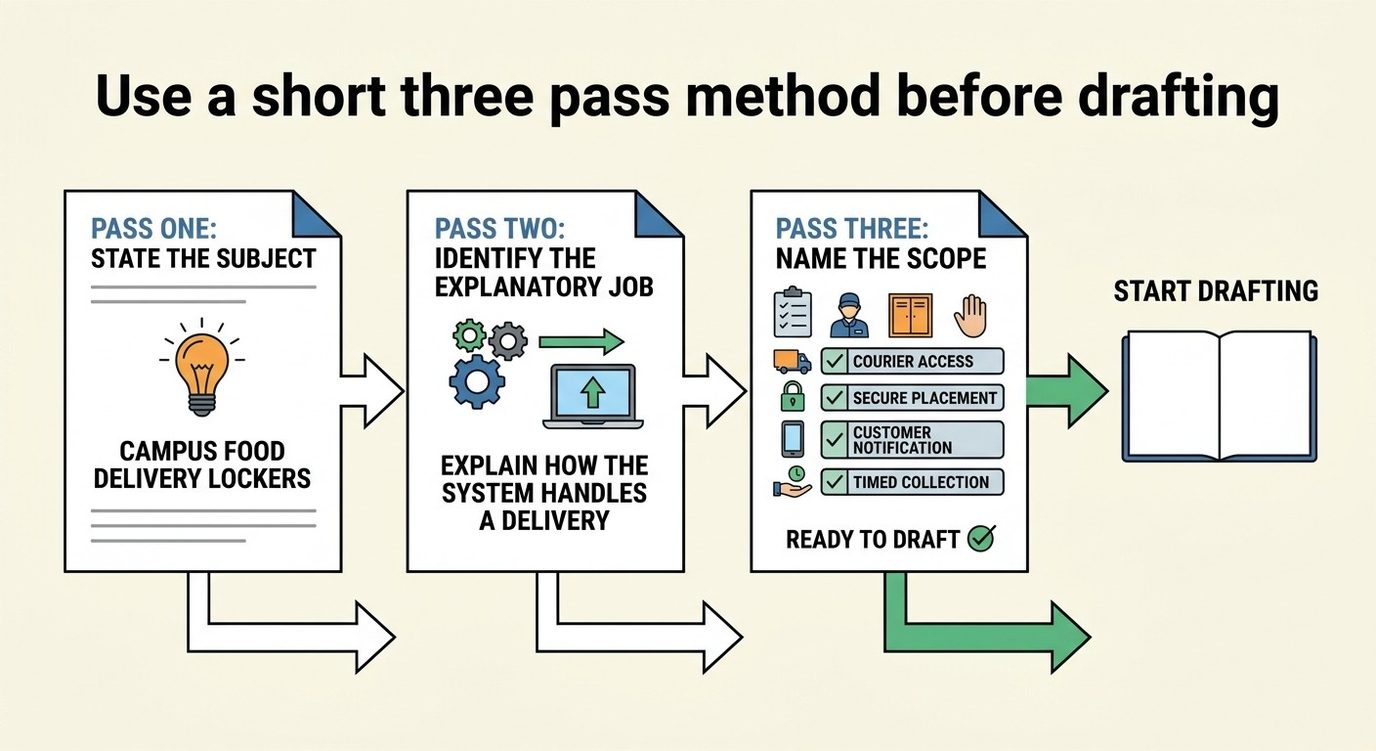
A useful thesis can often be built without spending an hour polishing one sentence.
Pass one: state the subject
Campus food delivery lockers
Pass two: identify the explanatory job
Explain how the system handles a delivery from arrival to collection.
Pass three: name the scope
Campus food delivery lockers manage orders through courier access, secure placement, customer notification, and timed collection.
That is enough to begin drafting.
The sentence can still change later. In fact, revision is expected if the research reveals a better organizing pattern.
Run the final thesis through a six point check
Before committing to the body, check that the thesis:
- Names a specific subject.
- Explains rather than persuades.
- Defines a manageable scope.
- Signals the organizing logic.
- Matches the material available for the body.
- Leaves unrelated background outside the paper.
If all six conditions hold, the writer has more than an opening sentence. The essay now has a boundary and a route.