The thesis statement is the intellectual center of gravity for any economics paper. It is not a mere introduction or a polite greeting to the reader. Instead, it functions as a condensed version of the entire logical machine you intend to build. Many writers struggle because they treat this sentence as a description of a topic rather than an assertion of a specific relationship.
A mediocre thesis says something happened. A sophisticated one explains why it happened and under what conditions. Economics is a discipline that rewards precision over vague generalities. If the reader finishes the first paragraph without knowing your stance on a specific causal relationship, the rest of the essay will likely feel like a collection of disjointed facts. Authenticity in this field comes from showing exactly how your independent variable forces a change in your dependent variable.
The Anatomy of a High-Scoring Thesis

To reach a high level of academic rigor, you need to treat your thesis like a laboratory experiment. You cannot simply observe that the sky is blue; you must explain how light refraction causes that specific hue under certain atmospheric assumptions. In an essay economics example, this means identifying the friction points where theory meets reality.
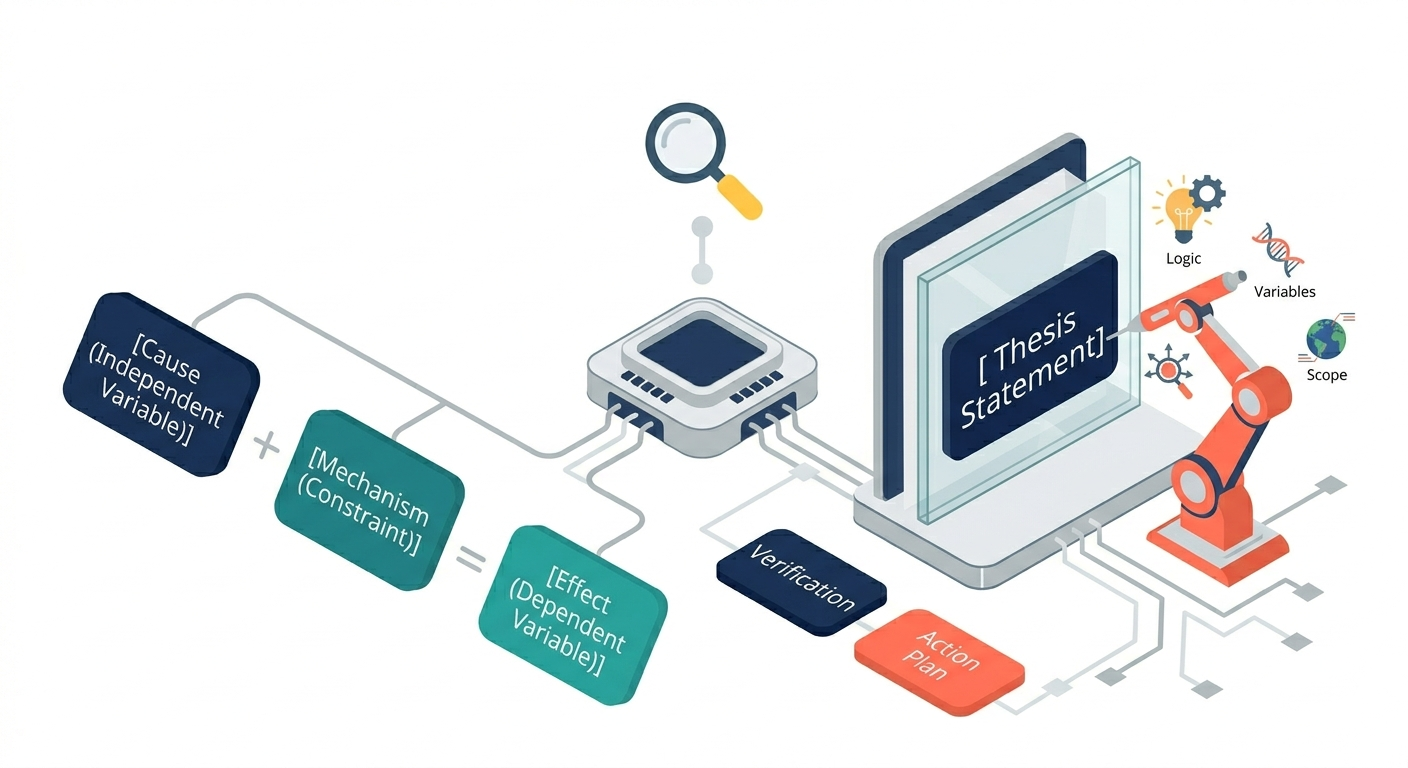
Effective economic writing relies on a clear logic-driven argument. You can think of the ideal thesis as a chemical equation. You have an independent variable (the cause) and a dependent variable (the effect), held together by a specific mechanism. Without these components, you are just providing a narrative, not an analysis. This is a common mistake when students pay for economics essay services that lack subject-matter expertise — they get fluff instead of mechanics.
Detailed Comparison Table
Moving from a generic idea to a sharp, analytical claim is a process of adding constraints. The following table demonstrates how to transform a “high school” thought into a university economics essay thesis.
| Economic Topic | The “Basic” Version (Avoid) | The “University” Version (Aim for) | Economic Lever Explained |
| Labor Markets | Minimum wage increases help poor workers earn more money. | Raising the federal minimum wage to $15 reduces turnover in the service sector, assuming the elasticity of labor demand remains low. | Uses economic intuition regarding search-and-match models. |
| International Trade | Tariffs on Chinese imports are bad for the American consumer. | US-China trade tariffs shift the trade-offs toward domestic production but trigger a 5% increase in consumer prices due to supply chain rigidity. | Identifies independent variable (tariffs) and specific dependent variable (prices). |
| Monetary Policy | The Federal Reserve should lower interest rates to stop a recession. | Expansionary monetary policy increases liquidity but risks a counter-intuitive finding where long-term inflation expectations stifle private investment. | Highlights a positive statement about risk and expectations. |
Positive vs Normative Stakes
A common pitfall is blurring the line between a positive statement and a normative statement. One deals with what is, while the other deals with what should be. If the assignment asks for an objective analysis, your thesis must remain firmly in the “positive” camp. It should be based on data and preliminary research rather than moral preferences.
Strong theses often embrace falsifiability. This means you are making a claim that could actually be proven wrong by the data. If your claim is so safe that it is unassailable, it probably lacks explanatory power. Professional economists look for claims that test the boundaries of assumptions and reveal how the world actually functions under pressure. This is a core part of how to write an economics essay university professors will actually want to read.
Step-by-Step Construction: The “Because” Strategy
If you are struggling with how to organize an economics essay, start with the “Because” method. Every strong thesis can be broken down into three logical segments that provide a roadmap for your body paragraphs.
- Segment A (The Action): “The implementation of universal basic income…”
- Segment B (The Outcome): “…increases local entrepreneurship rates…”
- Segment C (The Logic): “…because it lowers the significance level of personal financial risk for low-income households.”
When combined, these segments create a working hypothesis that you can actually test. If your research finds that entrepreneurship didn’t rise, you don’t scrap the paper—you adjust the thesis to explain why the causal relationship failed in that specific scope of analysis.
Advanced AI Prompts for Thesis Development
Using AI effectively means treating it as a specialized consultant. If you feed it generic prompts, you get generic trash. To get high-level results, you must use the entities we’ve discussed. Here are two “pro” prompts:
Prompt 1 (The Logic Tester): “I am arguing that [X] causes [Y]. Based on economic intuition, what are three hidden assumptions I am making? Also, suggest a counter-intuitive finding from peer-reviewed journals that contradicts this claim.”
Prompt 2 (The Variable Refiner): “Refine this thesis: ‘[Insert Thesis]’. Make it more concise, ensure it uses a positive statement approach, and define a narrower scope of analysis for a 2,000-word paper.”
Life-Hacks for Academic Rigor
- The 20-Word Rule: Try to fit your entire logic-driven argument into 20 words or less. If you can’t, your conciseness is lacking, and your argument is likely unfocused.
- The Data Check: Before finalizing the thesis, check if you have preliminary research that supports your independent variable. Don’t promise a quantitative analysis you can’t deliver.
- Focus on Elasticity: Almost every high-scoring thesis mentions or implies elasticity. How much does Y change when X moves? If you answer this, you win.
- Avoid the “Everyone” Trap: Don’t write about “everyone” or “the world.” Use a specific scope of analysis (e.g., “emerging markets in SE Asia” or “post-2008 retail banking”).
Finalizing the Logical Chain
Before you commit to your draft, ask yourself if your thesis is too ambitious. It is better to prove a small point perfectly than to fail at proving a massive one. Great economic writing isn’t about the size of the idea, but the strength of the logic-driven argument. You are looking for that sweet spot where your independent variable clearly dictates the movement of your dependent variable.
In the end, learning how to organize an economics essay starts with this single sentence. If the thesis is solid, the topic sentences of your body paragraphs will almost write themselves. They will simply be the sub-points required to prove your main claim. Take the time to get this right. A well-crafted thesis is the difference between an average paper and a piece of work that shows true explanatory power.