Narrative essay examples show how a writer turns one focused experience into a clear story with tension, detail, reflection, and a meaningful ending. The strongest samples do more than describe what happened. They control pacing, select details carefully, and connect the event to a larger idea without turning the essay into a lecture.
Start with a complete narrative sample built around one decision
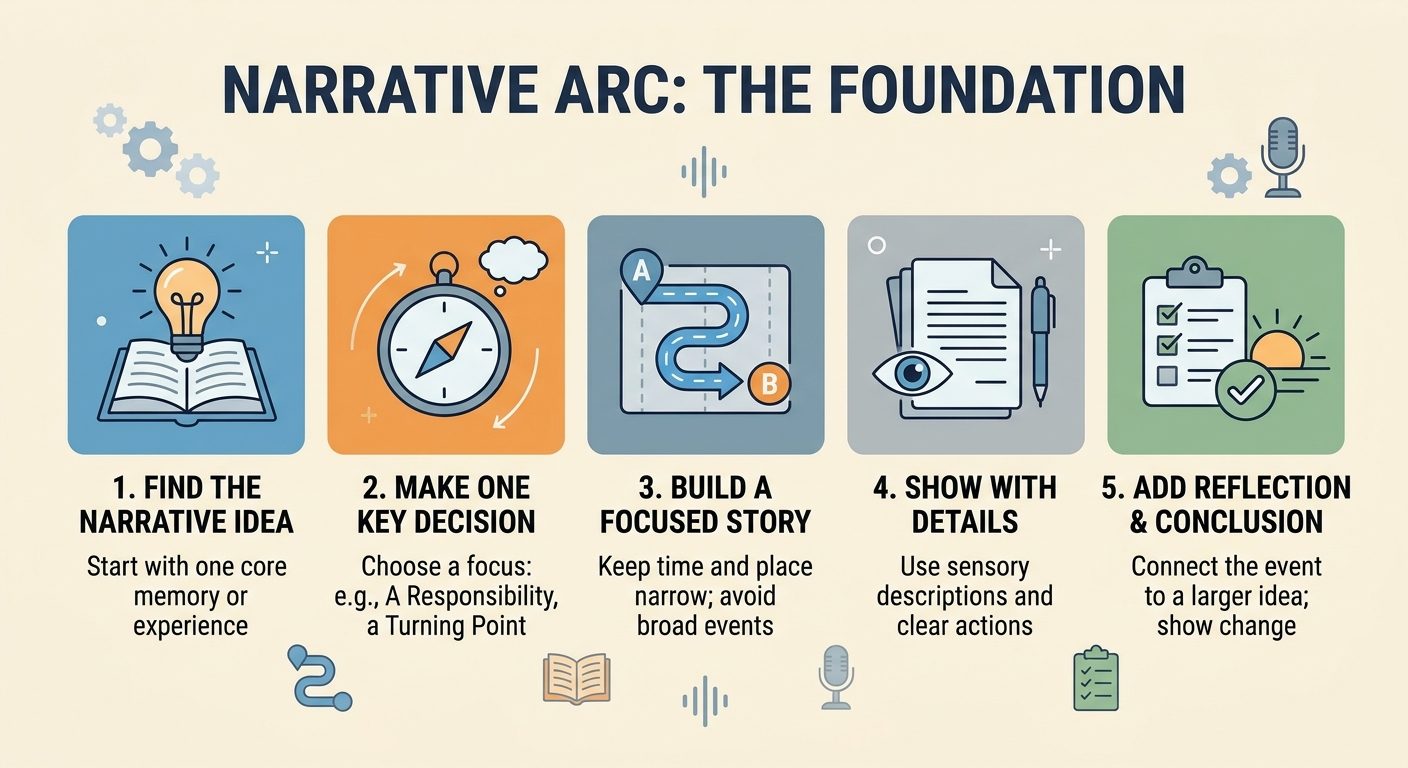
A useful sample should reveal the mechanics of a narrative, not just provide a polished paragraph to admire. The first sample below is a complete short essay at early college level. It uses a narrow time frame, one central decision, and a reflective ending rather than trying to cover an entire life event.
Students who need outside support while shaping or revising an assignment can use an essay service.
Sample 1: a complete short narrative essay
Level: first year college
Prompt: Write about a moment when a small responsibility became unexpectedly important.
The red light in Studio B
Mara had agreed to cover the final hour at a community radio station because the regular volunteer wanted to leave early. The job sounded simple. Watch the sound levels, play the scheduled songs, and read the station notice at ten minutes before midnight. Studio B was barely larger than a storage closet, and the biggest threat seemed to be boredom.
At 11:37, rain began striking the narrow window hard enough to blur the parking lot outside. The host in the next room finished his segment, waved, and hurried toward the door. Mara checked the playlist. Three songs remained. After that came the station notice, then the closing music.
The second song stopped after twelve seconds.
For a moment, the studio went completely quiet. The screen showed that the audio file had frozen. Mara clicked it again. Nothing. She opened the next track. The loading circle spun without moving. The red light above the microphone was still on, which meant the silence was going out to every person listening.
The training sheet beside the console suddenly looked much less decorative. Mara found the line for audio failure and followed it exactly. Switch to the backup input. Open the local music folder. Test the microphone before speaking. Her hand shook once when it touched the volume control, then steadied.
A piano track started from the backup folder. It was not on the schedule, but the room had sound again.
The larger problem came next. The station notice was stored in the same system that had frozen. Mara remembered seeing a printed copy pinned under the desk lamp. The page included the station number, the overnight schedule, and a short announcement about the weekend donation drive. She placed it beside the microphone and waited for the piano track to end.
The microphone light changed from red to green, then back to red when she opened the channel.
Her voice sounded smaller in the headphones than it did in her head. She read the notice slowly, added one sentence explaining that the music system had stalled, and introduced another backup track. No apology. No dramatic explanation. Just enough information to keep the hour moving.
At midnight, the closing music finally loaded. Mara shut down the microphone and noticed that the rain had already softened.
Before that night, she had treated the station checklist as a formality. Afterward, the sheet meant something different. Responsibility was not the exciting part of the job. It was the quiet preparation that mattered only when routine stopped working.
Why this sample earns marks
- The opening sets a narrow situation. The writer establishes place, role, and expectation quickly, so the essay can move into action without a long background section.
- The problem changes the meaning of an ordinary task. A frozen audio system creates pressure, but the real subject is responsibility rather than technology.
- Concrete details carry the scene. The red microphone light, the training sheet, the loading circle, and the printed notice make the event visible without overloading every sentence.
- Reflection grows from the event. The ending returns to the checklist and shows how its meaning changed, which gives the narrative a clear point.
Students who want to see the same type of story built from planning through revision can follow how to write a narrative essay.
A shorter sample can show how setting changes meaning
The next extract is deliberately smaller. It shows how a writer can make one place feel different before and after a single moment. That technique works well when an assignment asks for a memory, a turning point, or a scene in which perception changes.
Sample 2: a high school extract centered on place
Level: upper high school
Prompt: Describe a place that changed meaning after one event.
The back room of the repair shop
Before Saturday, the back room of the bicycle repair shop meant dust, old tires, and the sour smell of rubber glue. Lena had spent three months there sorting donated parts after school. She knew which shelf held brake cables and which drawer refused to close, but the room still felt borrowed.
That changed when an older customer brought in a blue bicycle with a bent front wheel. He did not want it repaired for himself. He wanted the shop to make it safe enough for his granddaughter, who had learned to ride on the same frame years earlier.
Lena found a matching wheel in the back room. Under the dust, the metal was clean. She carried it to the workbench, expecting the mechanic to take over, but he only pointed toward the tools and said the repair was hers.
The work took forty minutes. The new wheel spun straight on the first test, and the customer ran one hand over the faded blue paint as if checking that the bicycle still remembered him.
After he left, Lena returned to the back room. The shelves looked the same. The room did not. It was no longer where discarded parts waited. It was where useful second chances were stored.
Moves that strengthen the extract
- The first sentence defines the old meaning of the place. This creates a clear baseline for the change that follows.
- One object carries the emotional weight. The blue bicycle gives the scene a physical center and prevents the reflection from becoming abstract.
- The final image reinterprets the setting. The shelves stay unchanged, but the narrator’s understanding shifts, which creates a satisfying close.
- The reflection stays brief. The extract explains the lesson in one image rather than repeating it in several sentences.
Writers who want to make setting do more descriptive work can compare this approach with a descriptive essay, where sensory detail usually has a larger role than plot movement.
An advanced extract can let a mistake drive the story
Not every strong narrative needs a dramatic event. A small error can create enough tension if the writer makes the consequences specific and shows a change in judgment. The third sample uses that pattern and gives more space to internal reasoning.
Sample 3: a college extract built around a mistake
Level: second or third year college
Prompt: Write about a mistake that taught a concrete lesson.
The labels that looked close enough
The seed library used envelopes no larger than a playing card. On a busy Thursday, Dev sorted returned seeds into drawers marked beans, peas, herbs, and flowers. Two varieties of beans arrived in nearly identical brown envelopes. One label said Scarlet Runner. The other said Painted Lady. Dev glanced at the handwriting, assumed the packets belonged together, and filed both under the same card.
A week later, a volunteer preparing spring kits noticed that the counts did not match. Dev opened the drawer and saw the mistake immediately. Nothing had been lost, but every packet from that batch had to be checked by hand.
The correction took most of the afternoon. At first, the task felt absurdly slow. Then Dev noticed what the labels actually contained: planting depth, harvest notes, donor initials, and dates from previous seasons. The information was not decoration. It was the memory system of the library.
By closing time, the two bean varieties sat in separate rows. Dev added one habit to the sorting process: read the full label before placing the packet. The rule was almost embarrassingly simple. That was why it lasted.
Why the mistake feels meaningful rather than trivial
- The error is believable. The packets really do look similar, so the mistake does not feel invented only to create a lesson.
- The consequence is concrete. The writer shows the extra checking work instead of claiming that the mistake caused a vague disaster.
- The reflection comes through observation. The planting notes reveal why accuracy matters before the final lesson is stated.
- The ending turns insight into behavior. A specific new habit proves that the experience changed the writer’s process.
Compare the three samples before borrowing a technique

These narrative essay examples work for different reasons. The table makes the contrasts easier to see so students can choose a technique that fits their own prompt rather than copying the surface details of one model.
| Sample | Level | Prompt focus | Main technique | Approximate sample length | Move that lifts the grade |
| Studio B | First year college | A small responsibility becomes important | Rising pressure inside a narrow time frame | About 440 words | The final reflection changes the meaning of the checklist |
| Repair shop | Upper high school | A place changes meaning | Setting before and after one event | About 200 words | The same room is reinterpreted through one object |
| Seed library | Second or third year college | A mistake teaches a lesson | Concrete consequence followed by process change | About 200 words | The ending converts reflection into a specific new habit |
A sample becomes most useful when the writer can name the technique that makes it effective. The broader narrative essay page explains the genre as a whole, while this page stays focused on what students can learn from models.
Use sample essays as models without copying their content

A model should answer a craft question. It should not supply the writer’s experience, wording, or reflection. The safest approach is to separate the technique from the subject matter before drafting.
Separate the writing move from the story itself
For example, the Studio B sample uses a failed audio file to create pressure. The reusable move is not the radio station. The reusable move is placing a small responsibility under sudden pressure, then showing how the writer responds.
Safe to borrow
- A narrow time frame
- A before and after contrast
- One recurring object
- A delayed reflection near the end
- A specific action that shows change
Not safe to borrow
- The same scene or sequence of events
- Distinctive wording from the sample
- The same objects with only names changed
- The same lesson attached to a nearly identical event
- A copied paragraph structure sentence by sentence
A practical test is simple. After reading the model, students should be able to close it and draft from their own memory. If the new essay depends on keeping the sample open for wording, sequence, or details, the model is controlling too much of the draft.
Used correctly, narrative essay examples can also help students diagnose a draft. A student can compare where a model slows down, where it skips routine action, and where reflection appears, then check whether the new essay makes similar craft decisions for its own reasons. The goal is comparison, not imitation. A strong draft may use fewer scenes, more dialogue, or a quieter ending and still succeed if those choices fit the experience being told.
Let the example reveal structure without turning it into a template
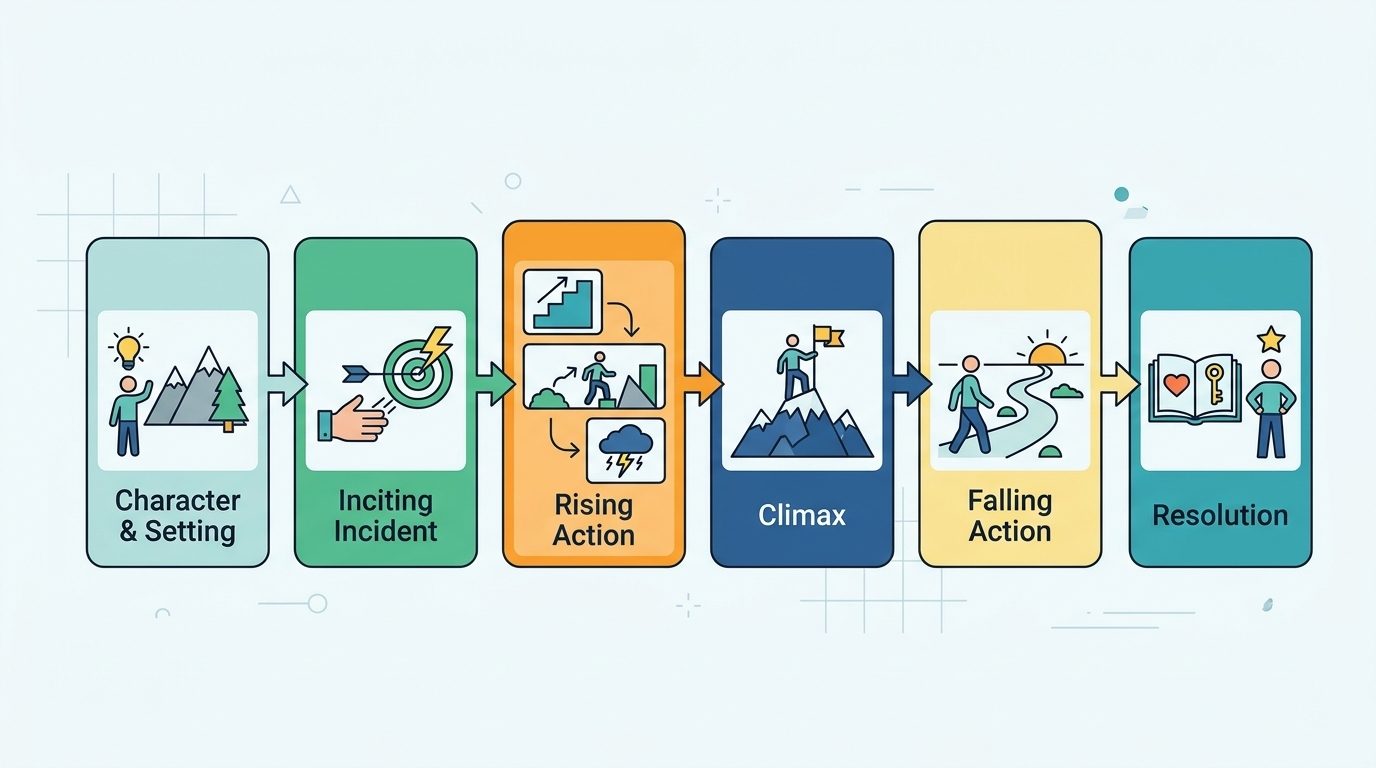
Strong narratives often feel natural because the structural work is hidden. A reader sees a scene, but underneath that scene the writer is controlling setup, pressure, response, and reflection.
Four structural moves visible in the complete sample
- Set the normal condition. Mara expects an uneventful final hour.
- Break the routine. The audio system freezes and silence becomes a problem.
- Force a response. The checklist and printed notice become useful under pressure.
- Reframe the experience. The ending changes what responsibility means.
This sequence is not the only option. Students who want to compare chronological order with other approaches can use the narrative essay structure page instead of forcing every story into the same pattern.
The crucial point is connection. Each part should make the next part necessary. If the opening detail never matters again, it may be decorative. If the reflection introduces a lesson that the event did not demonstrate, the ending will feel attached rather than earned.
Turn a strong sample into a planning tool for a new story
Reading becomes useful only when it leads to decisions. Students can convert a sample into a planning exercise by stripping away the original content and keeping only the function of each passage.
A five question planning pass
- What normal situation exists before anything changes?
- What single event creates pressure, uncertainty, or a new realization?
- Which two or three details make that event visible?
- What action shows the writer responding rather than only thinking?
- What changed in judgment, behavior, or meaning by the end?
For students who need a fill in planning model, the narrative essay outline page provides a separate template. Keeping planning and sample analysis separate helps the writer avoid copying the shape of one essay too literally.
One useful exercise is to reduce a sample to five short labels, such as routine, disruption, choice, consequence, reflection. Then the student creates a completely different story that can fit those functions. The resulting draft may have a different number of paragraphs and a different pace, which is a good sign that the model has been used as technique rather than as a mold.
Make the lesson visible without forcing a thesis sentence
Narrative writing still needs a controlling idea, but it does not always need to announce that idea in the opening paragraph. In the Studio B sample, the point becomes clear gradually: preparation matters most when routine fails. The essay never needs a formal sentence stating that argument at the start.
Explicit and implicit options
An explicit narrative thesis can work when the assignment expects a clear academic frame. An implicit thesis can work when the lesson emerges naturally from the scene and becomes unmistakable by the end. The writer should choose based on the assignment rather than assuming that every narrative needs the same opening formula.
Students who need help phrasing the controlling idea can use the narrative essay thesis page for formulas, weak and strong comparisons, and varied examples.
The best test is not whether the essay contains one special sentence. The better test is whether the selected details, conflict, and reflection all point toward the same meaning. If the event teaches one lesson but the final paragraph claims another, the draft needs revision.
Keep presentation choices from distracting from the story
A well told scene can still become difficult to read if dialogue, paragraphing, or citation expectations are handled carelessly. Narrative assignments may also have course specific requirements for title pages, spacing, headings, or source use.
Presentation checks that matter most
- Keep dialogue in separate paragraphs when the speaker changes.
- Keep tense consistent unless the time shift is intentional and clear.
- Use paragraph breaks to mark a shift in action, time, place, or reflection.
- Follow the assigned citation style if the narrative refers to outside material.
- Check the instructor’s requirements before adding decorative formatting.
The narrative essay format page compares MLA and APA presentation rules and shows how narrative specific choices fit inside each style.
Formatting should stay in the background. If a student spends more effort making the page look dramatic than making the sequence readable, the draft is probably solving the wrong problem.
Choose practice prompts that create a real narrative problem
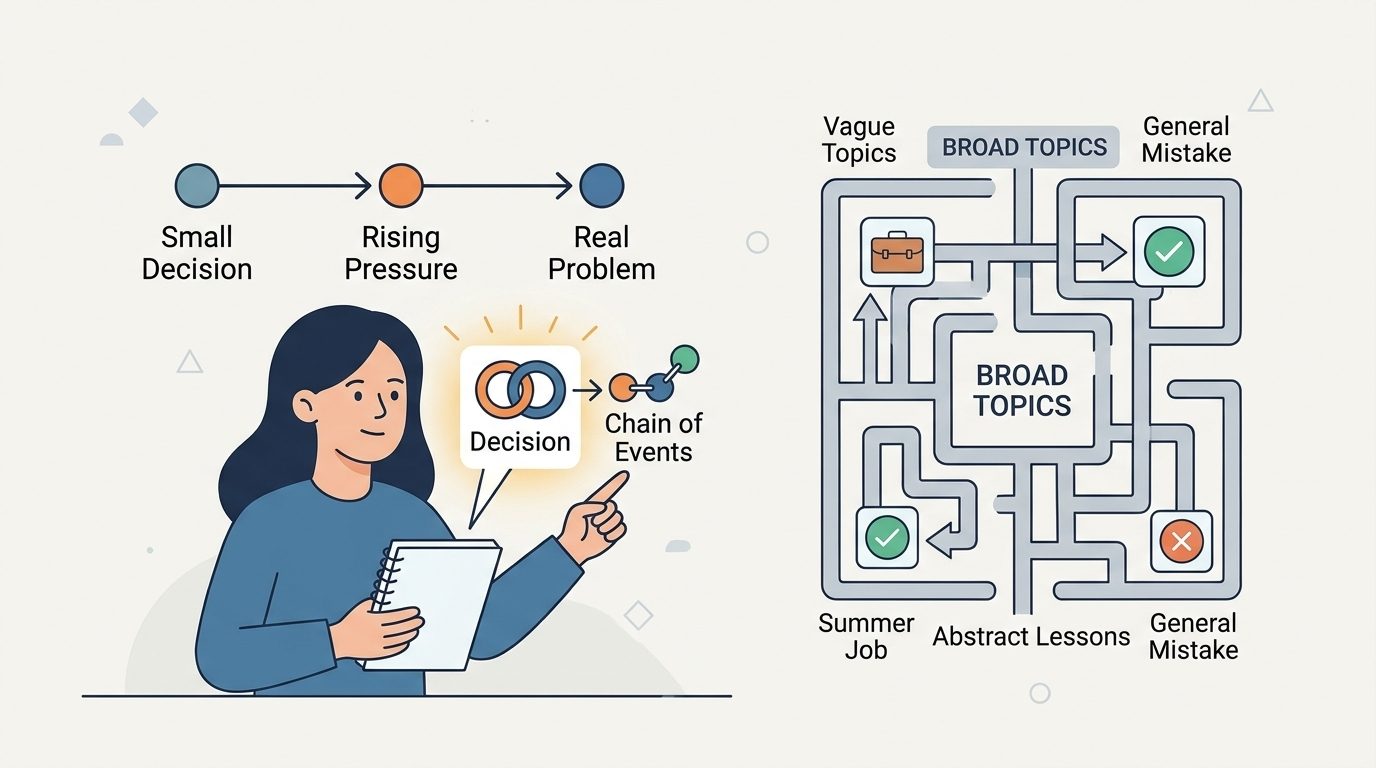
The best practice prompt gives the writer something that changed. A topic such as summer job is too broad by itself. A stronger prompt asks for a moment inside that job when a rule, person, mistake, or responsibility gained a new meaning.
Prompt shapes that tend to produce usable stories
- A routine that failed at the worst possible moment
- An object that changed meaning after one event
- A small mistake with a lasting effect on behavior
- A moment when a quiet task required an unexpected decision
- A place that looked different after a conversation
- A responsibility that seemed minor until someone depended on it
Students who need a larger pool of ideas can browse narrative essay topics and then narrow one choice to a single event rather than covering months or years.
A useful topic usually contains a before, a change, and an after. Without that movement, the essay may become a description or a list of memories. That can still be interesting, but it gives the writer less narrative tension to work with.
FAQ
What should a good narrative essay example include?
A good example should include a focused event, a clear sequence, concrete details, some form of tension or change, and reflection that grows from what happened. You should also be able to identify why each major detail is present. If the lesson could be swapped for any other lesson, the connection is probably too weak.
Can I use a narrative essay example as a template?
You can use an example as a craft model, but not as a content template. Keep the technique, such as a narrow time frame or a recurring object, and replace the event, details, wording, and reflection with material from your own experience. A finished draft should stand on its own without the sample beside it.
How long should a narrative essay sample be?
The useful length depends on the assignment. A short sample of 150 to 250 words can demonstrate one technique clearly, while a complete sample of 350 to 500 words can show setup, conflict, pacing, and reflection together. Your assigned word count should still control the length of the essay you submit.