Learning how to write a narrative essay quickly depends less on talent than on order of work: collect the memory, freewrite to find the turn, map the scenes, draft the turning point first, expand it in slow motion, add the opening and ending last, then revise. The steps below build one sample essay this way.
Seven Narrative Essay Steps at a Glance
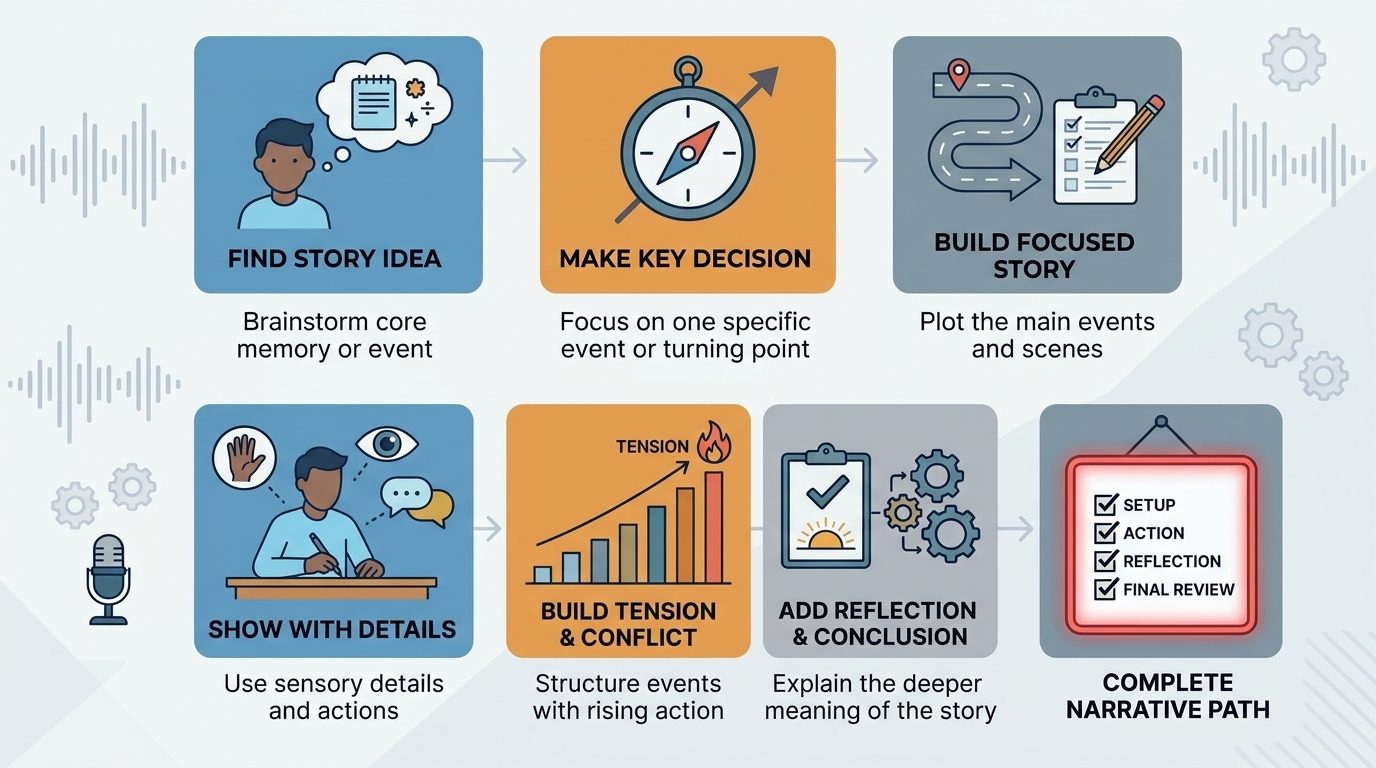
The table shows how to write a narrative essay in one evening or across a week. The twist is the drafting order. The opening and ending come last, because both are easier to write once the middle exists.
| Step | What it produces | One evening (about three hours) | One week |
| 1. Collect the raw memory | A page of sensory notes | 15 minutes | Day 1 |
| 2. Freewrite and mark the turn | The moment the story pivots on | 15 minutes | Day 1 |
| 3. Map the scenes | Four scene cards in order | 15 minutes | Day 2 |
| 4. Draft the turn first | The core of the essay | 50 minutes | Days 3 and 4 |
| 5. Expand the turn in slow motion | The most detailed scene | 25 minutes | Day 5 |
| 6. Add the opening and ending | A frame around the story | 25 minutes | Day 5 |
| 7. Revise in three passes | The final draft | 35 minutes | Days 6 and 7 |
The week plan lets the memory settle between sessions, and details that surface on day three often become the best lines in the essay.
The Sample Story Built on This Page
Every step is applied to one essay. The prompt asks for a true story about a moment that changed the writer’s understanding of another person. The student writing it volunteers on Saturdays at a neighborhood repair café, fixing toasters and lamps for free.
Students who want to read a finished model before starting can find one through a teacher, a school library or an essay service, but this method works best with a memory that belongs to the writer.
Step 1: Collect the Raw Memory Before Choosing Words
Goal: get usable detail out of memory while it is still loose.
Memory releases details in layers. The first pass gives the plot, and later passes give the sounds, smells and exact words that make a scene believable.
What to do:
- Set a ten minute timer and write five headings: sight, sound, touch, smell, words spoken.
- List everything under each heading, however small.
- Check photos, messages or calendar entries from that day.
- Note what the writer expected to happen before the moment began.
The running example:
- Sight: a green dish towel, a radio dial behind cracked plastic
- Sound: a faint hum just before the speaker died
- Touch: a sticky back panel held on with old tape
- Smell: solder and dust
- Words spoken: “It was my wife’s.”
Only one line of dialogue survived exactly, and it was Mr. Halloran’s. That is a strong hint about where the center of the essay sits. Writers still choosing a moment can take two or three candidates from a list of narrative essay topics and run this inventory on each, since the one that fills the page fastest is usually the one to write.
Step 2: Freewrite for Ten Minutes and Mark the Turn
Goal: find the exact moment the story pivots on.
The turn is where the writer’s expectation breaks. It is rarely the loudest event in the memory. More often it is a small line, a look or a silence.
- Write the whole memory in ten minutes without stopping or rereading.
- Underline the sentence where the writing suddenly gets more detailed or more emotional.
- Put a star next to it. That is the turn.
Finding the Turn in the Radio Freewrite
…and I tried the connections again and it still did nothing so I started saying sorry, like three times, and then he put his hand on the table and said it was his wife’s and I kind of stopped hearing the rest because suddenly it wasn’t about the radio at all…
The star goes on “it was his wife’s,” where the detail spikes and the freewrite even names the shift. Written as one deliberate sentence, that shift becomes the narrative essay thesis, stated early or left implied until the end.
Step 3: Map the Scenes on Four Cards
Goal: know what the reader sees, and in what order, before drafting. Index cards or four lines in a phone note both work, because each scene becomes a unit that can be moved around.
Four Scene Cards for the Radio Story
Card One: The Setup
Third Saturday at the café, two toasters and a lamp already fixed, confidence high.
Card Two: The Attempt
A radio in a dish towel, forty minutes of testing, a dial that flickers and dies.
Card Three: The Turn
The apologies start, his hand stops them, and he talks about his wife and the Sunday ball games.
Card Four: The Afterward
He leaves with the radio still broken, thanks the writer twice and looks lighter than when he arrived.
For a longer assignment, the narrative essay outline guide turns these four cards into a paragraph level plan with a blank template.
Step 4: Draft the Turn First, Then Fill In Around It
Goal: write the core while the energy from the freewrite is still there.
Most advice on how to write a narrative essay starts at the opening, which is where fast writers lose the most time. An opening has nothing to set up until the middle exists.
Drafting Order for a Four Scene Story
- Card three, the turn, written outward from the starred sentence.
- Card two, written so that it leads into the turn.
- Card four, written so that it grows out of the turn.
- Card one, written last, once it is clear what needs setting up.
Strike through instead of deleting, leave [detail here] notes rather than stopping, and keep going until every card has prose. Here is the fast draft of card three:
I was really nervous and I felt bad that I couldn’t fix the radio. I said sorry a lot. Mr. Halloran told me it was his wife’s radio and she used to listen to baseball on it. I realized he didn’t really care if it got fixed. It was a very meaningful moment for me.
It is flat, but the right event is in the right place, and that is all a first draft has to do. How finished scenes fit together, and when a nonlinear order is worth trying, is covered in the guide to narrative essay structure.
Step 5: Expand the Turn in Slow Motion
Goal: make the most important scene the most detailed one.
The slow motion rewrite is mechanical, which is why it works on a deadline. Break the scene into beats, the smallest separate actions, and give each beat its own sentence.
Beats in the Radio Scene
- The back panel comes off again.
- The dial lights and dies.
- The apology starts.
- His hand goes flat on the table.
- He speaks about his wife.
- He changes the subject to baseball.
The rewrite became the third paragraph of the final essay below. It runs to eight sentences, uses the amber dial and the flat hand straight from the inventory, and never explains what the moment meant. That sensory precision is borrowed from descriptive essay technique, applied to one scene instead of a whole paper.
Step 6: Write the Opening and the Ending Last
Goal: frame a finished story instead of guessing at one. The strongest frames work as a pair, with an object in the first paragraph returning, slightly changed, in the last.
Opening Moves for a Narrative Draft
- Start at the first moment of tension, not the start of the day.
- Put one concrete object in the first sentence.
- Plant the expectation that the turn will break.
Ending Moves That Close the Frame
- Bring back the opening object, seen differently.
- Show one habit that changed.
- Stop within three sentences of the last scene.
In the radio story, a radio in a dish towel opens the essay and a broken thing set on the table closes it. The reflection stays to a sentence or two, because once the meaning becomes the main subject, the piece has turned into a reflective essay.
Step 7: Revise in Three Passes
Goal: fix story, sentences and surface in that order, so nothing gets polished and then cut.
The Three Revision Passes
- Story pass. Cut anything that does not lead to the turn or follow from it.
- Sentence pass. Replace emotion words with actions and trim dialogue tags back to “said.”
- Surface pass. Check tense, dialogue punctuation and a new paragraph for each speaker.
In the sample, the story pass cut a paragraph about toasters, and “I was really nervous” became “My fingers smelled of solder and I kept wiping them on my jeans.” The surface pass is also the time to check the title, page setup and dialogue rules against the narrative essay format guide.
The Radio Story After All Seven Steps
The Radio That Would Not Play
The radio arrived in a grocery bag, wrapped in a dish towel like something that might catch cold. It was my third Saturday at the Elm Street Repair Café, and my record stood at two toasters and one lamp, all working again. Mr. Halloran set the bag on my table and kept his hand on it, as if he had not quite decided to let go.
I promised him twenty minutes. The radio was older than my parents, with a cracked plastic window over the dial and a back panel held on by tape. Forty minutes later my fingers smelled of solder and I had run out of things to check.
Mr. Halloran watched me take the back panel off for the third time. The dial glowed amber for a second, then went dark. I started apologizing before I had even put the screwdriver down. He laid his hand flat on the table, the way my grandmother does when she wants quiet. “It was my wife’s,” he said. “She had the ball game on every Sunday, loud enough for the whole street.” He did not ask whether I could fix it. He asked whether I followed baseball.
I did not, so he told me, about the summer the team almost won and his wife shouting at the umpires through the kitchen window. When the café closed, he wrapped the radio back in the towel, still broken, and thanked me twice.
I still cannot fix that model of radio. When someone sets a broken thing on my table now, I ask who it belonged to before I reach for a screwdriver.
Complete essays on other prompts and at other levels are collected in narrative essay examples, useful for measuring a draft against more than one model.
Four Process Mistakes That Slow Narrative Writers
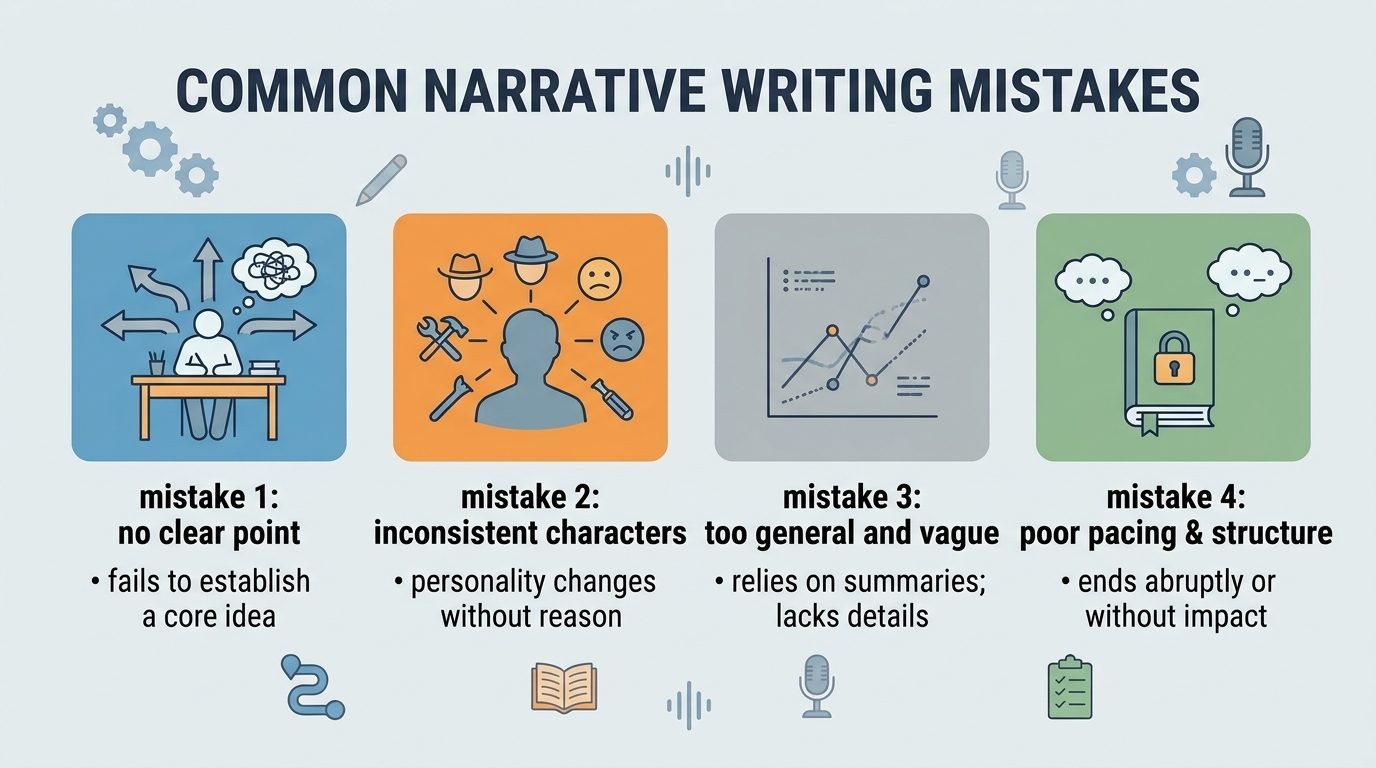
Polishing the First Paragraph for an Hour
Why it happens: a blank page seems to demand a perfect first line.
The fix: leave the opening for Step 6 and start with the turn.
Drafting From Memory Alone
Why it happens: the story feels vivid in the writer’s head.
The fix: spend ten minutes on the inventory, since those notes are what make scenes believable.
Editing While Drafting
Why it happens: mistakes are easier to spot than to ignore.
The fix: strike through and keep moving, because every stop costs momentum.
Revising Only for Grammar
Why it happens: surface errors are the easiest problems to see.
The fix: run the story pass first, since proofreading a scene that later gets cut is wasted time.
Final Pass Checklist for a Narrative Draft
This checklist covers the method on this page. For the genre itself, from purpose to typical traps, the main narrative essay guide is the place to start.
- Each scene contains at least one detail from the inventory.
- The starred sentence sits inside the turning point.
- The turn has more sentences than any other scene.
- The opening object returns in the ending.
- The story pass happened before any proofreading.
- The essay has been read aloud once from start to finish.
FAQ
How do I write a narrative essay fast?
Write the turning point first. Collect sensory notes for ten minutes, freewrite to find the moment the story pivots on, draft that scene, then build the rest around it. Leaving the opening and ending until last saves the time most students lose staring at a blank first paragraph, and a short essay can be finished in about three hours.
What part of a narrative essay should I write first?
Start with the scene where the story turns, not the introduction. That scene carries the meaning, so writing it first shows you what the other scenes need to set up and resolve. The opening is much easier once you know what it leads to, which is why many writers draft it last.
How can I remember details for a narrative essay?
Make a sensory inventory before drafting. List what you saw, heard, touched and smelled, plus anything people said, then check photos, messages or calendar entries from that day. Memory releases details in layers, so a second pass through the list usually surfaces the specific images that make a scene feel real.
How do I make a narrative essay longer without adding filler?
Expand the turning point instead of adding new scenes or background. Break that scene into its smallest beats and give each one its own sentence, using details from your notes. This adds length exactly where readers want it, while padding the setup or restating the lesson adds words and usually lowers the grade.
Can I reconstruct dialogue I do not remember exactly?
Yes, as long as the words match the spirit of what was said. Nobody remembers conversations word for word, and readers accept reconstructed dialogue in personal narratives. Keep the lines short and true to how the person actually speaks. Inventing statements someone never made, or events that never happened, turns the essay into fiction.