A narrative essay structure follows five connected parts: an opening that drops the reader into the story, rising action that builds tension, a climax where something changes, falling action that shows the consequences, and a resolution that reflects on what the experience meant. Each part hands the reader to the next.
The Five Part Narrative Map
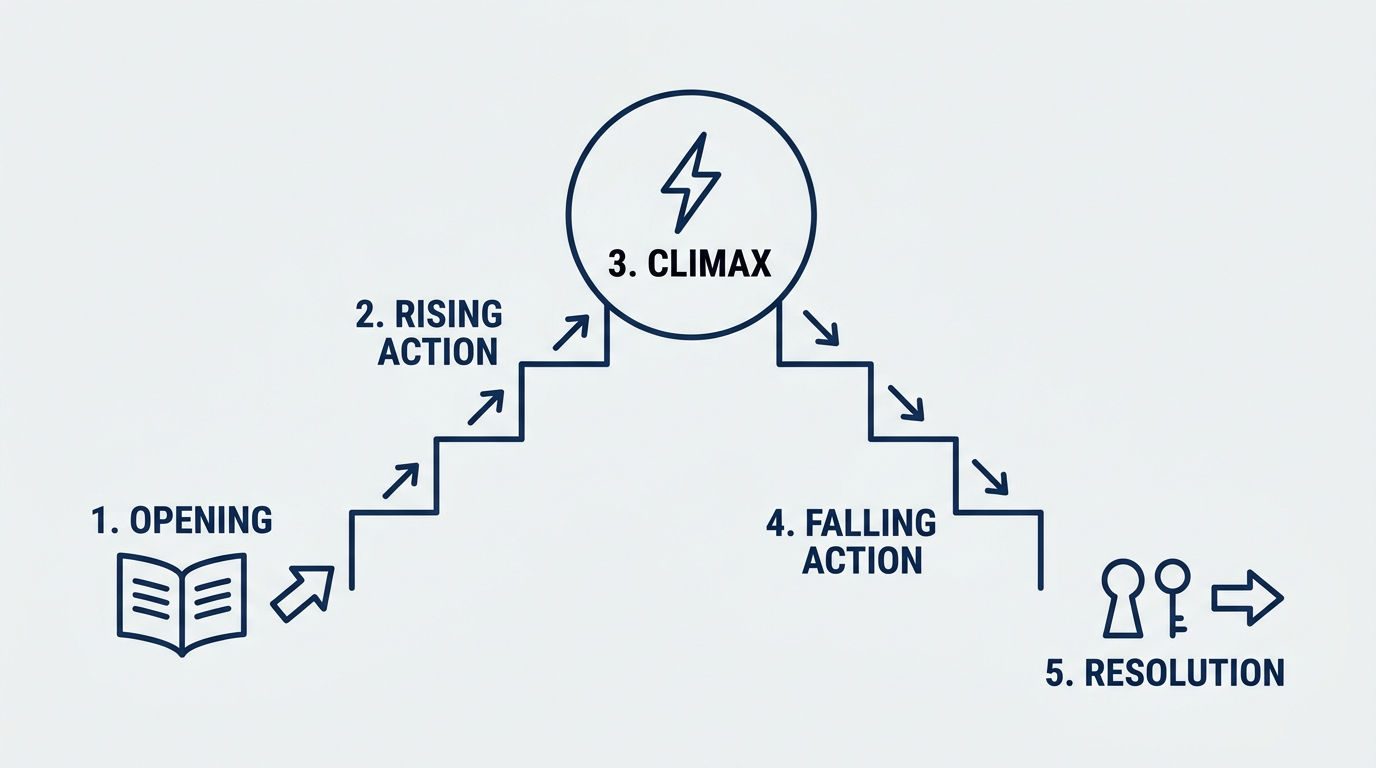
This narrative essay structure goes back to Gustav Freytag, a German novelist who described a five part pattern for drama in 1863, usually drawn as a pyramid. Narrative essays use a compressed version of it:
- Opening
- Hook: the first moment of the story
- Context: who, where and when, in a sentence or two
- Signal: a hint of what the story is really about
- Rising action
- Complication: the problem appears
- Escalation: the problem gets harder
- Climax
- The turning point: a decision, discovery or confrontation
- Falling action
- Consequence: what happens right after the turn
- Resolution
- Reflection: what the writer understands now
- Closing image: the last thing the reader sees
Space Each Part Deserves on the Page
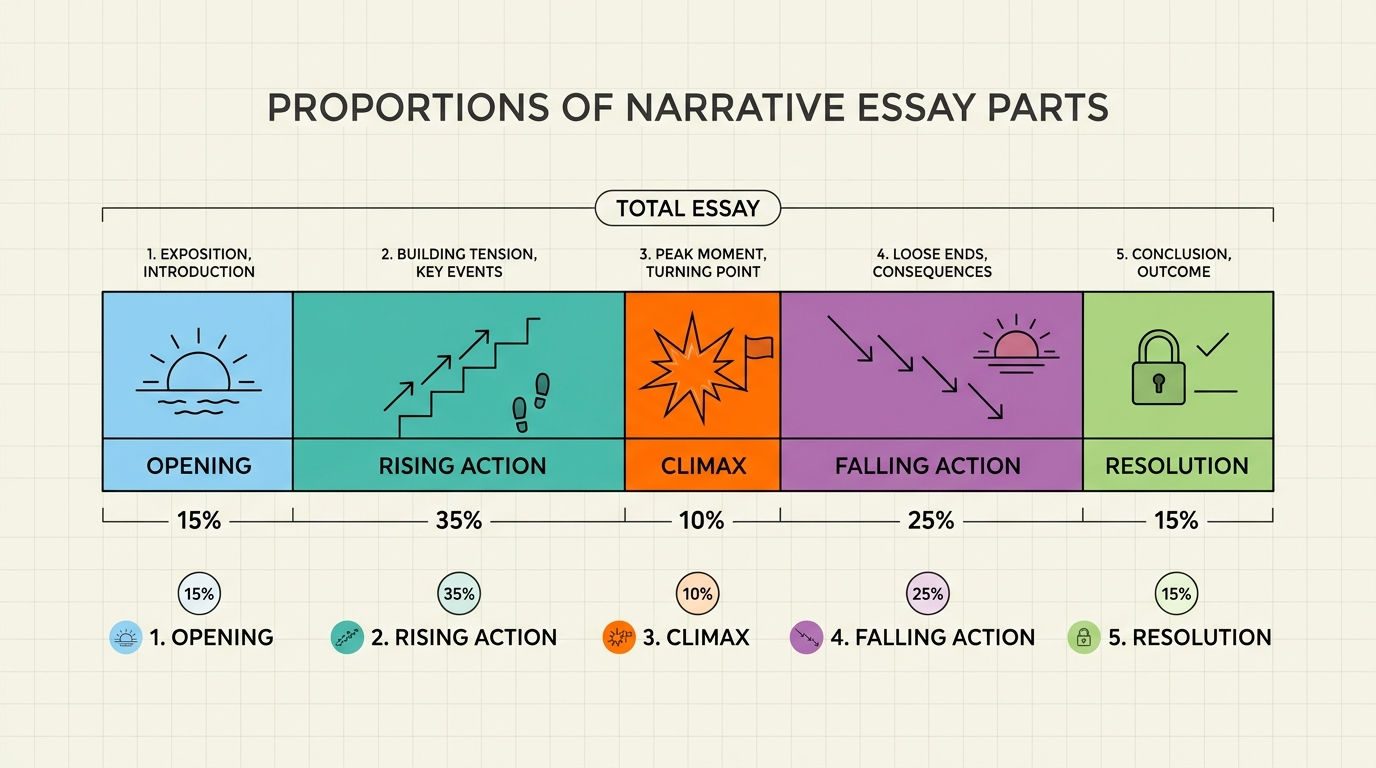
Students often know the parts but give them the wrong weight. The table below is a rough guide for a short essay, not a rule.
| Part | Its job | What it contains | Rough share of a short essay |
| Opening | Pull the reader into the story | Hook, brief context, a signal of the theme | About one paragraph |
| Rising action | Build tension step by step | A problem and at least one escalation | The largest share, often two paragraphs |
| Climax | Deliver the change | One decision, discovery or confrontation | One paragraph, the most detailed |
| Falling action | Show the immediate result | A consequence of the climax | A few sentences |
| Resolution | Give the story meaning | Brief reflection and a closing image | One short paragraph |
The pattern to notice is that rising action takes the most space while the climax gets the most detail per sentence. A model paper from a teacher, a writing center or an essay service is easier to learn from when read with this table beside it, marking where each part begins.
Inside Each Part of a Narrative Essay
Each part has a job to finish and a point where it hands the reader on. Knowing where a part ends matters more than knowing what goes in it, because most structural problems come from parts that run too long or stop too early.
The Opening Paragraph
What the Opening Establishes
A person, a place and something about to be tested, usually a belief or an expectation. The theme can be signaled here or held back until the end, and the guide to the narrative essay thesis shows both versions.
Where the Opening Ends
The opening is finished the moment the first complication appears. Background that is still running after that point belongs in the rising action or nowhere.
The Rising Action
What Rising Action Builds
Stakes: what the writer stands to lose, fail at or misunderstand. Every paragraph here should leave the situation slightly worse or more uncertain than before.
Where Rising Action Ends
It ends when no further escalation is possible without a decision or a discovery. That point is the doorway to the climax.
The Climax Scene
The climax has one job: to change something that cannot be changed back. A useful test is whether the writer could return to the opening situation unchanged after it, and if so, it is not the climax yet. How to expand this scene on the page is covered in how to write a narrative essay.
The Falling Action
The falling action ends as soon as the reader knows the immediate result. One or two sentences often do it, and anything longer starts to compete with the resolution.
The Resolution Paragraph
What the Resolution Measures
The distance between the writer at the start and the writer now. When that distance becomes the main subject of the paper, the piece has turned into a reflective essay rather than a narrative.
Where the Resolution Ends
On the last concrete detail, not on an explanation. The final sentence belongs to the story, not to a summary of it.
Three Other Shapes a Narrative Can Take
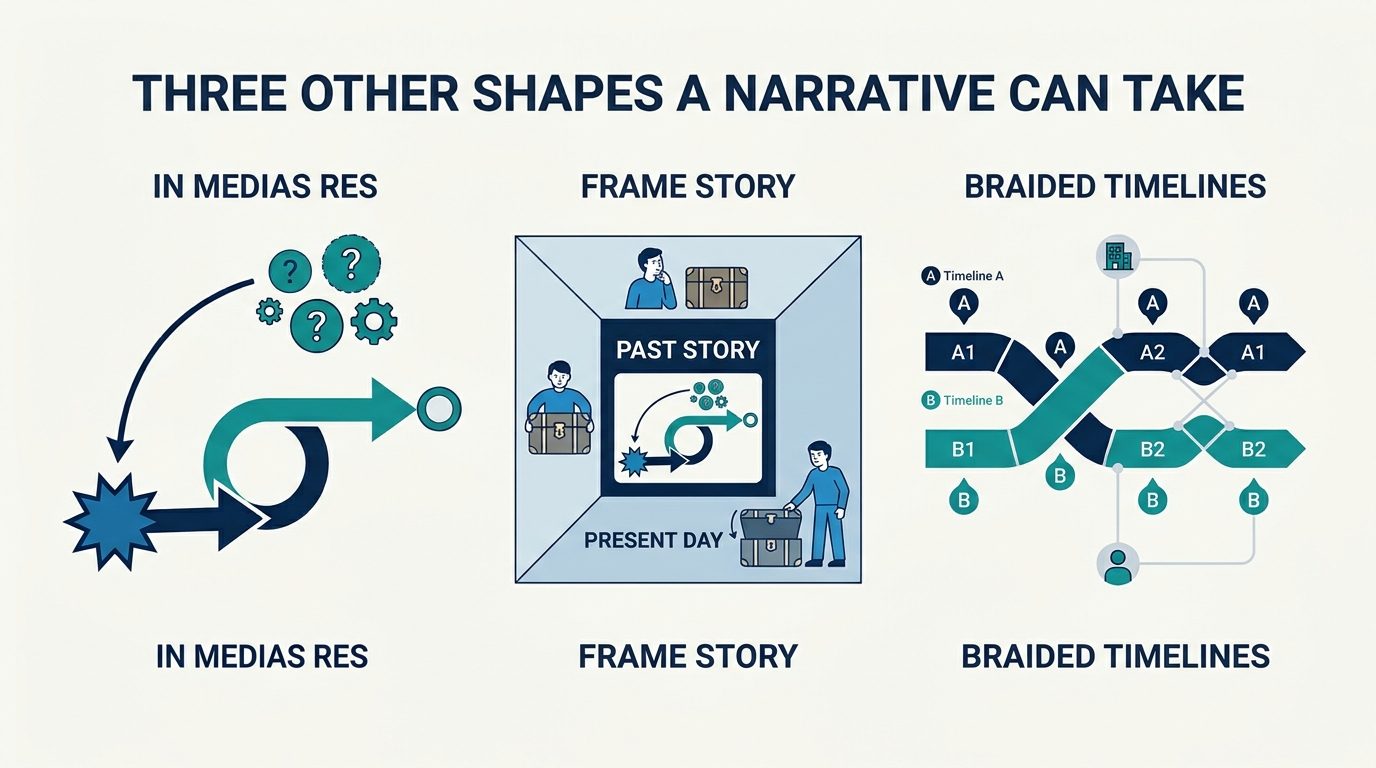
The five part map follows events in chronological order, and that remains the safest choice for most assignments. Some stories work better in a different shape, and once one is chosen, the narrative essay outline template turns it into a paragraph plan.
In Medias Res
The essay opens at the most tense moment, then steps back to explain how things got there.
Works best when: the climax is dramatic enough to hook a reader on its own.
Risk: the backstory can stall momentum if it runs longer than a paragraph.
Frame Story
A present day scene opens and closes the essay, with the past story told in between. For example, the writer might open while cleaning out a garage and find the object that starts the memory.
Works best when: the meaning only became clear years later.
Risk: the frame can overshadow the story if it gets more than a few sentences at each end.
Braided Timelines
Two related stories alternate section by section, such as a grandparent’s migration and the writer’s first job abroad.
Works best when: the two stories reflect each other in a way neither shows alone.
Risk: without clear breaks, readers lose track of which timeline they are in.
A Short Narrative With Its Parts Labeled
The sample below comes from an ordinary volunteer morning, the kind of small moment many narrative essay topics are built around.
By nine in the morning I had filled two buckets with weeds from bed eleven, and I was proud of both. [opening] Then Mrs. Ferreira arrived with her watering can and stopped at the edge of the bed. She looked at the buckets, then at the bare soil, then at me. The neat green rows I had cleared were not weeds. They were her tomato seedlings, three weeks of work. [rising action] I started to apologize, but she was already kneeling. She took one seedling from the bucket and one real weed from the path and held them side by side. “Smell,” she said. The tomato leaf smelled sharp and green; the weed smelled of nothing. “I pulled out half my own beans my first year,” she said. [climax] We replanted every seedling that still had roots, and most of them took. [falling action] I still crush a leaf between my fingers before I pull anything. What stays with me, though, is how quickly she knelt beside me instead of standing over me. [resolution]
What the labels show:
- The opening starts mid activity and plants a belief, pride in a job well done, that the story will break.
- The rising action escalates through three looks before the mistake is named.
- The climax is a small action and one line of dialogue, not a speech.
- The falling action takes one sentence, and the resolution reflects through a habit and a memory.
Full length pieces that follow this shape, and some that break it on purpose, are collected in narrative essay examples.
Structural Mistakes That Flatten a Narrative
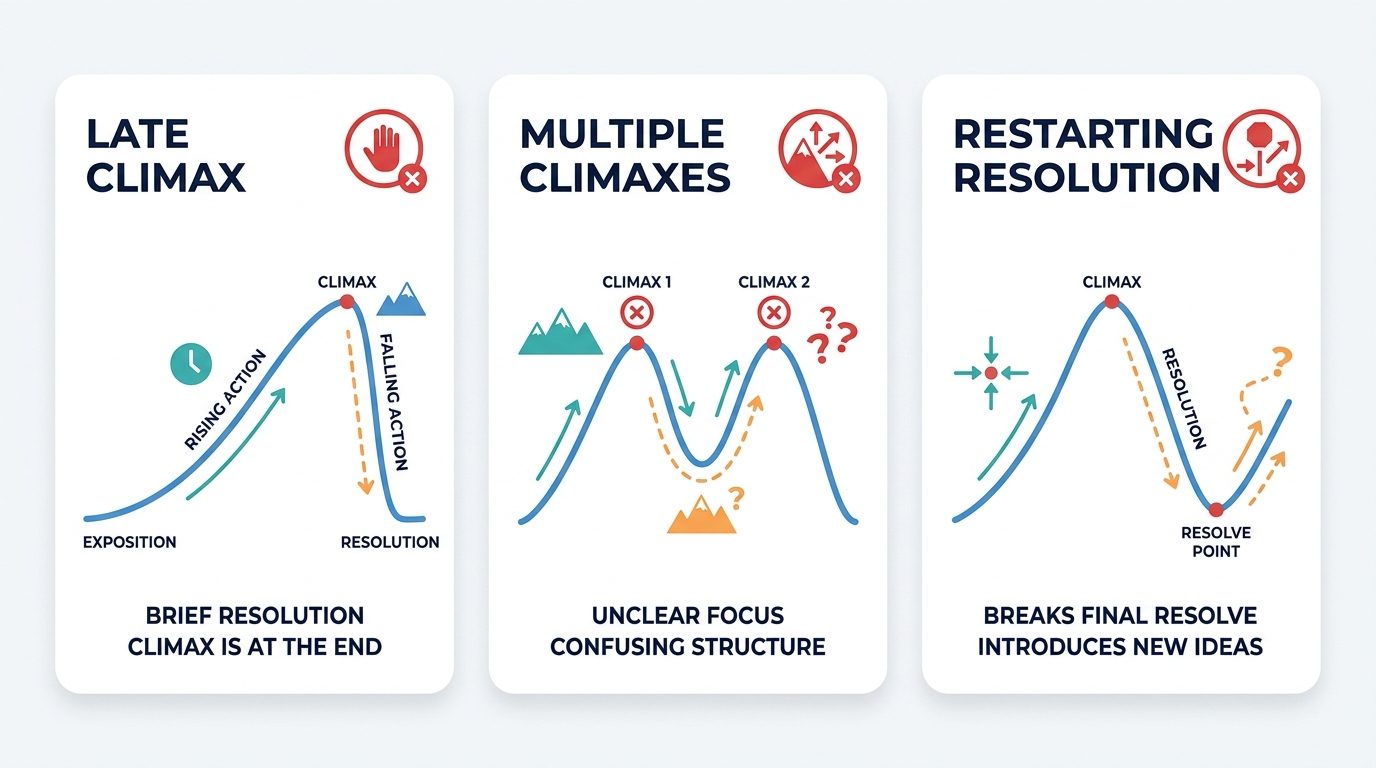
Saving the Climax for the Last Line
Why it happens: writers hold back the big moment to make it hit harder.
The fix: leave room after the climax for falling action and resolution, even if each is only a few sentences.
Two Climaxes Competing for One Essay
Why it happens: the memory holds two dramatic moments, and cutting either feels like a loss.
The fix: keep the one that changes the writer’s understanding and demote the other to rising action.
A Resolution That Starts Over
Why it happens: writers add everything that happened in the months afterward.
The fix: keep the resolution tied to the climax and give later events one sentence at most.
Problems that begin before structure, such as choosing a story that is too big to shape, are covered in the main narrative essay guide.
FAQ
What is the difference between narrative essay structure and an outline?
Structure is the shape every narrative follows, while an outline is your plan for one specific essay. Structure tells you which parts exist and what each must accomplish. An outline fills those parts with your own scenes, details and order. Most writers pick a structure first, such as chronological or frame story, and then outline within it.
Can a narrative essay start in the middle of the story?
Yes, and starting at a tense moment is a well established technique called in medias res. You open at or near the climax, then fill in how events got there. Keep the backstory short and move back to the present of the story quickly so the reader does not lose momentum.
Can a narrative essay end without a clear resolution?
Yes, as long as something has changed by the end. A resolution does not require a happy ending or a solved problem. It can close on an open question or an unfinished relationship, provided the writer’s understanding has shifted. What readers reject is an ending where nothing moved, not one where things stay complicated.
Does a narrative essay need headings?
Usually no, because headings interrupt the flow of a story. Most narrative essays use paragraphs, and sometimes section breaks between timelines or scenes. If your instructor asks for a particular page setup, the narrative essay format guide covers headers, titles and spacing in MLA and APA.
What is the climax of a narrative essay?
The climax is the turning point, the moment when a decision, discovery or confrontation changes the situation or the writer’s understanding. It is often quieter than students expect, such as a single line of dialogue or a small action. It deserves the most detail on the page, even though the rising action takes more space.