Set up the page before touching the story
Formatting works best when the document is set correctly before drafting. That prevents the writer from fixing dozens of paragraph indents, page numbers, or spacing problems at the end.
A fast setup takes only a few decisions:
- Confirm whether the assignment requires MLA 9, APA 7, or an instructor specific format.
- Set one inch margins on every side.
- Use double spacing unless the instructor states otherwise.
- Choose a readable font allowed by the required style.
- Add the correct page number or header.
- Decide whether the assignment needs a title page.
- Keep paragraph indentation consistent from the first paragraph onward.
Students who want help preparing or revising a draft can use an Essay service.
The key is not to make a narrative look decorative. Academic formatting should stay quiet. The story, scene, reflection, and voice should carry the reader.
MLA 9 and APA 7 at a glance
The narrative essay format changes most visibly on the first page, in the header, and in citation style. The core page setup is similar in both systems.
| Formatting point | MLA 9 | APA 7 student paper |
| Font | Readable typeface in a standard size. Twelve point Times New Roman is acceptable, but MLA does not require that one font | Accessible and consistent font. Twelve point Times New Roman and eleven point Arial are accepted choices |
| Spacing | Double space the paper | Double space the paper |
| Margins | One inch on all sides | One inch on all sides |
| Header or running head | Writer surname plus page number at upper right | Page number at upper right. Student papers do not use a running head |
| Title page | Usually no separate title page unless the instructor requests one | Student title page is standard unless the instructor gives different directions |
| In text citation | Author name and page number where applicable | Author name and year, with a page number for a direct quotation |
| List of sources | Works Cited | References |
| Headings | No fixed heading system is required for a short essay, but headings should be consistent if used | APA provides heading levels. A short narrative may need few headings or none if the assignment does not call for them |
The full narrative essay guide covers the genre itself. Formatting should support those storytelling choices rather than replace them.
Build an MLA first page that looks academic, not designed
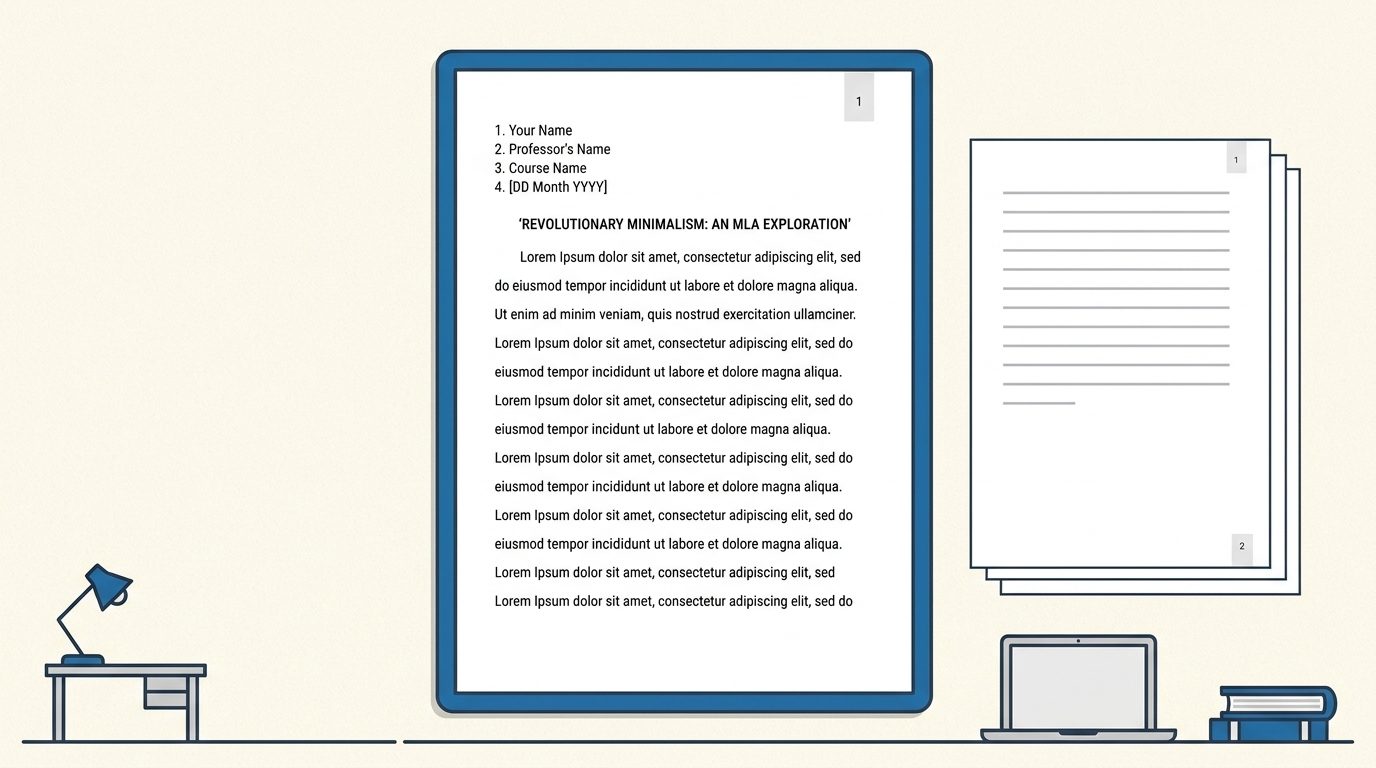
MLA usually starts the essay on page one without a separate cover page. The identifying information appears at the upper left, while the writer surname and page number appear at the upper right.
MLA first page mockup
Rivera 1
Jordan Rivera
Professor Lee
ENG 102
23 September 2026
The Last Train Home
The platform clock changed to 11:48 just as the station
speaker announced another delay. Jordan had twelve minutes to decide
whether to wait for the final train or call the person Jordan had spent
the entire evening avoiding.
The title is centered and uses the same general font and size as the rest of the paper. It does not need quotation marks, bold text, or decorative styling unless those features are part of a title that requires them.
A narrative opening should still read as prose, not as a report. Students can compare fully developed scenes on the narrative essay examples page rather than adding visual effects to make the first page feel more dramatic.
MLA details worth checking
- Indent the first line of each paragraph by one half inch.
- Keep the entire document double spaced.
- Place the surname and page number in the upper right.
- Use a separate Works Cited page only when the essay cites sources.
- Follow the instructor if the course requires a cover page or another variation.
Give an APA student paper a clean title page
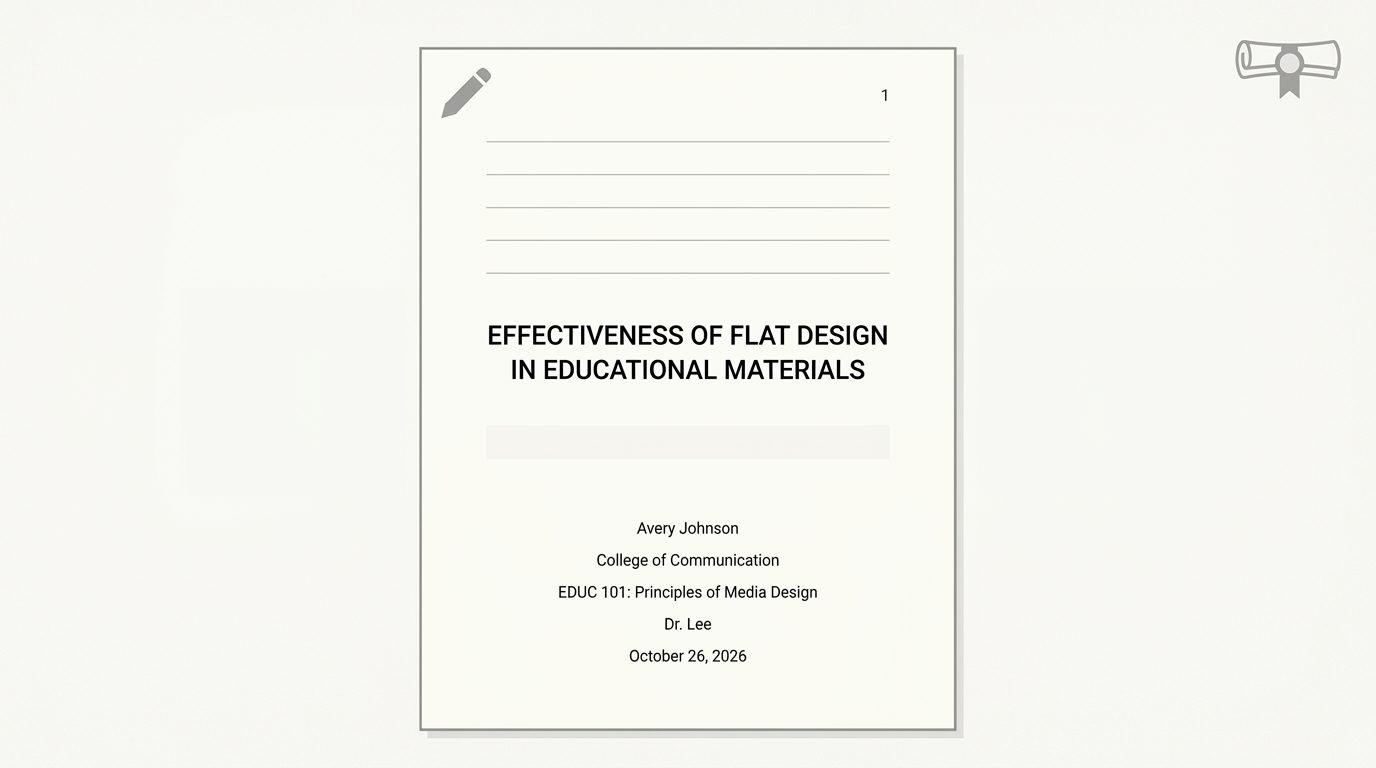
APA 7 handles the opening differently. A student paper normally begins with a title page, followed by the essay text on the next page. The page number appears at the upper right, including on the title page.
APA title page mockup
1
The Last Train Home
Jordan Rivera
Department of English, North College
ENG 102: Composition
Professor Lee
September 23, 2026
The paper title is centered and bold. The remaining student information is centered beneath it and double spaced. A student paper does not need the professional running head used in some publication manuscripts.
Once the essay begins, the writer should focus on scene control rather than visual formatting. The step process on how to write a narrative essay shows where drafting decisions belong so page setup does not get confused with storytelling.
APA details worth checking
- Keep the page number at the upper right.
- Use the same font consistently throughout the paper.
- Double space the title page and body.
- Start the References list on a new page if sources are cited.
- Follow instructor directions if they replace the standard student title page.
Format dialogue so the reader never has to decode it
Dialogue is one of the few formatting choices that can directly affect the pace of a narrative. A page can follow MLA or APA perfectly and still become hard to read if several speakers are packed into one paragraph.
Start a new paragraph when the speaker changes
Each change of speaker should normally begin a new paragraph. This lets the eye track the conversation without repeated labels.
For a clean exchange
“The office closed at six, right?” Maya said.
“It does,” the receptionist replied. “The side door is still open.”
For dialogue mixed with action
“Let me carry the box,” Daniel said.
Nora looked at the torn bottom seam. “Not that way.”
He stopped before lifting it.
Action can stay in the same paragraph when it belongs closely to the same speaker. A new action beat may deserve its own paragraph when attention shifts.
For larger questions about where scenes, reflection, and turning points belong, the narrative essay structure page is the better reference.
Keep punctuation subordinate to clarity
The writer should not use unusual spacing, oversized quotation marks, or a different font to signal conversation. Standard quotation marks and clean paragraph breaks are enough.
If a narrative contains a long conversation, the writer should also ask whether every line earns its place. Formatting cannot fix dialogue that repeats information the scene already shows.
Keep tense and first person voice consistent
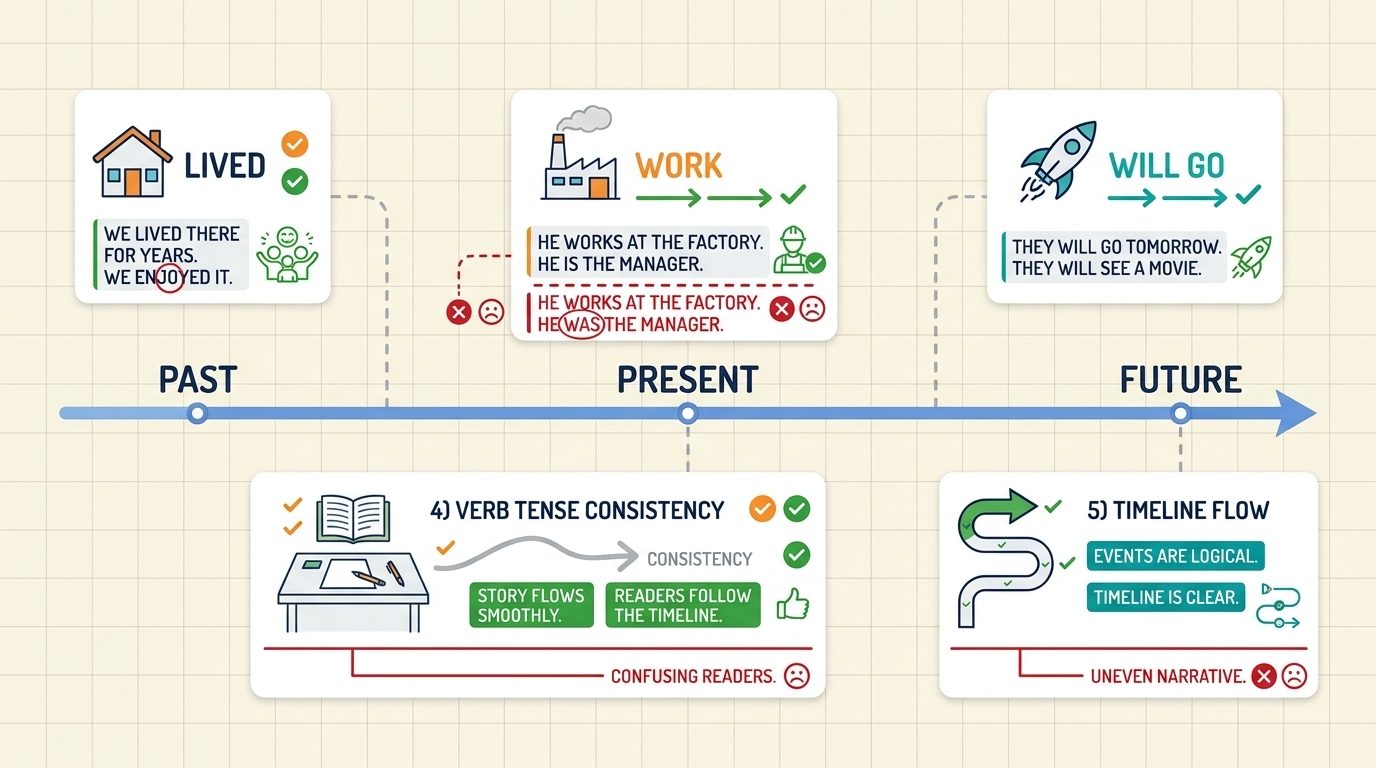
A narrative often uses first person because the writer is describing a personal experience. That is compatible with academic work when the assignment permits personal narration. The formatting style does not force a writer into third person simply because the paper uses MLA or APA.
Choose a main tense and control shifts
Past tense is common for a completed event:
Maya opened the envelope, read the first line, and understood why the room had gone quiet.
Present tense can also work if the assignment or narrative strategy supports it:
Maya opens the envelope. The first line is enough. The room suddenly feels smaller.
The problem is accidental switching. A writer who moves between past and present without a clear reason makes the timeline harder to follow.
A thesis in a narrative may be explicit or may emerge through the lesson of the story. The narrative essay thesis page covers that distinction in more depth.
Use paragraph breaks to control pace
Shorter paragraphs can slow attention around a decision, line of dialogue, or realization. Longer paragraphs can carry routine movement or reflection. The goal is not to make every paragraph the same size.
The page should still look academically consistent. Extra blank lines between ordinary paragraphs are usually unnecessary when the document is already double spaced.
Cite borrowed material without breaking the story
Many narrative essays rely mainly on personal experience and need no outside sources. If an assignment asks the writer to connect the story to a text, concept, quotation, or source, the citation should follow the required style without swallowing the scene.
MLA citation inside a narrative
A brief borrowed idea can be introduced naturally:
The memory became easier to explain after the writer encountered Author’s description of attention as a deliberate practice (42).
The corresponding Works Cited entry would use MLA rules. A placeholder model might begin with the author, title, publisher, and year rather than a made up real source.
APA citation inside a narrative
APA uses the author and year system:
The experience became easier to interpret through Author’s account of attention as a deliberate practice (Author, 2026).
A direct quotation would also include a page number when one is available. A placeholder reference can follow this pattern:
Author, A. A. (Year). Title. Publisher.
Students should plan where outside material belongs before inserting it into a personal scene. The narrative essay outline page can help separate story beats from supporting material.
Fix formatting errors that make a good narrative look unfinished
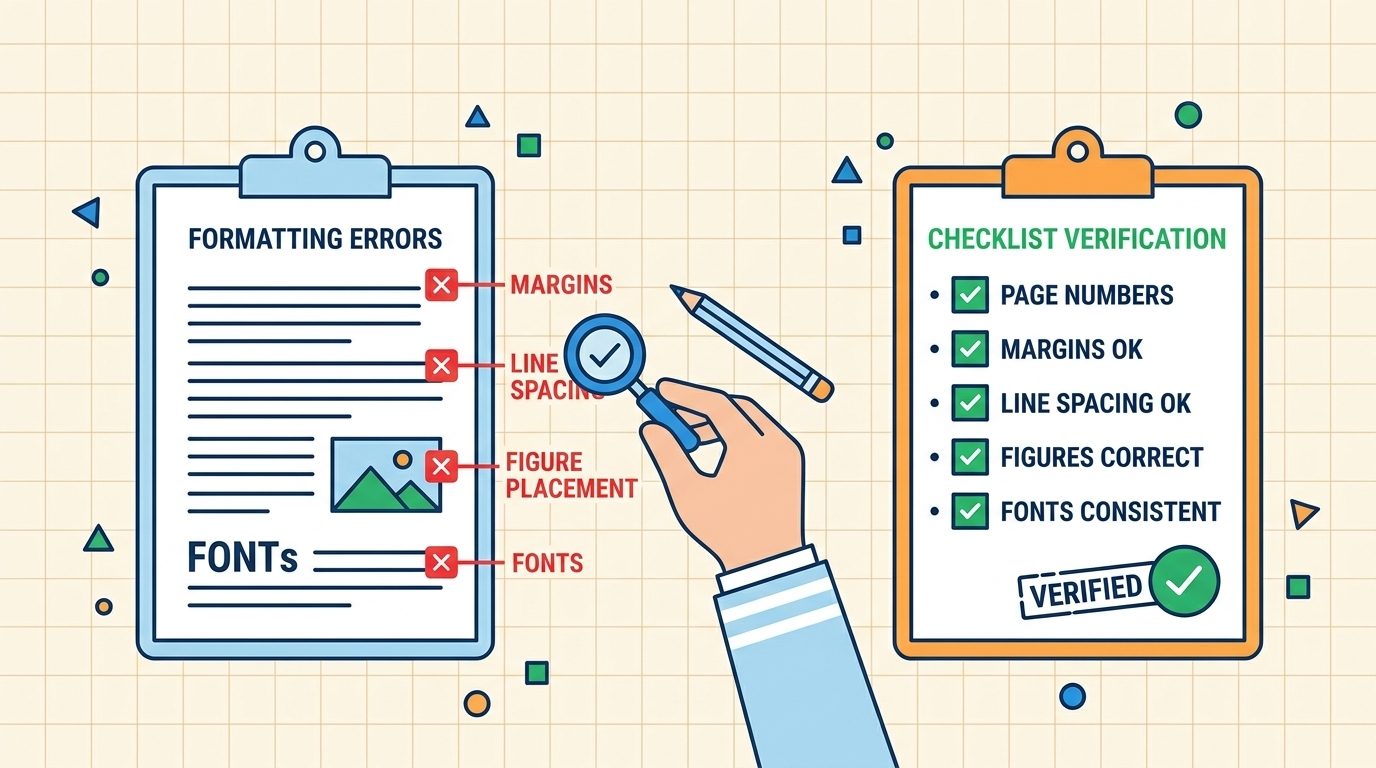
Small inconsistencies rarely destroy the story, but they can make the paper look rushed. Three problems appear often because writers focus on the narrative and check the document only at the end.
The title page follows the wrong style
Why it happens: MLA and APA are often remembered as similar systems, so a writer may combine an MLA heading with an APA title page.
The fix: Decide on one required style before drafting and use its first page setup from start to finish.
Dialogue stays inside one dense paragraph
Why it happens: The writer formats dialogue as ordinary prose and forgets that a change of speaker needs a visible break.
The fix: Start a new paragraph for a new speaker and keep action with the speaker only when the connection is clear.
Citations appear but the source list does not
Why it happens: A writer adds one quotation late in revision and forgets that the source also needs a matching Works Cited or References entry.
The fix: Check every citation against the final source list before submission, then remove any entry that is never cited in the paper.
A strong topic also makes formatting easier because the narrative stays focused on one event instead of becoming a loose sequence of memories. Students still choosing a subject can use the narrative essay topics page to narrow the assignment.
Run one final format check before submission
The last review should be mechanical. At this stage, the writer is not rewriting the whole story. The goal is to catch page setup errors that are easy to miss while drafting.
Narrative essay formatting checklist
- Confirm the required academic style.
- Check one inch margins and double spacing.
- Verify the font against the chosen style and instructor directions.
- Confirm page numbers and the correct MLA or APA first page setup.
- Scan dialogue for speaker changes and clean paragraph breaks.
- Check tense shifts and first person consistency.
- Match every in text citation to Works Cited or References.
A correct narrative essay format should disappear while the reader is inside the story. The paper looks orderly, the dialogue is easy to follow, citations do not interrupt the scene, and no page setup choice competes with the experience being narrated.
FAQ
Does a narrative essay need a title page in MLA?
Usually, no. In MLA style, you normally place the writer name, instructor name, course, and date at the upper left of the first page, then center the essay title below. You should use a separate title page only if your instructor or institution specifically requests one.
Does a narrative essay need a title page in APA 7?
Yes, a standard APA 7 student paper normally uses a title page. It includes the paper title, writer name, institutional affiliation, course information, instructor, due date, and page number. You should still follow any different format supplied directly by your instructor.
Can I use first person in an MLA or APA narrative essay?
Yes, you can use first person when the assignment calls for personal narrative or reflection. MLA and APA formatting rules do not automatically ban first person voice. You should keep the point of view consistent and make sure personal experience serves the purpose of the assignment rather than replacing required analysis.